This is a common, easily recognised bird that prefers an elevated perch
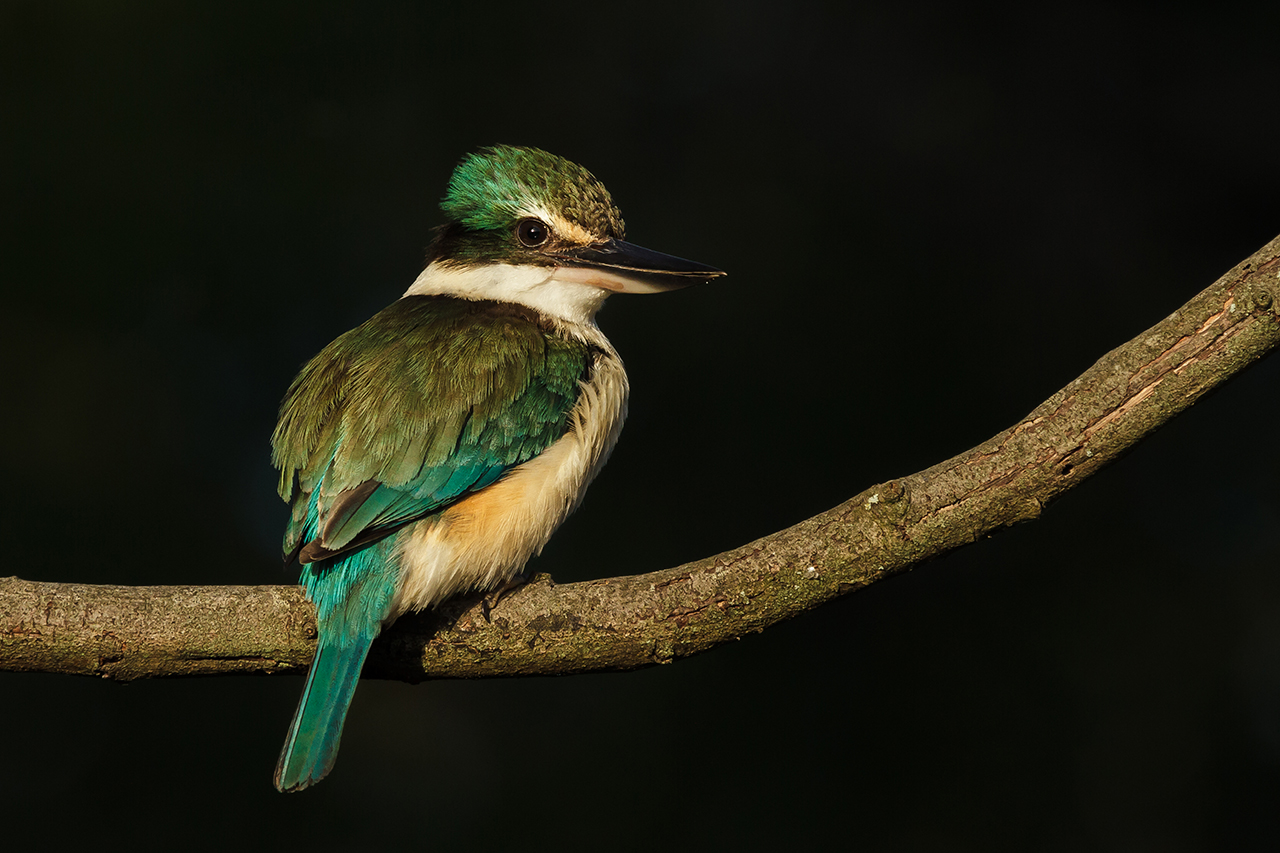
The kingfisher (kōtare) is one of New Zealand’s best known birds; almost everyone will recognise the hunched silhouette waiting patiently on a power line or other elevated perch over an estuary or mudflat, ready to pounce on unsuspecting prey.
They are present on all three main islands, but are encountered more frequently in the North Island. Existing in both coastal and inland freshwater habitats, the kōtare can be found in a wide range of forests, river margins, farmland, lakes, estuaries and rocky coastlines – anywhere there is water or open country with adjacent elevated perches.
Their stand out physical feature is their green-blue (almost iridescent) back. The female is greener, while the male has a tinge of blue. The undersides of both are a beige-yellow.
They possess a broad black eye-stripe which runs from the base of the beak to behind the ears and adults have a white collar underneath the eye stripe. Juveniles are generally duller in colour with conspicuous brown mottling on the chest.
Nest sites are always chambers dug into trees, cliffs, banks and cuttings. The excavating is initially done by repeatedly flying at the intended site and using the bill to chisel out dirt, bark or wood. Once a purchase point is created, the birds peck and scoop out the nesting tunnel and chamber. It is believed the same nesting sites are used year after year, with one studied burrow being in use for 20 consecutive years, although it is not known how many birds nested there.
The breeding season goes from September to February, with an average of five smooth, white and glossy eggs being laid. Incubation (20 days) and feeding duties are shared by both parents, and chicks fledge at 26 days.
The kōtare’s diet consists of a wide range of terrestrial and aquatic invertebrates and vertebrates. In estuarine environments, the diet is mainly small crabs. In freshwater habitats, tadpoles, crayfish and small fish are taken. They have been recorded diving up to one metre into the water to take prey. In open country, insects such as cicadas, beetles, stick insects and weta are caught along with spiders and small vertebrates, including lizards, mice and small birds.
A feeding habit of the kotare is to return to a perch with their prey, where they smash, batter and beat larger items before consumption.
– Matt Winter is a Marlborough-based nature photographer