1. Cook’s Cove Walkway, Eastland
Cook’s Cove is the closest walk to Young Nick’s Head, Cook’s first sighting of land. The Endeavour was anchored here on October 23, 1769, and the crew came ashore for water and wood.
Various botanical experiments were carried out including boiling manuka to make tea. A cabbage tree was chopped down and apparently ‘ate well boiled’.
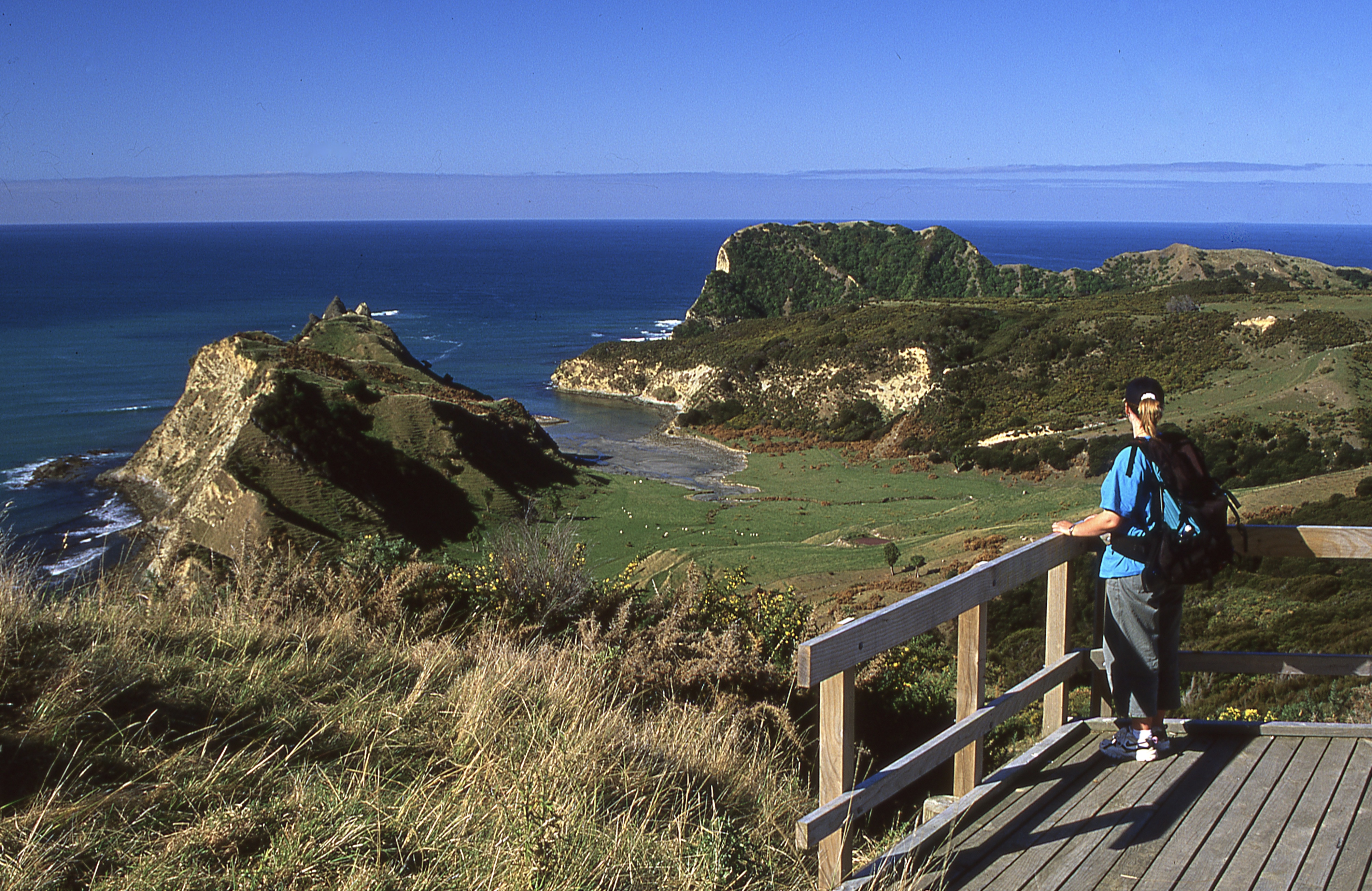
The track is well-formed and climbs through a forested tea-tree canopy before crossing a stile. Following the marker posts over open farmland to the wooden lookout, 125m above sea level rewards with magnificent views. The winding track then descends through the low canopy of kanuka forest before reaching the flats behind Cook’s Cove.
Near the coast, turn left to the hole in the wall, or head right to the monument. Continue to Cook’s Cove and its northern headland (from the end of which glimpses of Mitre Rocks appear).
Grade Easy Time 2.5hr return
2. Whitianga Rock to Cook’s Beach, Coromandel
Having spent a month sailing the east coast of the North Island, Cook was keen to determine the location of the new land and plot it accurately on the map of the known world.
Endeavour dropped anchor on Novem-ber 3, 1769, near the eastern end of Cook’s Beach. After some wary initial interactions with Ngati Hei, Cook’s landing party came ashore and began trading.
On November 9, Cook and Charles Green, the ship’s astronomer, came ashore to observe the transit of Mercury across the face of the sun. By accurately recording the sun’s altitude and the rough time the transit took place, they were able to calculate their latitude and longitude.
Mercury Bay thus received its European name and positioned New Zealand in relation to the rest of the then known world.
Before leaving the bay, Cook climbed a low hill on the far side of the Purangi River and placed the Union Jack. Despite Māori occupation of NZ, to Cook this action claimed New Zealand for His Majesty George III and Great Britain.
The ferry from Whitianga to Cook’s Beach is a delightful way to begin this walk.
Head south to investigate Whitianga Pa which guards the entrance to Whitianga Estuary then retrace your steps a bit to traverse a defensive ditch and climb over the hill towards Maramaratotara Bay, where the creamy white ignimbrite rock takes on a seemingly fluid form.
Ahead, the white face of Shakespeare Cliff becomes evident (on his visit, Cook noted an imagined figure etched on the cliff face and quipped it must be speaking poetry).
The trail then skirts the cliff-edge before crossing a paddock. A metalled track then loops around the various lookouts. A useful plaque names prominent landmarks and islands of Mercury Bay. Below, Lonely Bay basks in splendid isolation and Cook’s Beach stretches away in a golden arc.
Descend to the sealed road and turn left. A signposted track leads to the western end of Cook’s Beach.
Grade Easy Time 4hr return
3. Astronomer’s Point, Dusky Sound
Cook first saw Dusky Sound on March 14, 1770, but the winds did not favour and Endeavour was blown north. Around three years later, he returned aboard Resolution. anchoring at Pickersgill Harbour.
It was here that a temporary observatory was built by William Wales, a member of the Board of Longitude, to determine more accurately New Zealand’s position in the world. It was a tough job – Wales spent three days clearing 4000m2 of vegetation so he could gain a clear view of the night sky.
From Pickersgill Harbour – which can only be reached by boat – a short circuit leads to a viewpoint overlooking Dusky Sound.
A rough track also follows the true left of Cook’s Stream to Lake Forster.
The landscape here is every bit as impenetrable, foreboding and untouched as in Cook’s day.
Resolution could have left last week.
Grade Easy Time 1hr
4. Ship Cove, Queen Charlotte Sound
Cook first arrived at Queen Charlotte Sound on January 15, 1770. This was the first of five visits between 1770 and 1777.
Ship Cove provided the timber, water, grasses and fish needed to repair his crew and ship.
The walk begins with a water taxi ride to Ship Cove, then it’s a 45 minute climb to the lookout platform at Resolution Saddle. From here, it’s possible to see the tempestuous waters of Cook Strait with the white caps gleaming in the sun. To the south, the views of the inner sound are more sedate.
The descent to Resolution Bay is as steep as the ascent. Continue through private land to
Resolution Bay to the accompaniment of bellbirds duetting in the trees.
The old bridle track climbs through manuka to a saddle which overlooks Endeavour Inlet. The track then winds its way around the hillside, finally arriving at the inlet’s shores.
The usual water taxi pick-up point is at nearby Furneaux Lodge.
Grade Easy Time 4.5hr one-way
5. Motuarohia Island Track, Bay of Islands
On November 29, 1769, Cook and his men landed on Motuarohia to collect wild celery. He noted the island was populated and substantially cultivated. On being surrounded by 200-300 warriors, Cook ordered several shots to be fired and the parties retreated.
The track climbs to a lookout where the final section has been aided with elaborate wooden steps. Views show Motuarohia Island was once two separate islands, which are now joined by a sandspit.
Grade Easy Time 20min