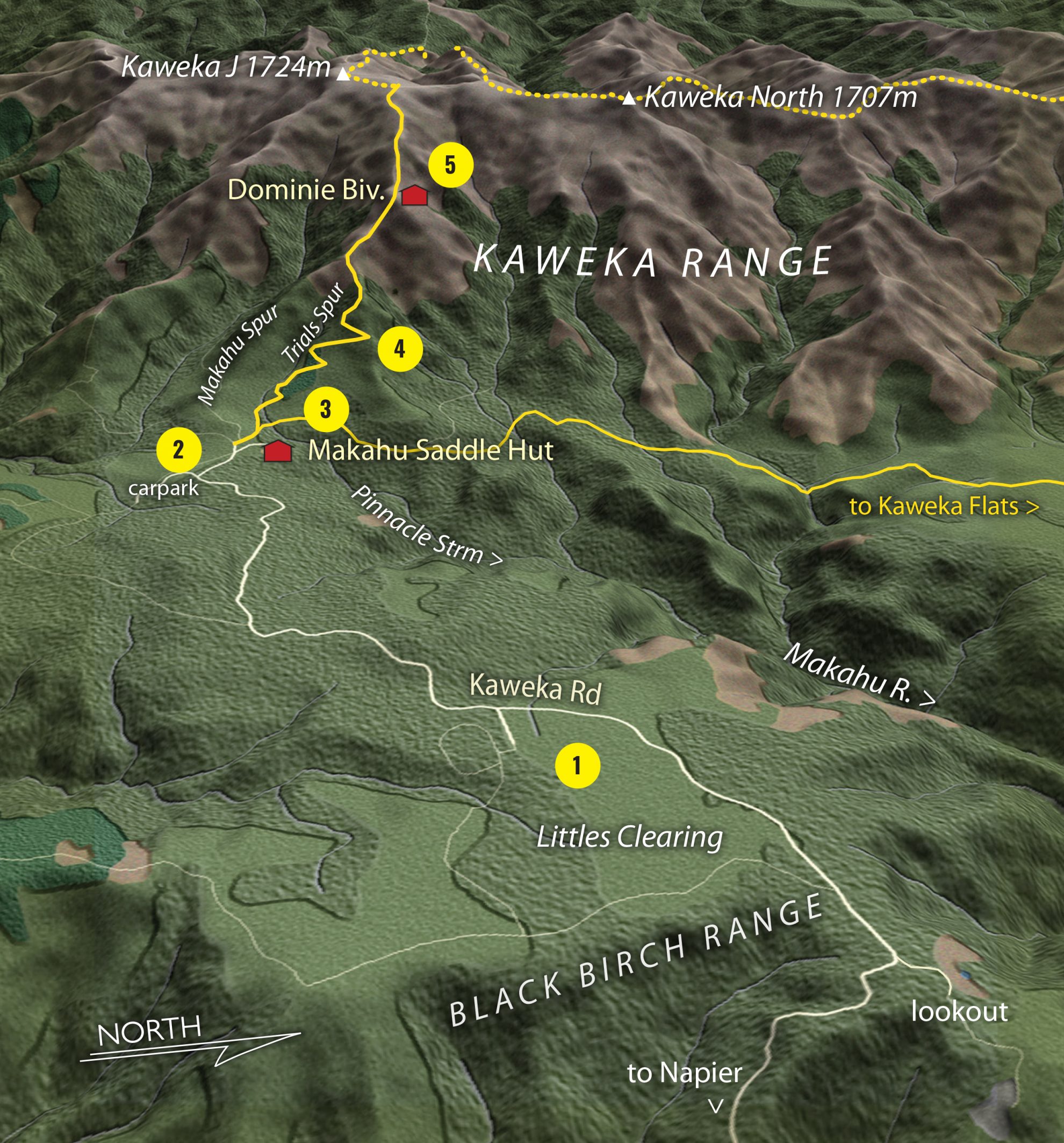
1. Littles Clearing lookout
After a steep grind onto the crest of the Black Birch Range, Kaweka Road levels out somewhat, and a short road to the right leads to this viewpoint, offering a panorama of the main Kaweka Range and the Makahu catchment. Littles Clearing lies a short distance further along the road, where red tussock thrives in a small alpine wetland.
2. Makahu Saddle
Kaweka Road ends at a car park with information panels and a toilet at the lofty altitude of 975m. In 1959, the Forest Service selected this as their research area, but back then no road existed and it wasn’t until eight years later that access was possible by 4WD. These days, the road is manageable by 2WD in most conditions, but may require chains in winter.
3. Makahu Saddle Hut
It takes just five minutes to walk to Makahu Saddle Hut. This historic, bright orange hut was one of two early deer-culling huts designed and built by the Forest Service in 1957. The frame was built using Meccano-like sections of aluminium, called Dexion, which could be bolted together. Short lengths of it were parachuted in by planes. But the increasing availability of helicopters meant longer lengths
of timber could be transported, and the use of Dexion was fleetingly brief.
4. Trials Spur
Two tracks offer access onto the main Kaweka Range and Kaweka J, and Trials Spur is the easiest to ascend. It zigzags through regenerating forest, among the dead remains of lodgepole pine, which was trialled as an erosion-prevention tree before being recognised as a fast-spreading wilding pine. DOC has since removed the pines, although ongoing work is needed
to deal with new seedlings.
5. Dominie Bivouac
About 20 minutes after the junction of Trials Spur and Makahu Spur, a short sidetrack leads to Dominie Biv. A small but welcome shelter, this two-bunk hut nestles on a ledge with a fine view over North Kaweka, Kaweka Flats and the farmed foothills of Hawke’s Bay. The hut served as a hide for deer researcher Mavis Davidson in the nearby Blowhard Bush, but in 1968 Ashley Cunningham and others relocated it onto the present site.
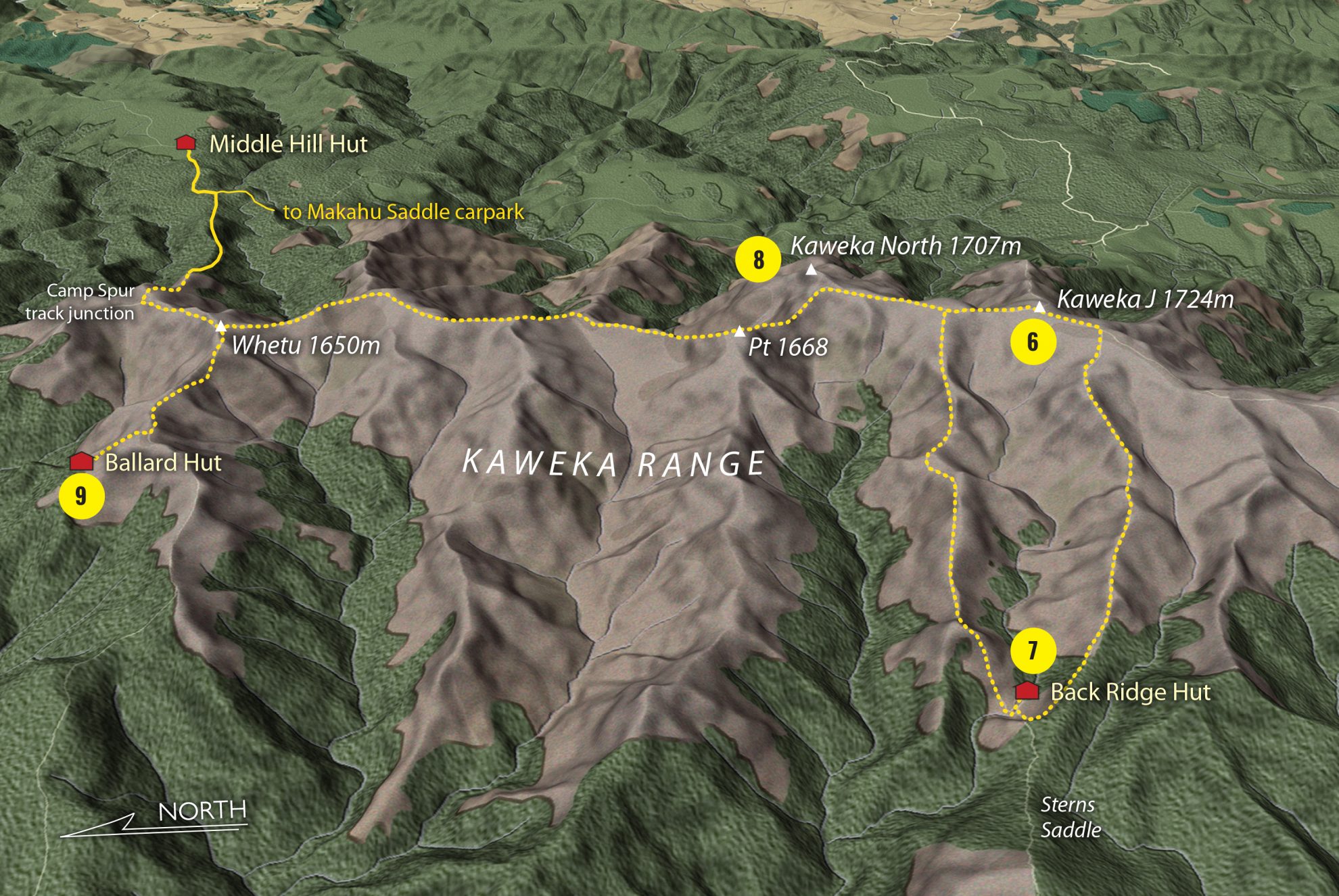
6. Kaweka J and memorial cairn
The well-marked trail climbs ever upward, passing some rocky knolls and a couple of small tarns. Higher up, the terrain levels off onto the expansive flat tops of the Kaweka Range. Ruapehu and Ngauruhoe shoulder into view, as well as the countless ridges of the Kaimanawa Ranges. The Kaweka J summit lies to the south, on a poled route. The sizeable memorial cairn was built by members of the Heretaunga Tramping Club after the Second World War in remembrance of trampers lost from their ranks during the war. Each year, the club holds a service here and replenishes the stones.
7. Back Ridge Hut
The route to Back Ridge Hut is indicated on a signpost near Kaweka J, and gradually descends a spur towards the west. Poles lead the way and the small orange square of the hut in the valley below can be seen. In the forest, the track leads towards Sterns Saddle until branching off to the hut, which is set in an attractive valley-head, near the burbling stream. Like Makahu Saddle Hut, Back Ridge was built in 1957 and also features a Dexion frame.
8. North Kaweka
From Back Ridge Hut, take the route up the spur on the northern side of the valley, which once more climbs onto the open tops. It regains the main range about a kilometre south of North Kaweka. From there, poles lead northward across undulating terrain to Whetu.
9. Whetu and Ballard Hut
From Whetu, a track junction offers choices to trampers. If you want to visit or stay in Ballard Hut, take the poled route west to another track junction above Ballard Hut. It’s a steep 200m scree descent to the hut. Alternatively, from Whetu head north-east to the Camp Spur track junction.
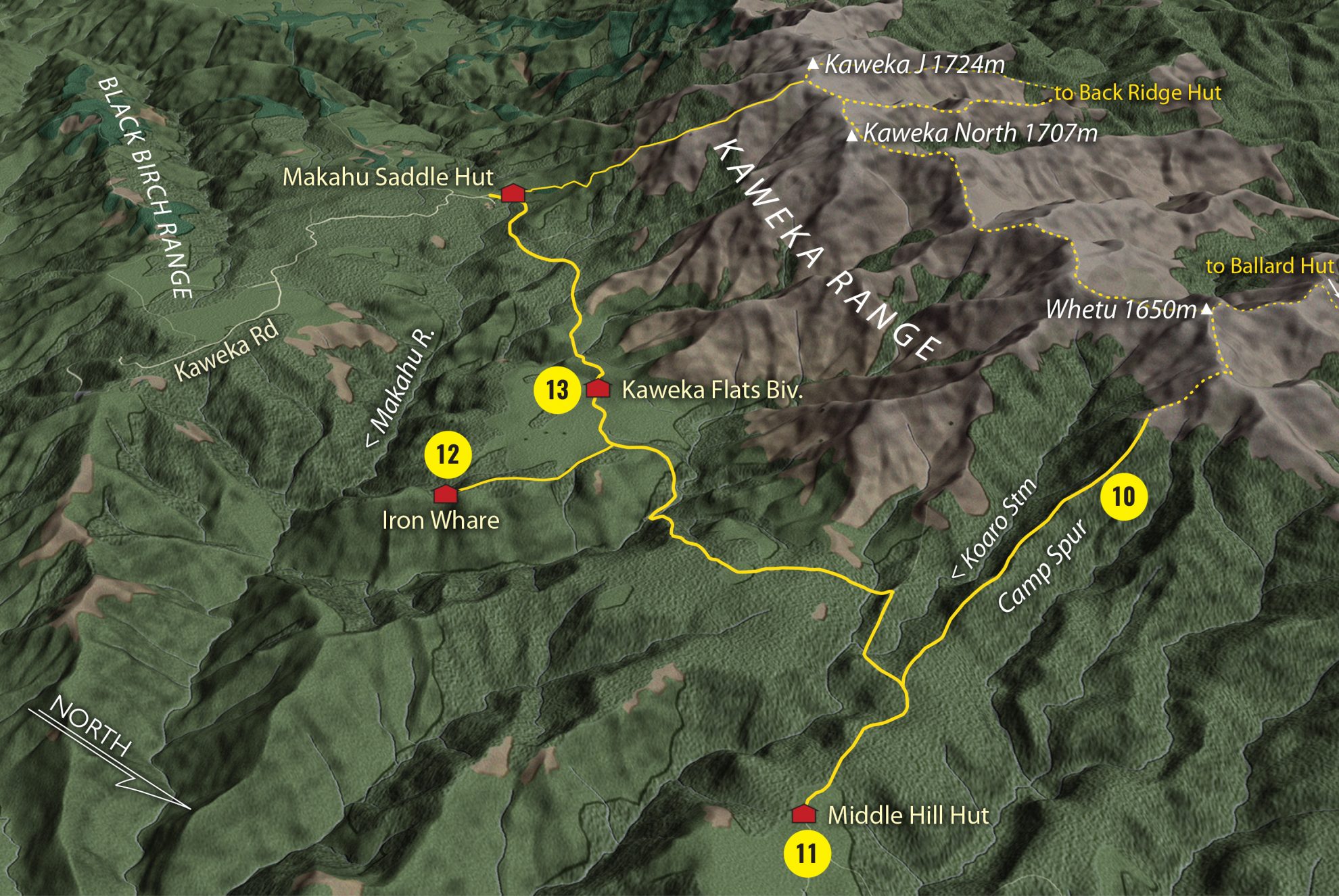
10. Camp Spur
It’s a short distance down the ridge on Camp Spur to the bushline, then a long downhill march to Middle Hill Hut, with the gradient easing as you descend.
11. Middle Hill Hut
Set in a clearing among the beech trees, Middle Hill Hut has a large and welcoming veranda, and makes a sheltered, comfortable destination for the night.
12. Iron Whare
From Middle Hill Hut, head back along the Camp Spur Track until the turn-off to Kaweka Flats. The track drops to ford the Koaro Stream, climbs onto another high, forested plateau, and then drops again to ford a branch of the Makahu River. A stiff climb leads to Kaweka Flats, where a signposted side-trail leads to the Iron Whare, the oldest hut in Hawke’s Bay. Built sometime in the 1870s, it served as a hunters’ hut and a place for sheep musterers using the Hawkestone stock route late in the nineteenth century.
13. Kaweka Flats
BivouacSet in a clearing fringed by manuka, this Forest Service-era bivouac is a typical ‘dog box’, with not enough room to swing a cat. Despite the fact you can’t stand up in it, the two-bunk bivvy offers more than adequate shelter and has fine views of the Kaweka Range. From here, undulating travel through increasingly diverse forest leads back to Makahu Saddle and the end of the tramp.