Studies of Fox Glacier Te Moeka o Tuawe show the link between glacier recession and rising global temperatures. By Heather Purdie
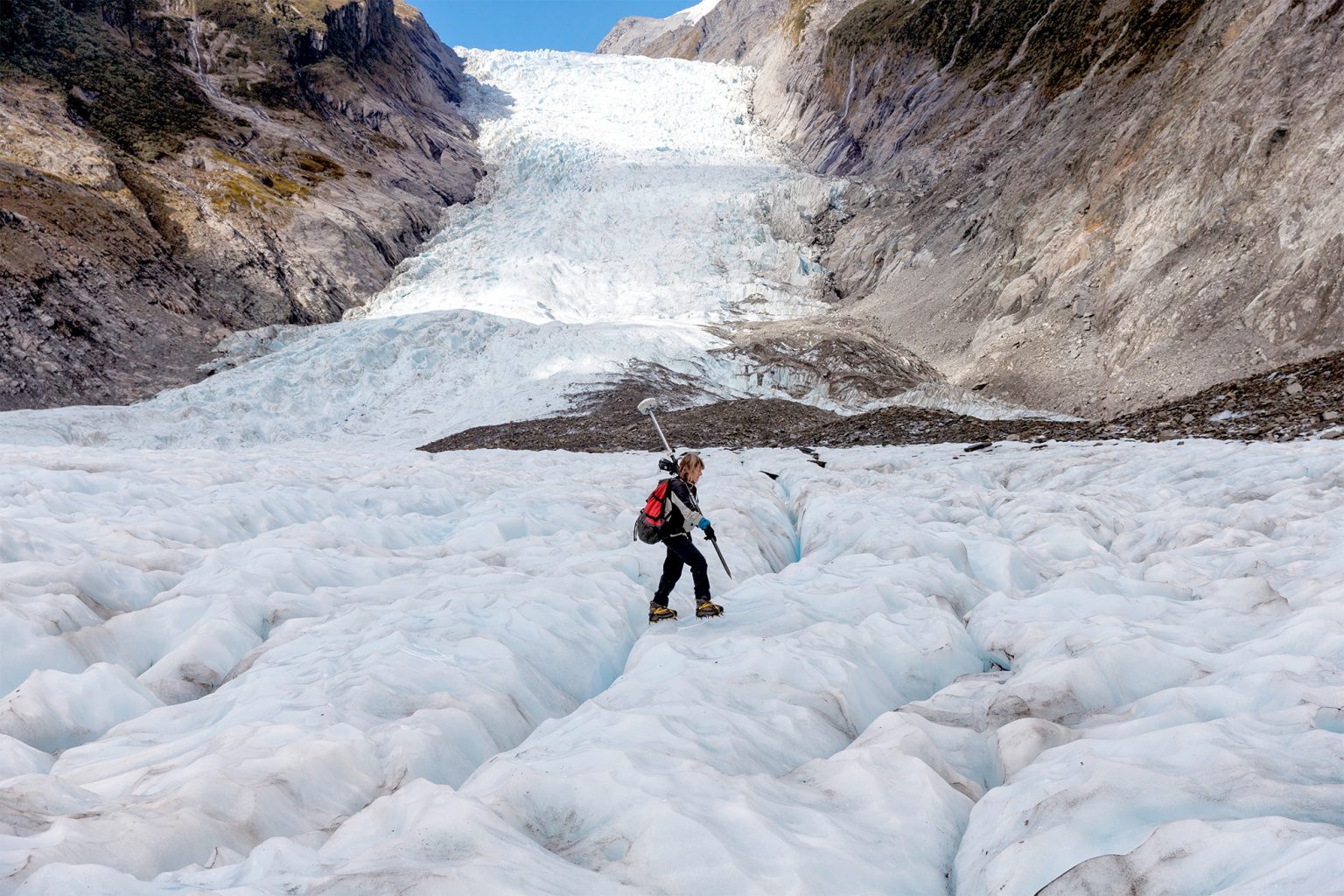
Fox Glacier Te Moeka o Tuawe began to change in the mid-2000s with the start of a new advance phase. I was researching and teaching about glaciers then, and over the next five years Fox Glacier thickened and grew 300m in length, overriding boulders and vegetation at the glacier margins.
This growth was over by the end of 2009 and Fox Glacier, along with glaciers all around the world, has receded rapidly ever since. There is no mystery surrounding the cause of these spectacular fluctuations. As renowned glaciologist Trevor Chinn put it, “glaciers can’t lie”. This global glacier recession is connected to rising global temperatures.
Glaciers are systems that constantly adjust in size. They’re balanced with climate, growing or shrinking with climatic cooling or warming. A glacier’s health is tied to its mass balance – the balance between how much snow accumulates high in the mountains to nourish it versus how much snow and ice melts away at lower elevations. If more snow accumulates than is melting away the glacier will grow; if the opposite occurs the glacier will shrink.
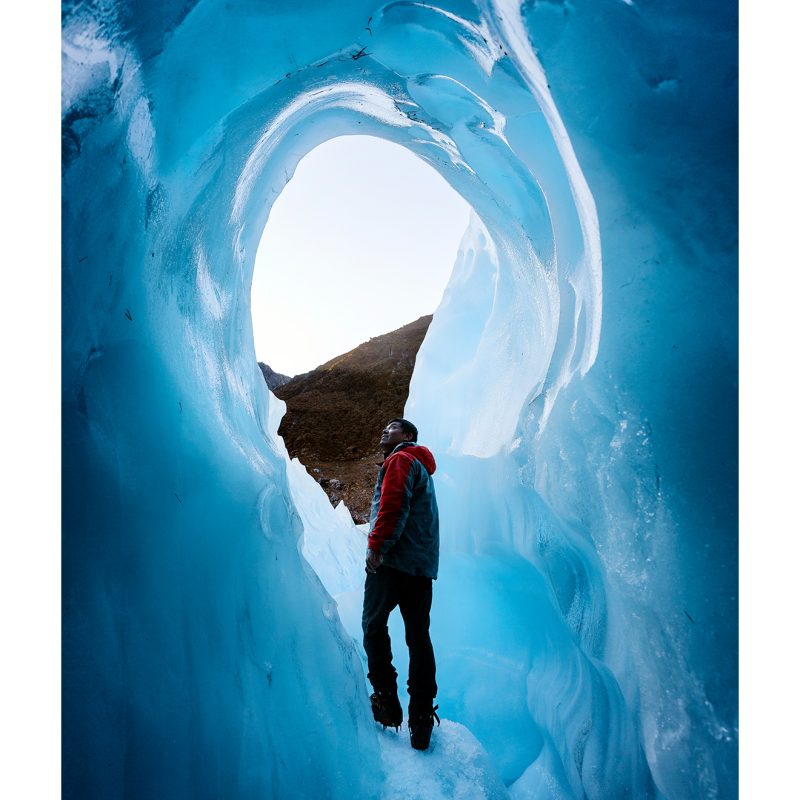
Ice forming at the top of the glacier flows down the mountains, being stretched and compressed as it goes. At Fox Glacier the results of this tumultuous journey are seen in the form of seracs (ice pinnacles), crevasses (cracks) and caves. In summer, melt water weaves its way over the ice surface, accumulating in blue ponds or cascading down deep shafts (moulins) on its journey to the valley floor.
As the ice disappears, the glacier’s highly reflective surfaces are replaced by darker rock. Snow and ice reflect a large amount of energy from the sun back to space, keeping the surface cool, but darker surfaces absorb that energy and heat up. This heat is then transferred into the air, increasing the air temperature, which in turn melts more ice. We call this ‘positive feedback’ – where a change occurring in a system is reinforced or amplified – but it is not at all positive to a glacier’s health.
These reflectivity changes can also be seen on a glacier’s surface as the exposure of more rock leads to increased dust in the atmosphere, which then coats the ice, darkening it and making it melt more quickly.
If rocks accumulate on the ice, as is often seen near a glacier’s terminus, this actually insulates the ice, slowing down the melt rate. So although glaciers might not look ‘pretty’, a blanket of rock debris is actually a positive.
My latest glaciological surveys at Fox Glacier reveal that, since it started to recede, over 1km in length and over 100m in ice thickness has been lost. Even so, the ice is still more than 100m thick in the valley and is still dynamic, moving at around 45cm a day.
While it is sobering to witness such rapid change in the mountains, glacier models indicate that if global warming can be kept below 2°C then glaciers will remain in the mountains. It is up to us all to learn to live more lightly on Earth, so that future generations may be able to experience the magic of ice-clad mountains.
Dr Heather Purdie is an associate professor at the University of Canterbury. She has been studying the Southern Alps glaciers for two decades and has ongoing projects at the Fox, Tasman and Rolleston glaciers.
Award-winning photographer Virginia Woolf has been working with Heather, capturing images of glaciers and glaciology as part of her Final Meltdown project. Virginia hopes her photos raise awareness, and encourage and convince people that we need to take stronger actions to stop climate change and consider our own human activities.
34 years of inspiring New Zealanders to explore the outdoors. Don’t miss out — subscribe today.

Questions? Contact us