During autumn you’re likely to spot interesting fungi growing in the bush. By Athena Rhodes
Werewere kōkako
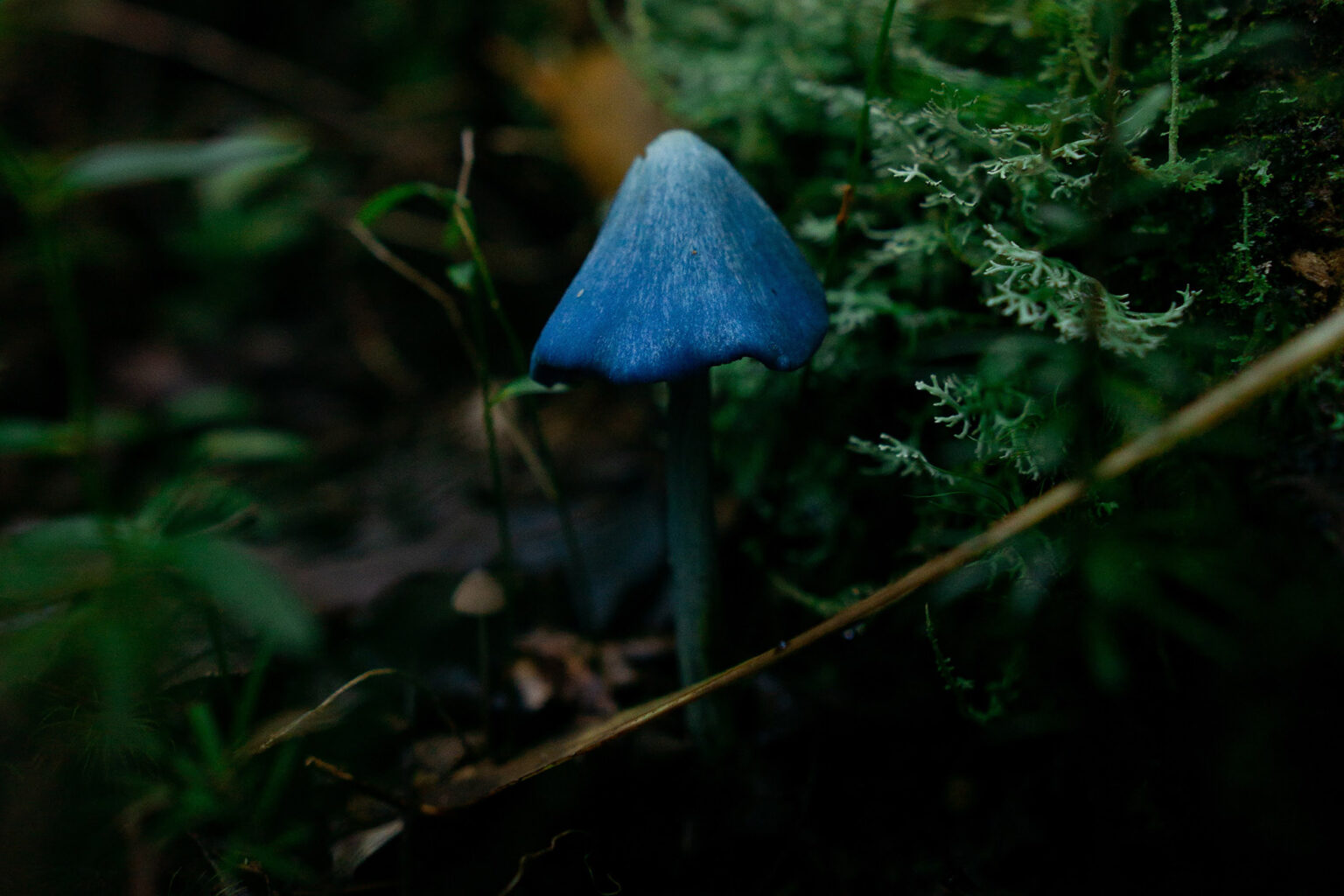
The werewere kōkako, Entoloma Hochstetteri, is on the $50 note. It’s quite the showstopper. This one is distinctive because of its bright blue colour – making it stand out in New Zealand’s green bush. Its Māori name originates from its colour, which is akin to the hue seen on the wattles of the kōkako. Yet, while the majority of this mushroom is blue, the spores have a slight red tinge. It is endemic to New Zealand and can only be found here.
The werewere kōkako grows in lowland forests, such as Pureora Forest, Rotorua Redwoods and the Tararua Ranges. Interestingly, in the forests around Mount Holdsworth, the werewere kōkako’s blue hue is paler.
Purple pouch
Another brightly coloured mushroom is the purple pouch, Cortinarius porphyroideus which is a gorgeous bright purple colour. It is also unique in having spores enclosed inside the cap. This means spores are dispersed in one of two ways: when the cap rots or when insects and other animals feed on the mushroom and disperse the spores.
The mushroom gained its name due to some believing it resembled a tobacco pouch. It is found in beech forests here and is often spotted in Nelson Lakes National Park and Tararua Forest Park.

Fly agaric
This one comes straight from Alice in Wonderland and is a striking mushroom to stumble across. Amanita muscaria stands out with its bright red cap splashed with white dots. It was colloquially named fly agaric because it could be crumbled into saucers of milk to attract flies, which would be killed by this concoction. It’s an ancient practice dating back to the 13th century, when the German priest Albertus Magnus made mention of it in his De Vegetabilis.
Fly agaric contain muscimol, a toxic hallucinogenic that can be fatal if eaten. The mushrooms are widespread and are commonly seen in pine forests in autumn.

Geastrum velutinum
Geastrum velutinum is a type of earthstar fungi. When it first bursts forth above ground there’s a resemblance to a little egg on the forest floor. The outer layer then splits and folds back, resembling a star, hence the name. In the middle is a sphere, which contains its spores. When raindrops land on it, the spores are released through the hole in this sphere. Earthstars can be found in the cooler months of autumn among leaf litter on the forest floor.

Auricularia
This mushroom goes by a few names, including wood ear – as it loosely resembles a floppy ear – and hakeke in Māori. Auricularia grow on dead trees in lowland forests in New Zealand, commonly tawa and māhoe. There are no gills or stalks, and it grows directly off the tree. The top parts are hairy and spores grow on the lower surface of the mushroom. It has a soft feel and is coloured brown to dark grey. Depending on rainfall, the mushroom may either shrink or swell.
Auricularia can be eaten – though it is rather flavourless. People often mix it with other vegetables and food to imbue flavour. In the 19th century it was collected commercially and tonnes of the mushroom were harvested and exported overseas.
Nowadays, most wood ear fungus is imported into New Zealand in its dried form. But people also forage recreationally.

34 years of inspiring New Zealanders to explore the outdoors. Don’t miss out — subscribe today.

Questions? Contact us