

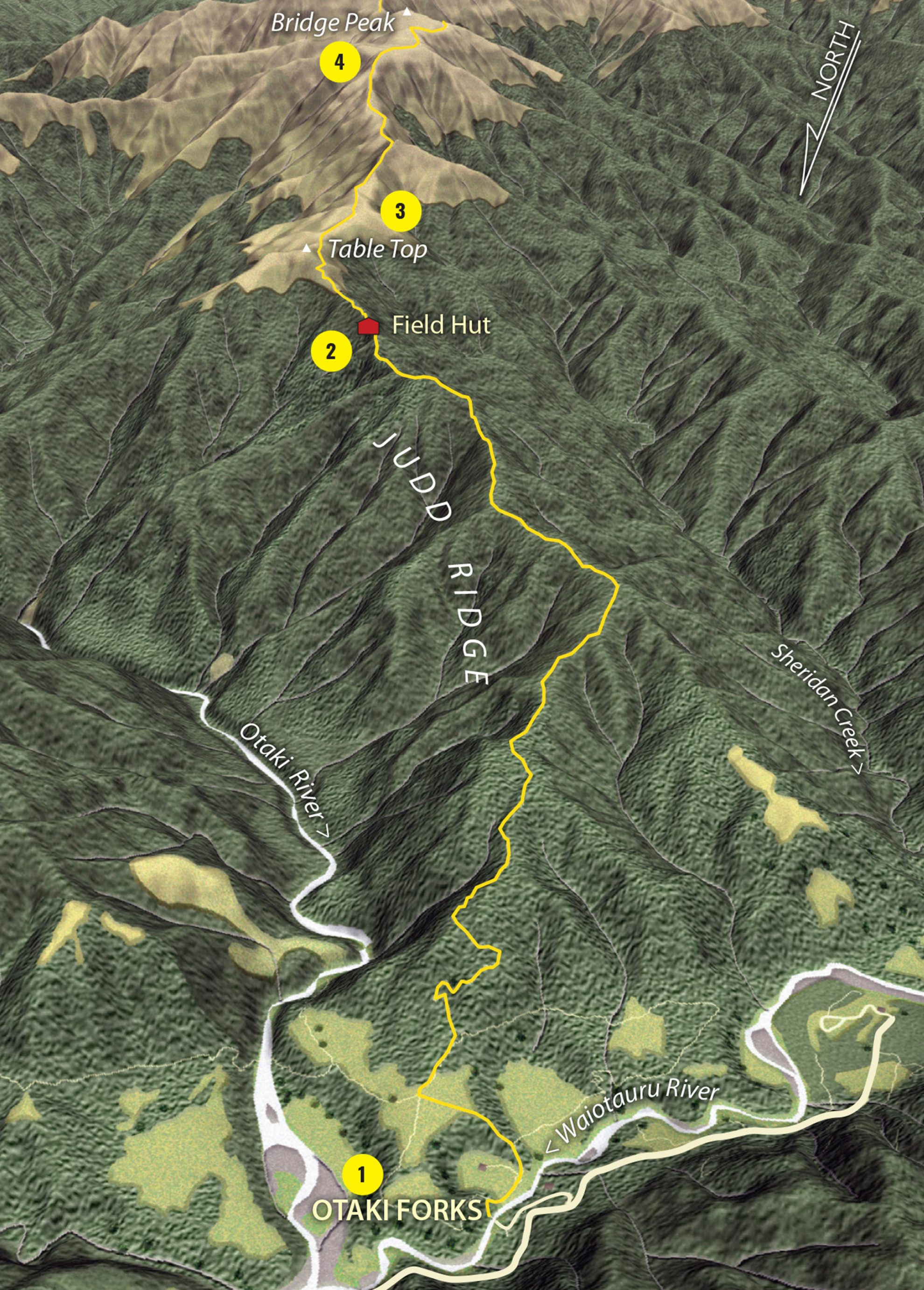
1 Otaki Forks
Once the site of a small milling settlement, Otaki Forks is where several rivers meet, and the Southern Crossing begins. From a car park and picnic area, cross the footbridge over Waiotauru River and begin the climb towards Field Hut. The track initially passes through regenerating scrub, but soon enters more mature forest of kamahi, hinau and totara.
2 Field Hut
It says much about the skills of bushman Joe Gibbs, and the subsequent efforts of the Tararua Tramping Club, that this hut still exists – largely in its original form. Built by Gibbs in 1924, it was constructed from timber cut on site. Situated just below the bushline, it’s nicely sheltered and rightly celebrated as the oldest purpose-built tramping hut in the country. It was built after club member Harold Freeman died of hypothermia while attempting the crossing in 1922.
3 Table Top
Beyond Field, the track climbs to merge into the tussocklands and undulating terrain of Table Top. A boardwalk crosses boggy terrain and views of the range stretch north and south.
4 Bridge Peak
A steady upward climb on a well-worn route, marked by occasional poles, reaches a track junction at Bridge Peak (where the route along the Main Range branches off). This knoll is named after Bill Bridge, a second generation TTC member who made a huge contribution to developing Search and Rescue.
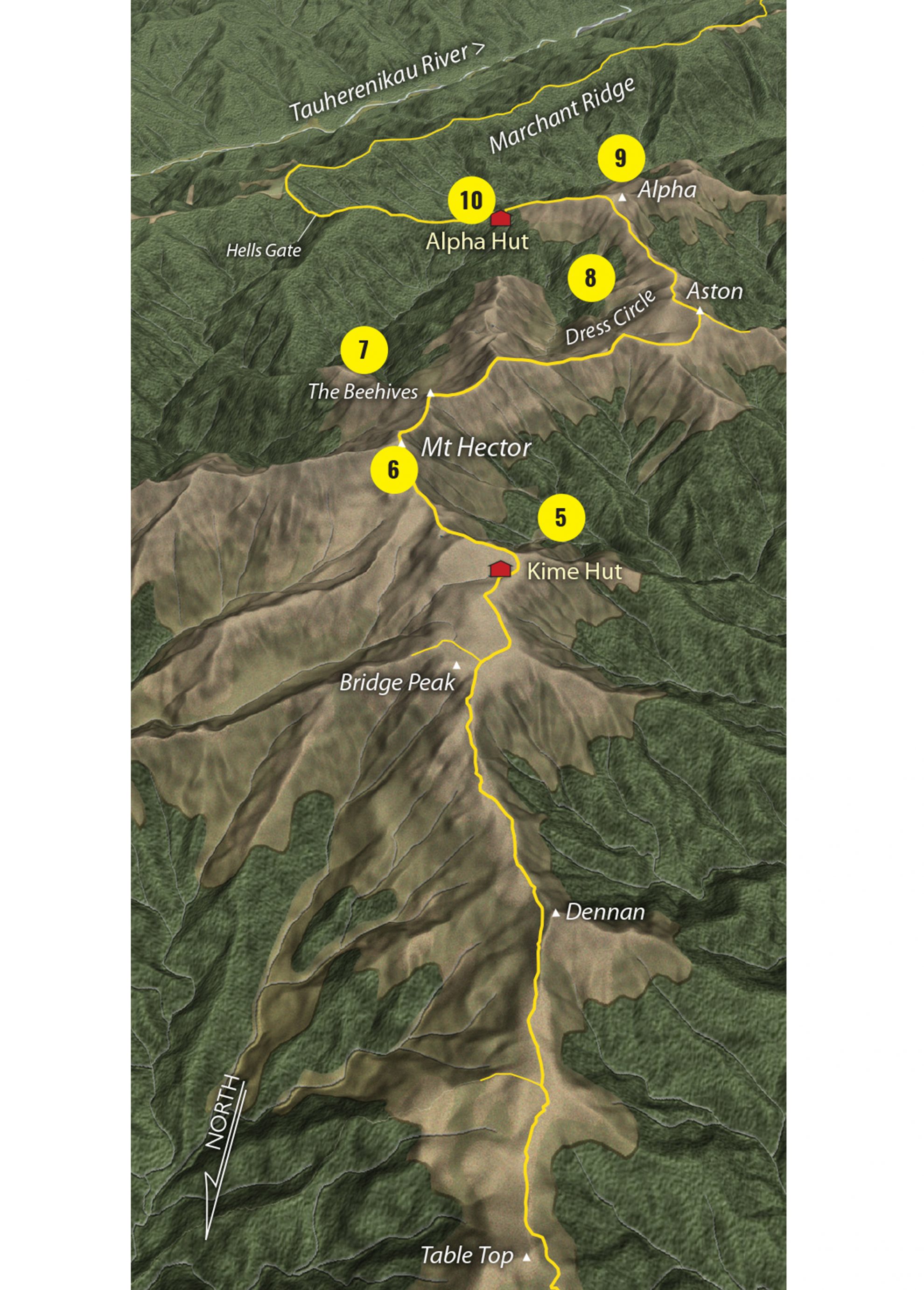
5 Kime Hut
Unlike Field, Kime Hut has been through three different incarnations. The original hut was built by the TTC in 1930 after the hypothermia-related death of Esmond Kime on the exposed tops. It was replaced in 1978, but though a pleasing shape, the high-ridged hut was never warm. DOC replaced it with Kime III in 2014.
6 Mt Hector
Beyond Kime, the track climbs to its highest point, Mt Hector (1529m), where a wooden cross commemorates those trampers who lost their lives in war. Naturally, it offers fine views, even as far as Mt Taranaki.
7 The Beehives
These two mounds, known appropriately as The Beehives, form the narrowest section of the entire route, one that can be dangerous in high winds or winter conditions.
8 Dress Circle
After The Beehives, the terrain becomes flat, almost moor-like, before arcing around a sickle of tops known as the Dress Circle to Aston. Poles at key places help navigation where the topography loses definition.
9 Alpha
On a good day, Alpha affords perhaps the best vantage point of the crossing, with views over the sweep of the Dress Circle and the extensive forests of the neighbouring Tauherenikau and Hutt catchments – not to mention the distant Kaikoura mountains and Marlborough Sounds.
10 Alpha Hut
A descent off Alpha leads to the bushline, and shortly beyond, Alpha Hut. The TTC took over the original hut, but, when authorities made a draconian decision to exclude trampers from the Hutt catchment in the 1950s, had to rebuild it at a new location. Alpha II burned down in the early 1980s, and the Forest Service replaced it with the existing hut in 1983.
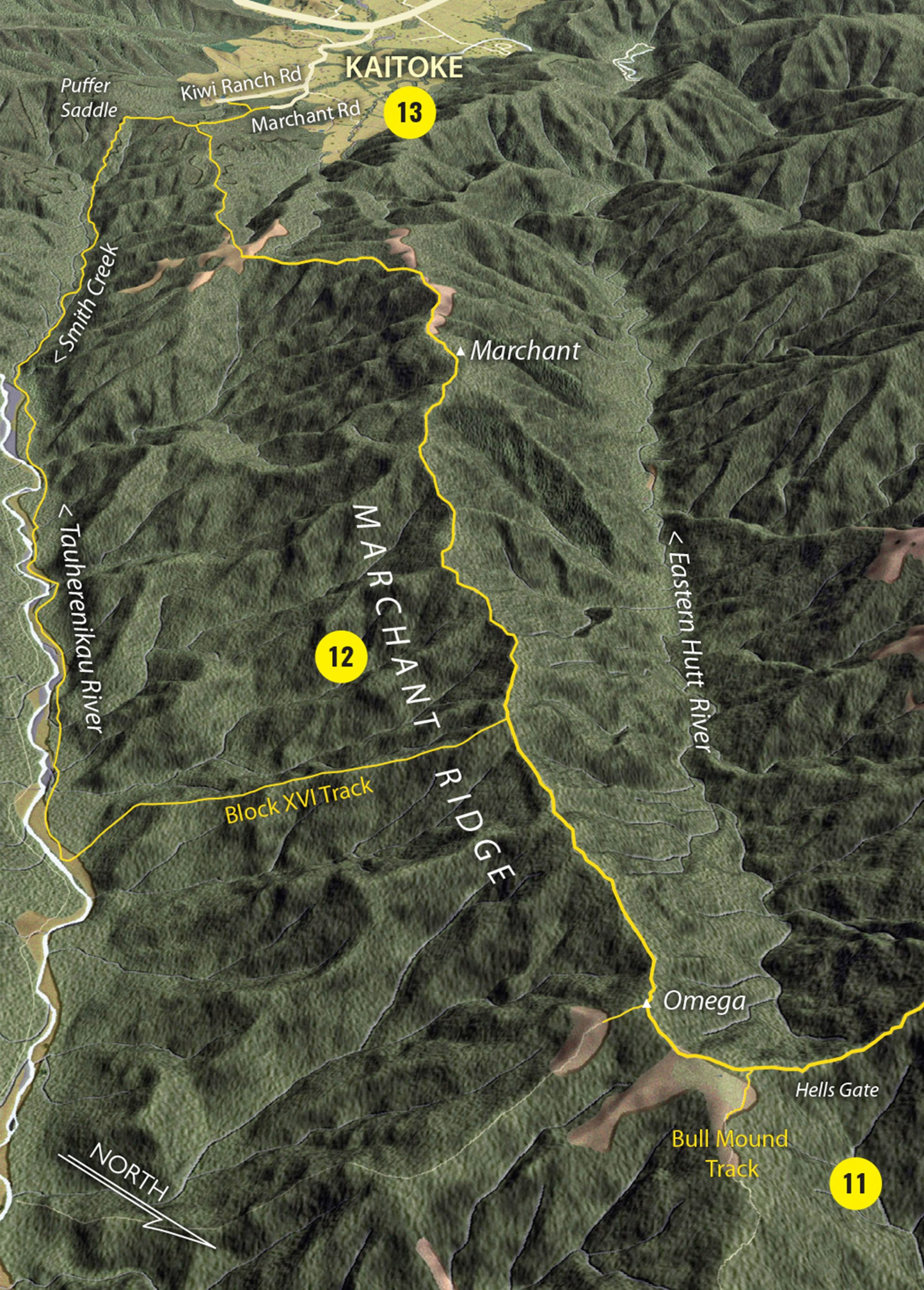
11 Hells Gate
Beyond Alpha, the track dips into a saddle with the somewhat exaggerated name of Hells Gate before reaching a track junction to Bull Mound. It continues along Marchant Ridge.
12 Marchant Ridge
The Marchant has a deserved reputation as a long slog, with rooty, muddy, undulating travel through stunted beech forest. Part of the ridge was burned in a great fire in 1938. My personal preference (even though it takes longer) is to drop down the Block IV track to the Tauharenikau Valley and Smith Creek tracks.
13 Kaitoke
The tramp concludes at a large gravel car park at the end of Marchant Rd, off SH2 at Kaitoke. Cars are frequently vandalised here, so you’re better to park at the car park on Kiwi Ranch Road.



