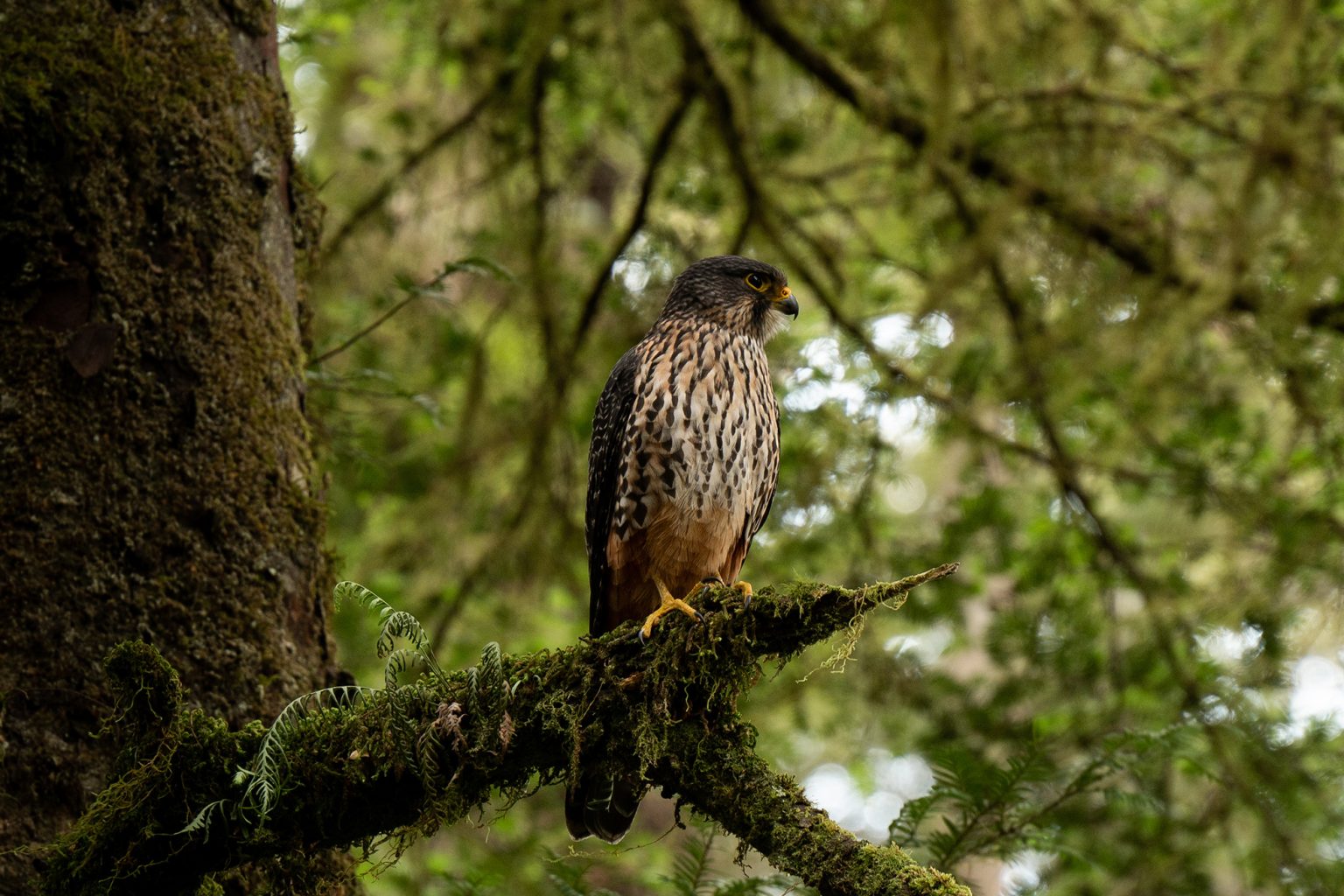
The kārearea is the only surviving endemic raptor species in New Zealand, and is unique among the world’s falcons.
The kārearea is an avian A-lister, and a charismatic one. It is New Zealand’s fastest flying bird and can dive at up to about 200km/h, hurtling from the sky like a feathered taiaha. In 2012, the karearea won Forest and Bird’s annual Bird of the Year poll, and, did you know that one may be in your pocket right now perched on a $20 note.
This sole surviving endemic raptor is also an apex predator with attitude. If you’ve ever locked eyes with one, you’ll have felt its fearless ‘death stare’.
These birds are also aggressive defenders of their chicks, ready to attack and drive off humans by diving and striking with their razor-sharp talons. One has even been seen attacking a helicopter.
A farmer near Dunedin with first-hand experience of an attack told Stuff that “it feels like you’ve been clubbed by a bat” when one flew in and hit his head. But such attacks are rare, only occurring when someone inadvertently approaches too close to an active nest; usually within about 50m to 100m.
I’ve been attacked a couple of times but managed to avoid a direct hit. If you are ever under attack, it’s best to retreat until the dive bombing stops, or crouch low and cover your head with your arms until the bird desists, and then retreat. Don’t try to hit the bird with anything.
Kārearea grow up to 50–60cm tall and weigh up to 740g. They are capable of taking down a bird as big as a heron (67cm) or as heavy as a takahē (3.5kg).
The female is up to a third larger than the male, but what the male lacks in size it makes up for in style with its striking striped and spotted plumage, gunmetal grey colouring and orange ‘trousers’. Immature birds are mostly solid brown with grey rather than yellow facial skin and legs.
Most of the world’s 38 falcon species either chase or ambush their prey but the kārearea uses both methods, which is rare. Perhaps this is because it is a forest falcon living in an isolated island country with a depleted number of endemic raptor species.
Kārearea are highly versatile aerial hunters and can make fast, stooping dives. They have relatively short, rounded wings and a long tail for maximum manoeuvrability, which helps them hunt at breakneck speeds inside forests. As they strike, they use their long legs and talons to grab their prey in flight, they then kill with a bite to the back of the neck that severs the spinal nerve.
Most kārearea live within forests or rural open country south of Waikato. Over the years I’ve found the best way to locate them is to listen for their insistent kek-kek-kek calls, then to look up in the direction of the call, or listen for the calls of tūī mobbing them.
You can also find them standing on prominent high points like dead trees or branches, or fence posts, where they have a commanding view of the surroundings. In recent years, I’ve also seen them standing on the Carillon Tower in Wellington.
I’ve seen them ‘stooping’, sleek as an arrow, at their quarry – a pipit on Arapawa Island and a flock of terns on Taputeranga Island. I once saw one catch a small songbird and hover briefly as it bit the back of its prey’s neck.
The most common confusion species for the kārearea is the kāhu. The harrier is slightly larger and heavier and has slightly longer wings and a more languid, gliding flight. The kārearea has a more direct flight with much faster wingbeats.
There used to be four raptor species here, but the others – Haast’s eagle, kērangi Eyles’ harrier and whēkau laughing owl – are now extinct.
If you go in search of a kārearea, just be sure to wear a hat!
– Michael Szabo is the author of Native Birds of Aotearoa (Te Papa Press) and editor of Birds New Zealand magazine.