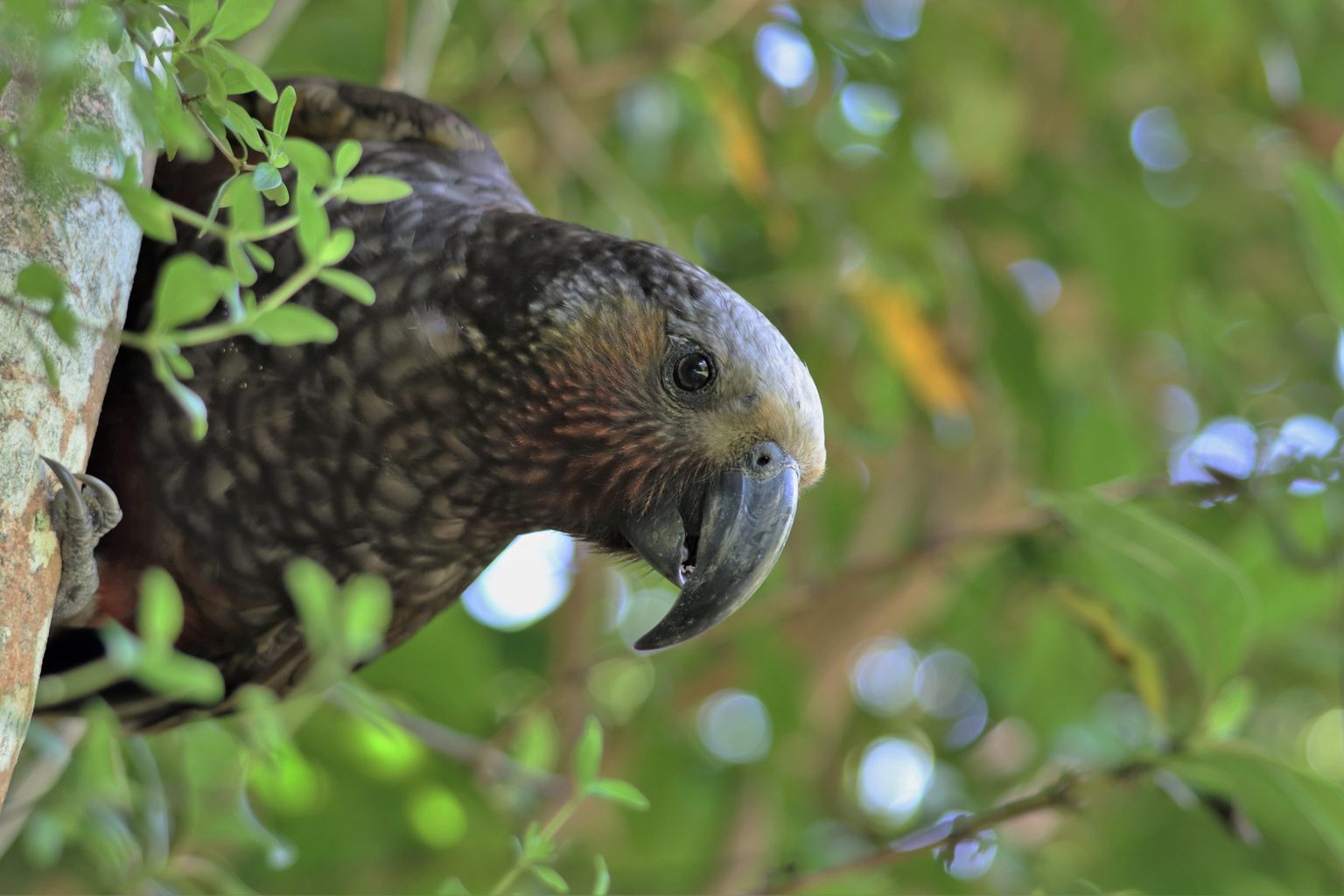
Like its kea and kākāpo cousins, the kākā uses its powerful bill as a third ‘foot’.
Ancient Aotearoa was a land of giant birds, with two species of giant moa, a giant eagle and a giant parrot, which researchers have dubbed ‘squawkzilla’. All these feathered giants are extinct now, but fortunately New Zealand is still a land of parrots.
The kākā is one of the largest and loudest of our forest birds. Along with its kea and kākāpo cousins, it belongs to the endemic parrot superfamily Strigopoidea. Two other kākā species – Norfolk Island kākā and Chatham Island kākā – have been extinct for 175 years and 300–400 years respectively. All of them are thought to stem from a ‘proto-kākā’ that lived in the forests of Aotearoa five million years ago.
Even earlier, the giant ‘squawkzilla’ parrot Heracles inexpectatus lived 16–19 million years ago. Researchers think it also probably belonged to Strigopoidea. Fossils, including two large leg bones found at St Bathans, Otago, in 2008, were initially mistaken for those of an eagle. Based on these finds, researchers estimate that Heracles inexpectatus stood 1m tall and weighed 7kg, had a massive bill, and was possibly flightless.
Adult kākā are half that size, growing up to 45cm tall and weighing 340–640g. Mainly olive-brown, they have a grey-white crown, bright red-orange underwings and a deep crimson belly and undertail. Listen out for their harsh, repeated rhythmic ‘ka-aa’ calls made when flying over forests, raucous ‘kraaak’ alarm calls and loud musical whistling.
Male kākā have a longer bill and larger head than females and are about 10 per cent heavier. Like kea and kākāpō, they can use their powerful bill as a third ‘foot’ to help them climb.
Kākā live for up to 27 years in the wild (some birds in captivity have reached 40), and form long-term monogamous pair bonds.
Endemic to the three main islands plus some of the larger pest-free offshore islands, they inhabit lowland and mid-altitude native forests. After a long absence, they are once again a frequent sight in Wellington, especially in urban reserves and parks such as Zealandia Ecosanctuary, Wellington Botanic Garden ki Paekākā and Otari-Wiltons Bush, where they feed on flowering kōwhai and rātā and the fruit of rimu and miro. Since the release of captive-bred birds at Zealandia in the 2000s, over 1300 kākā have been banded there.
In winter I watched a boisterous flock of 15 flying around the botanic garden as they fed on ripe nīkau fruit and flowering kohekohe. Other good places to see them include Aotea Great Barrier Island, the Waitākere Ranges, Pureora Forest Park, Kāpiti Island, Kahurangi National Park, Orokonui Ecosanctuary, the Routeburn Track and Rakiura Stewart Island.
Being strong fliers, kākā can cover long distances. One recent study tracked a bird that completed a 1000km round trip, flying north from the Waikato to several Hauraki Gulf islands, the Coromandel and back to the Waikato during winter.
Kākā breed mainly in spring and summer, most in tree cavities over 5m above ground. The female typically incubates four white eggs and rears the chicks, while the male feeds its mate through the breeding season. Both adults feed the juveniles once they have fledged from the nest.
Kākā eat mainly seeds, forest fruits, nectar, sap, honeydew and invertebrates such as huhu grubs. They can use their strong bill to dig into the cones of kauri and exotic pines to extract and eat the seeds. The Department of Conservation advises trampers not to feed kākā as they have not evolved to digest the same foods as us; our foods may be harmful to kākā.
Next time you see or hear a kākā, remember that it’s a modern day squawkzilla!