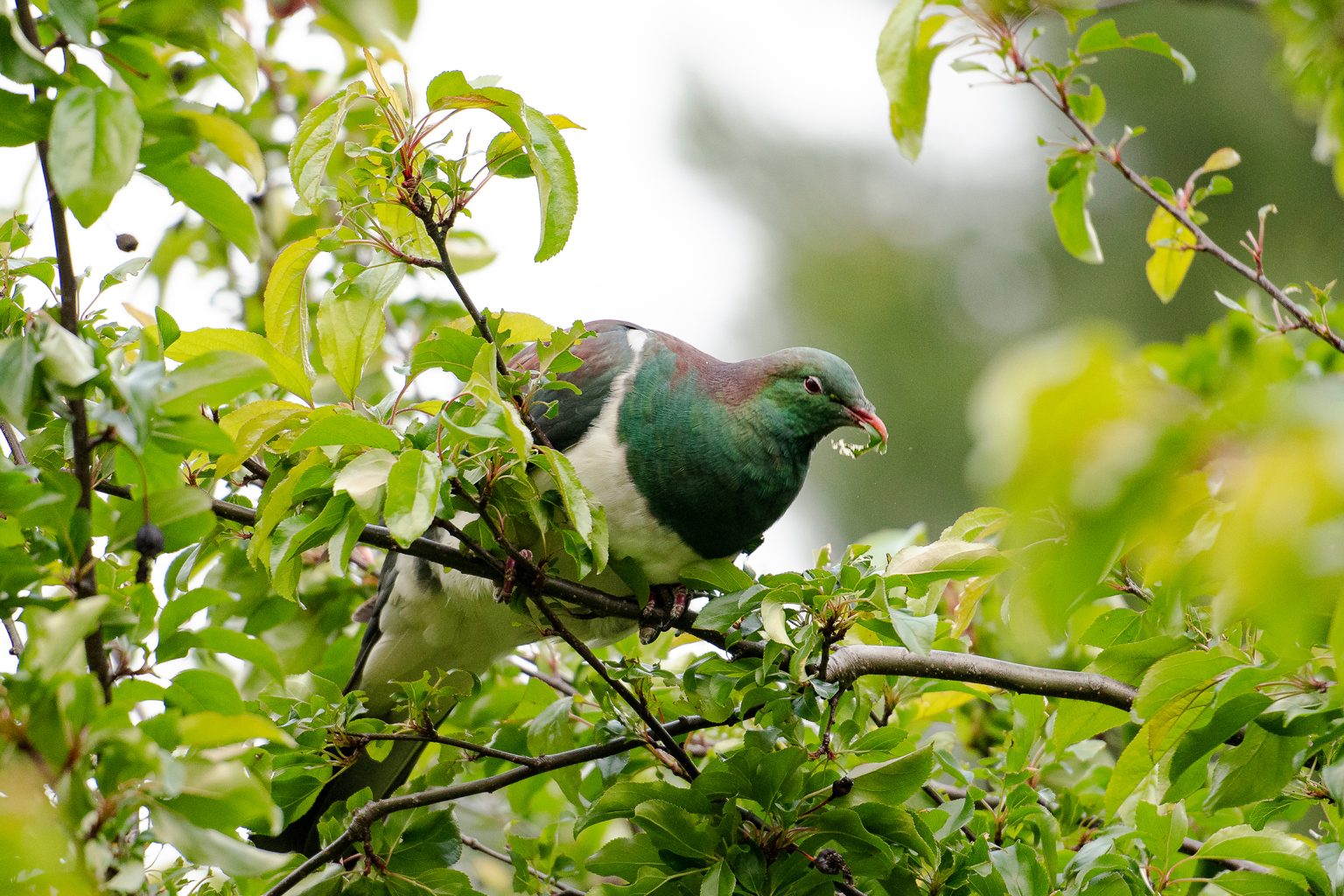
The kererū might best be described as a daredevil skydiving giant ‘fruit dove’. This gentle forest giant has a Zen-like serenity when resting on a branch, but it can also be comically clumsy when landing awkwardly and surprisingly pugnacious when defending a fruiting tree from another bird, striking out with its powerful wings.
Along with their even bigger Chatham Island cousin, the parea – about ten per cent larger, with a longer tail and bigger bill – kererū are among the largest arboreal pigeons in the world, respectively 50cm/630g and 55cm/790g. The kererū is also known as the kūkūpa or kūkū in Northland.
Males of both species often perform spectacular flight displays at the start of the breeding season. They will fly high above the forest and stall, with wings and tail spread out, before falling into a dramatically steep skydive.
Close up, the kererū has a vibrant blue-green iridescence on its head, upper breast and upper wings, and a purple-bronze sheen on its neck and back. Its eyes, feet and bill are red and its breast and belly white. Both species are usually silent but sometimes make quiet, throaty oo calls, or brief, louder oo alarm calls.
Kererū were once present on Raoul Island in the Kermadecs until wiped out by human hunting and feral cats. On the mainland, however, although some kererū populations have been threatened by introduced predators and human hunting, they are no longer listed as threatened. Where invasive pests have been removed from offshore islands and fenced sanctuaries, or kept at low levels, populations have increased visibly.
The birds are now widespread from Northland to Stewart Island in large areas of native forest, exotic plantations with an understorey of native trees and shrubs, rural areas and urban parks. They are thriving in parts of Wellington where there is native forest or urban parkland, and in suitable habitats in other main centres including Auckland, Christchurch and Dunedin. I recently saw a flock of 15 feeding on a fruiting tree in Wellington Botanic Gardens. Annual New Zealand Garden Bird Survey counts show a 102 per cent increase in kererū numbers from 2012 to 2021.
The parea is still listed as threatened but its population is now estimated to be more than 800 birds, up from a low point of 40 in the late 1980s. They are found on Rēkohu, the main Chatham Island, mostly in forest with pest controls in place in the southwest, such as Tuku Nature Reserve and Sweetwater Conservation Covenant.
Although some kererū occupy a relatively small area for extended periods, they can also make long-distance flights in search of seasonal food sources. One satellite-tagged kererū flew at least 480km in Southland during a 100-day period, including crossing Foveaux Strait four times, and in Taranaki a few tagged birds flew up to 60km to find autumn food.
Both species are among the only remaining New Zealand birds that can swallow whole fruit from native trees such as tawa, taraire and karaka, and spread their seeds – hence their vital role in the rejuvenation of native forests. While both species eat forest fruits, leaves, flowers and buds, parea will also land in paddocks to feed on clover and dandelion flowers.
Both of these portly pigeons are monogamous. Kererū breed mostly in September–April, laying their single white egg on a surprisingly flimsy platform of dead twigs built in a tree.
Both adults share incubation duties and feed their chick a protein-rich, milky secretion mixed with fruit pulp until it fledges after about five weeks. Parea breed mostly in June–November and their chick takes about seven weeks to fledge. When forest fruit is abundant, many parea pairs breed a second time and raise a second chick.
Next time you’re out tramping (or in an urban park) listen out for the whooshing wings of a kererū sailing overhead – and watch out for aerial scatterings of forest seeds!
– Michael Szabo is the author of Native Birds of Aotearoa (Te Papa Press, 2022) and editor of Birds New Zealand magazine.