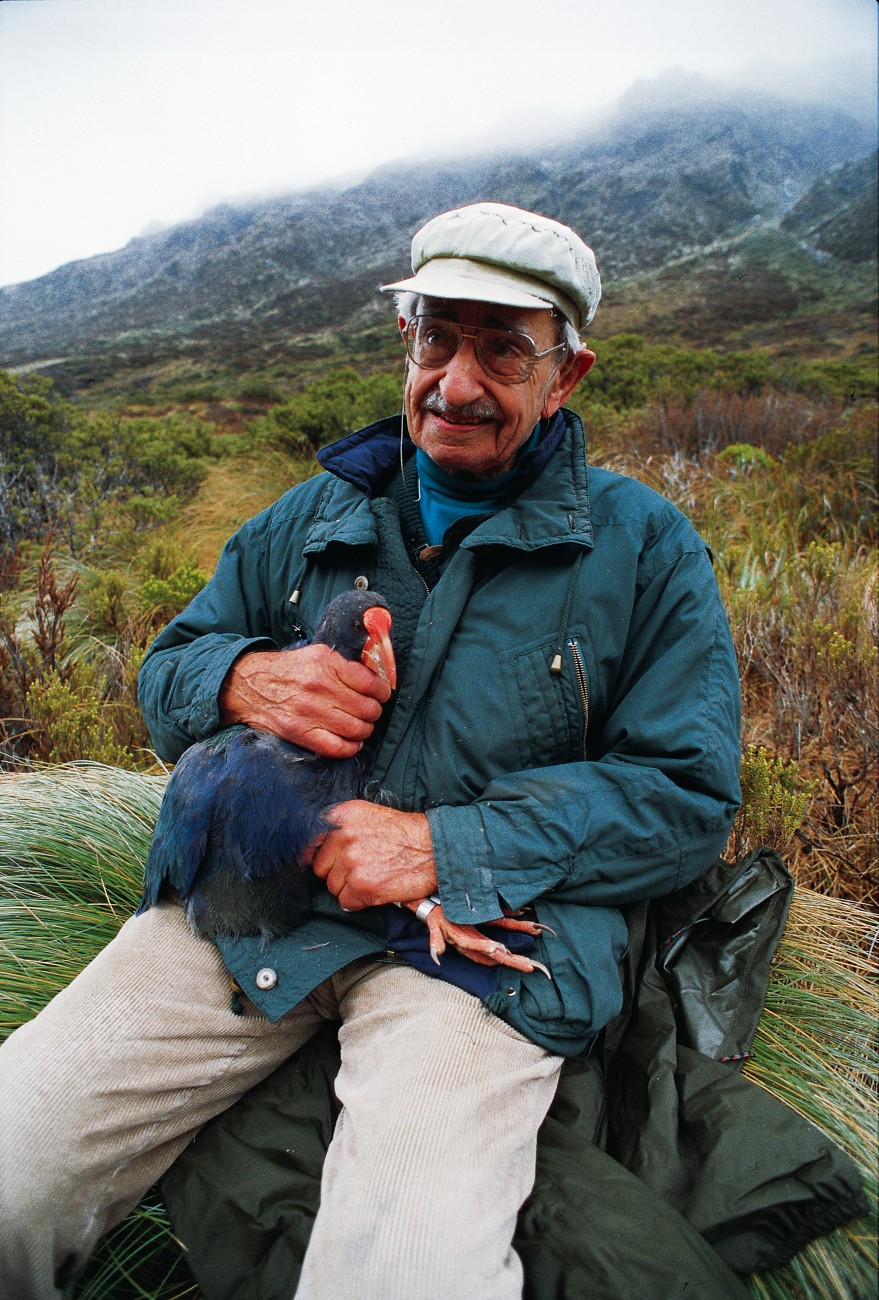
Alongside the breeding programme, DOC took steps to protect the birds living in the wild, using pest control and relocating birds to predator-free islands.
According to Crouchley, takahē’s natural propensity to disperse widely worked to the birds’ own detriment. “In a dispersed community it’s hard to find a mate, and it made it difficult to set up new sites for the takahē,” he says.
It’s been a steep learning curve hampered by setbacks. The attempt to establish a new wild site in the Stuart Mountains in the late 1980s failed. Almost all of the 52 birds released there vanished or were killed by predators and a series of unusually heavy winters in the early 1990s.
During a stoat plague in 2007, the Murchison Mountain population shrank from 168 to 93 in a matter of months. In 2015, four takahē were accidentally shot on Motutapu Island by hunters culling pukeko.
But more recent years have seen a turn-around. DOC senior biodiversity ranger Glen Greaves has been working on the Takahē Recovery programme for 12 years.
“The takahē survival rate at Burwood was higher than in the wild, but puppet rearing was incredibly intensive and therefore very expensive,” he says. “In addition, puppet reared birds were not as good at parenting as wild birds.”
In 2011, DOC ceased the practice and moved to a hands-off approach relying on supplementary feeding, nest management and genetics to maximise takahē productivity and survival of the chicks.
The Burwood unit has 19 one-hectare pens – one per breeding pair – and a 150ha open enclosure housing a further five pairs. The tussock reserve provides similar conditions to the home of wild takahē in Fiordland.
Supplementary feeding occurs twice. Every Monday and Thursday, ranger Sam Haultain walks the enclosures with a bin full of ‘takahē cereal’ on her back and a smaller container with food which she shakes to encourage the birds out of the tussock.
One of Haultain’s jobs at Burwood is shifting and pairing birds, which she likens to playing chess.
“You’re trying to work out genetic information, ages, sizes and who is breeding,” she says.
In the wild, takahē breed once a year laying two eggs (20 per cent of them infertile), but usually only manage to rear one chick. DOC removes infertile eggs and moves eggs between nests for a better breeding outcome.
The programme became so successful that Burwood was running out of space.
“We now we have 104 birds with Burwood producing about 25 chicks each year,” Greaves says. “We had to build more sanctuaries [around New Zealand] to house them all. We used to have all eggs in one basket. Now we have diversified.
“Two years ago, there were 250 takahē. Now we have 350 birds and we expect to have 500 within five years.”
The predator control programme has also intensified. Across the 50,000ha of the Murchison Mountains reserved for takahē, DOC manages 2500 traps which are checked at least four times a year.
Until last year, the Murchison Mountains were the only wild takahē site, with 130 birds. DOC spent years searching for other sites where a wild population could be established. To qualify, the site needed to be in the South Island where takahē occurred naturally, it had to be large enough to support a population of at least 30 breeding pairs, it needed native grass cover, low predator density and better climate and geography than Fiordland.
Gouland Downs on the Heaphy Track was perfect and earlier this year 30 takahē were released there.
Monthly monitoring shows that so far the birds appear quite settled. They are feeding on a wide range of plants and keep in good health. The real test will come this spring when successful breeding and raising of chicks would confirm the site’s suitability for takahē and whether further birds could be released into the area.
Last year, takahē moved two steps away from extinction – from nationally critical to nationally vulnerable in the New Zealand Threat Classification System. My sighting of the takahē on the Heaphy Track suggests that one day spotting takahē in the wild will be a reality for many more people.