

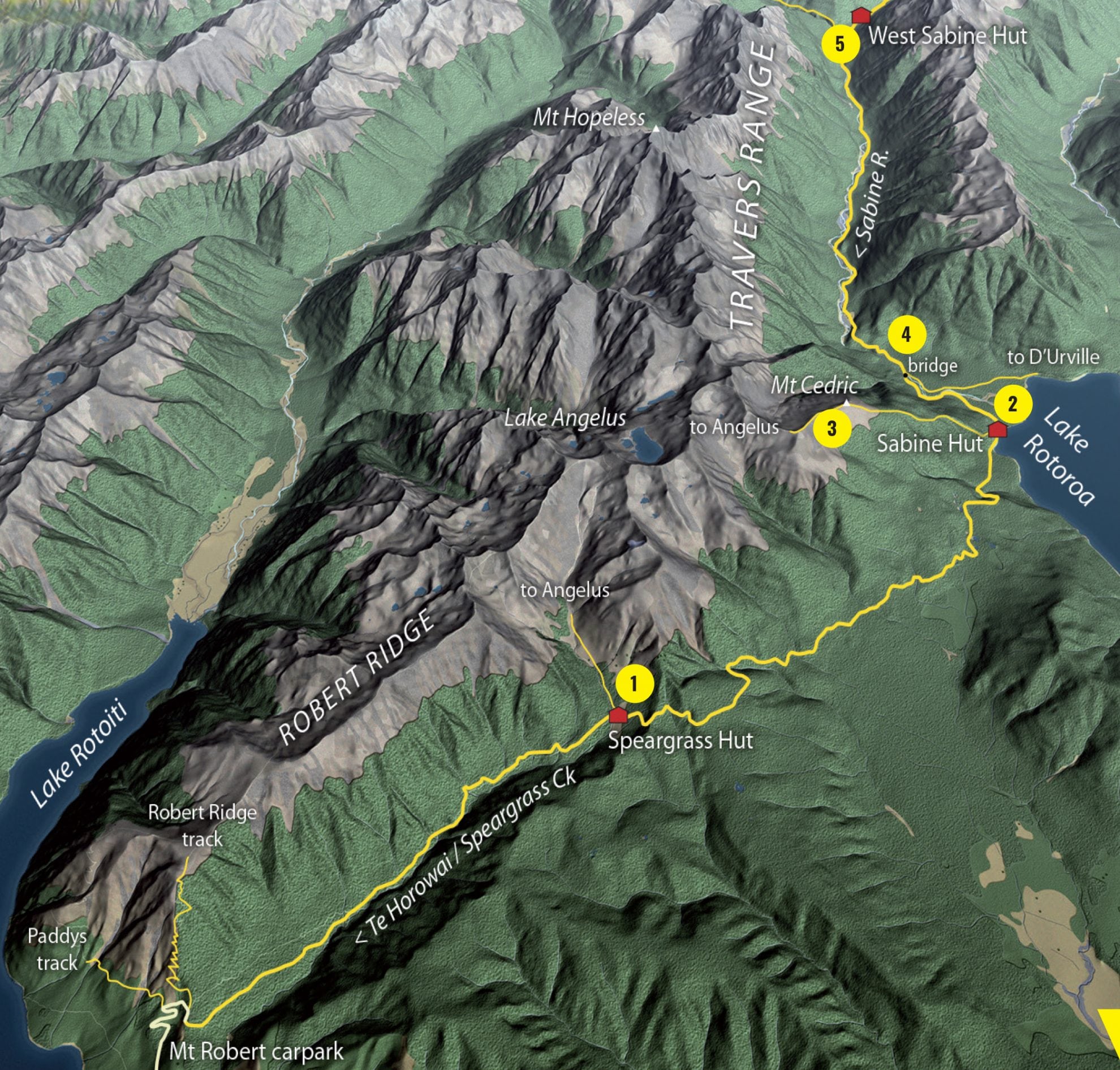
1. Speargrass Track
From Lake Rotoiti, the Speargrass Track provides access to Sabine Hut.
2. Sabine Hut
Marking the beginning of the Moss Pass trek, the large and comfortable Sabine Hut is right on the shore of Lake Rotoroa with a jetty for boat access.
3. Mt Cedric side trip
Directly behind Sabine Hut, a steep bush track heads to the open tops on Mt Cedric and Lake Angelus, which could be used as another way to access or exit the Moss Pass route. This would most likely add another day or two.
4. Sabine River footbridge
A scenic view over the deep, narrow chasm on the Sabine River, not far from the lakehead.
5. Sabine Forks
The forks mark the junction for the Travers Saddle route to Lake Rotoiti and where the Te Araroa Trail intersects the Moss Pass trip. The West Sabine Gorge, not far along this route, is impressive. The 30-bunk West Sabine Hut is also here – a good option for the second night of the trek.
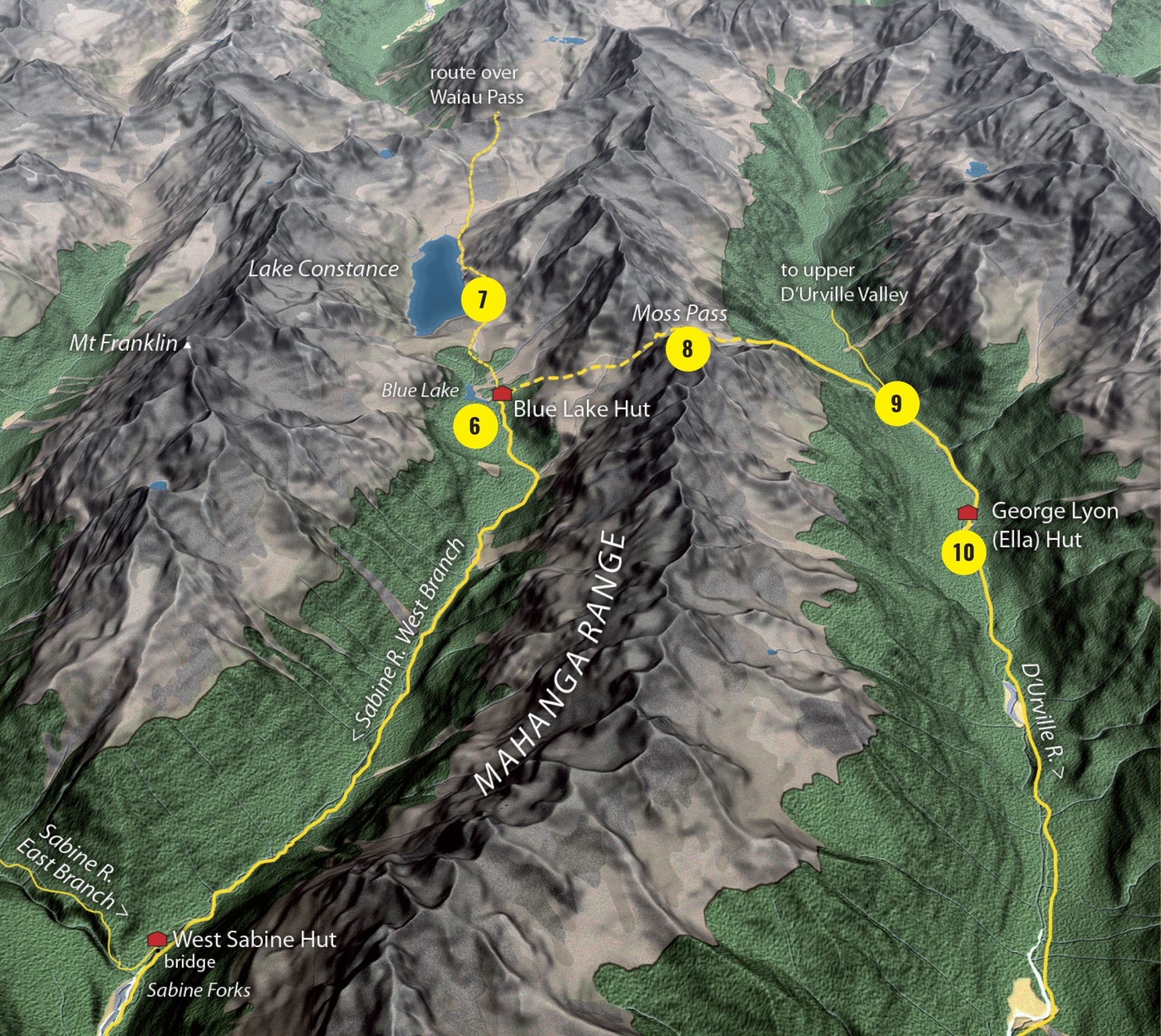
6. Blue Lake
One of the highlights of the trip, Blue Lake’s luminous blue waters shimmer beneath the steep flanks of Franklin Ridge and Mt Franklin, 2340m, the highest summit in the park. The lake is reputed to be the most optically pure in the world.
7. Lake Constance
Sombre Lake Constance fills a large trough beneath Waiau Pass and is certainly worth the two hour return excursion up the moraine wall from Blue Lake Hut to view its deep, clear waters.
8. Moss Pass
Moss Pass, 1785m, straddles the Mahanga Range just 600m above Blue Lake and in good conditions it can be reached in about two hours. There is a steep, rocky couloir to ascend just before the top. This can sometimes be snow-filled.
From the pass, it is a long 4-5hr descent to the floor of the D’Urville, so don’t underestimate the time it takes to get down the western side after the relatively short scramble up from Blue Lake. The track is well poled and marked and has great views above the bushline.
9. D’Urville Valley
Deep, long and beautiful, the D’Urville rises in the Spenser Mountains before draining into the head of Lake Rotoroa. Heavily-forested and with only short gorges, it also has many pleasant grassy flats below George Lyon Hut.
10. George Lyon Hut
This 16-bunk mid-valley hut is where most parties stay before or after crossing the pass and is set on a small flat about an hour downstream from the D’Urville River footbridge.
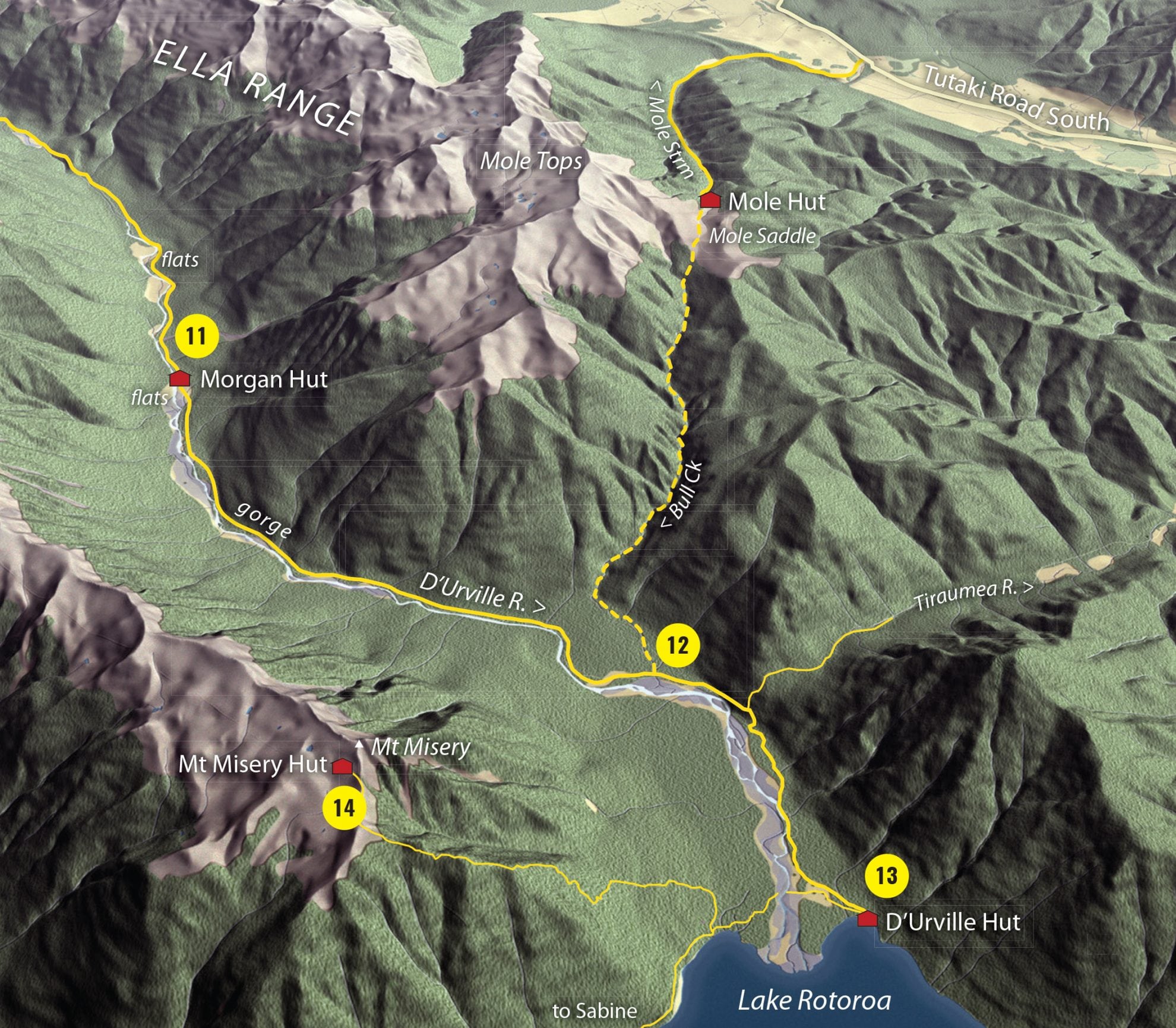
11. Morgan Hut and flats
Morgan Hut has a great setting on a large grassy terrace away from the river and is very peaceful with an outlook over the lower valley and Mahanga Range.
12. Mole Saddle-Tiraumea Track
The Track to Mole Hut provides another route in or out of the D’Urville Valley. NOTE: Though the map above shows the route heading up Bull Creek, this route is no longer passable. Trampers should take the Tiraumea Track to Tiraumea Hut and then take the Mole Saddle-Tiraumea Track on to Mole Hut.
13. D’Urville Hut
With its memorable lakeside setting and boat jetty, from which you could fish, D’Urville Hut is a peaceful place to spend a night and enjoy the early morning, or late evening light across the lakehead and Travers Range.
14. Mt Misery Hut side trip
If you have a day or two extra, a side trip to Mt Misery and its bivvy, perched at 1500m, is a rewarding excursion offering fantastic views over Lake Rotoroa, the Mahanga and Travers ranges and Buller Valley.



