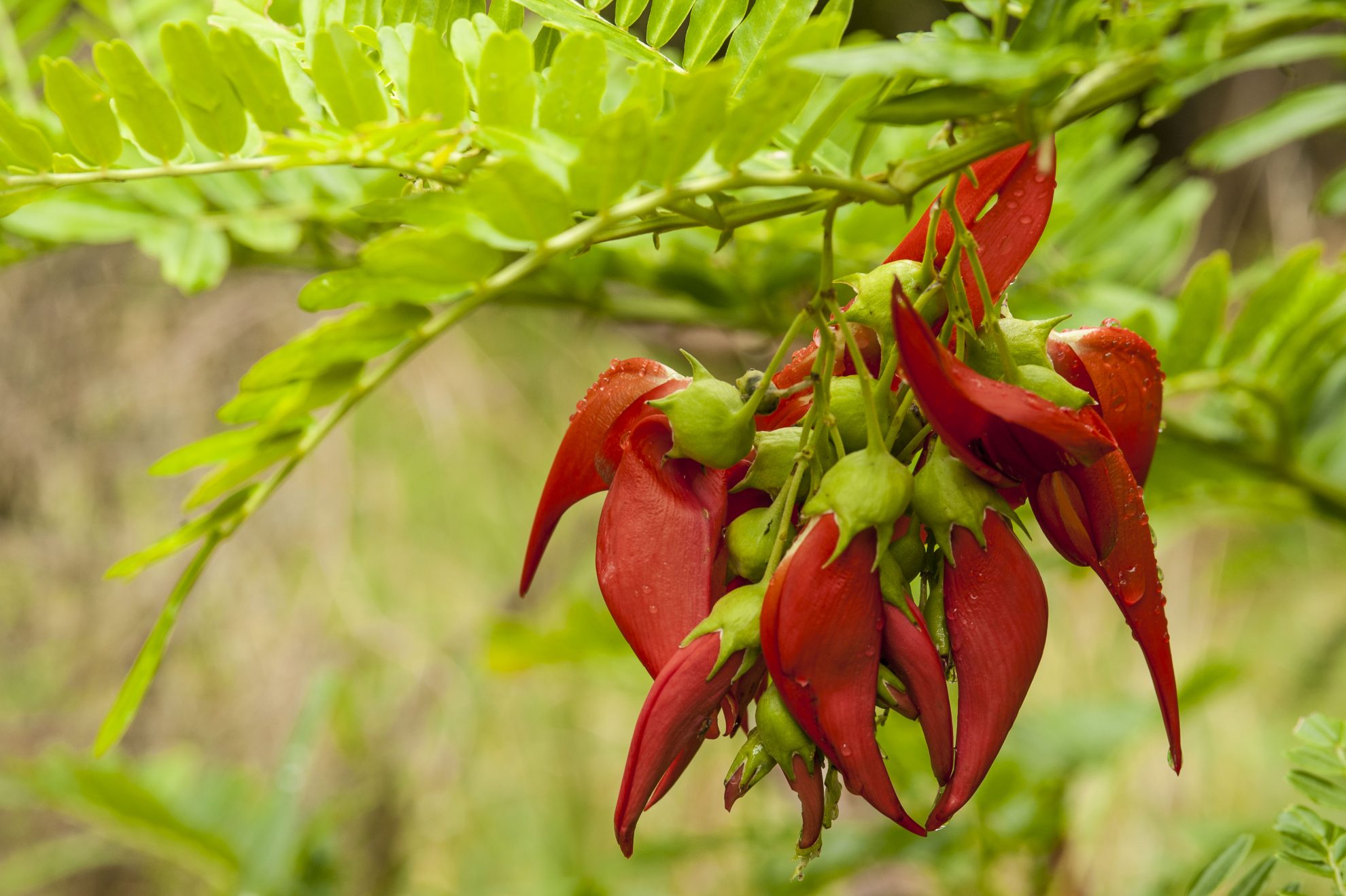
You probably won’t have noticed kakabeak unless you’ve seen it in flower. Only then does the small, green, shrub live up to its name, with its bright red or white flowers, the size and shape of a kaka’s beak. Even if you have noticed this plant, that’s probably been in a domestic garden, rather than in the wild, because it’s critically endangered.
Maori know the plant as kowhai ngutukaka, and in the past ate its seedpods. Its easily transported small black seeds meant the plant was often traded around the country, so its original natural distribution remains uncertain. But it once grew in Northland, Auckland, Great Barrier Island, Coromandel, around Lake Waikaremoana, the East Cape and Hawke’s Bay, and still survives in a few of these areas.
Unfortunately, the endemic shrub has proved highly palatable to introduced browsers such as deer, goat and possum, and it now remains in the wild only where these pests are kept in check.
A plant that loves light, kakabeak grows in the open, on outcrops, old slips, around the base of cliffs or beside lakes and streams. The two species are Clianthus maximus (which reached as low as 150 wild plants in 2005), and Clianthus puniceas – the latter of which survives in the wild at only one place – Moturemu Island, in Kaipara Harbour.
There’s hope for the plant though, with several conservation efforts underway. One involved school children from Tutira School in Hawke’s Bay, who have grown kakabeak seedlings and replanted them in their local area. Tolaga Bay and Hicks Bay school children and local iwi have also planted the shrub along SH35.
Visit these sites in the spring, when the plant’s flowers add colour and interest to the surrounding forest.

1-Boundary Stream, Hawke’s Bay
Boundary Stream is one of the most significant forest remnants in Hawke’s Bay, and the site of intense predator control efforts over the last two decades. One of the most pleasant walks in the area is the track to Shine Falls (58m), Hawke’s Bay’s highest waterfall. Beginning from Heays Access Road, it follows marker poles across farmland beneath limestone cliffs before entering the forest above Boundary Stream. Watch for kakabeak on the first part of the track. A return trip to the falls takes about 90 minutes.
2- Lake Waikaremoana, Te Urewera
The well-known Lake Waikaremoana Great Walk begins at Onepoto, near the site of the redoubt once used to house military during the hunt for great Maori warrior Te Kooti. Near the start of the track, DOC staff and a local hapu have fenced off a nursery area for kakabeak and these plants provide a source for replanting the rare shrub back into other parts of Te Urewera.
3- Otari-Wilton’s Bush, Wellington
Wilton’s Bush is famous for its diverse collection of native plants, and its range of walking tracks, including some suitable for wheelchairs. Longer walks are possible in the larger reserve beyond. It’s a place to not only see kakabeak and other rare native plants, but also enjoy good birdlife, thanks to predator control efforts.