

Te Reo terms explained
Iwi – tribe
Kaitiaki – guardian
Kaitiakitanga – guardianship
Manuhiri – visitors
Rohe – tribal region
Te Kawa o Te Urewera – Te Urewera management plan.
Te Kura Whare – Tūhoe HQ at Taneatua
Te Kura Whenua – Waikaremoana tribal office at Lake Waikaremoana
Tūhoe – Iwi of Te Urewera/Waikaremoana
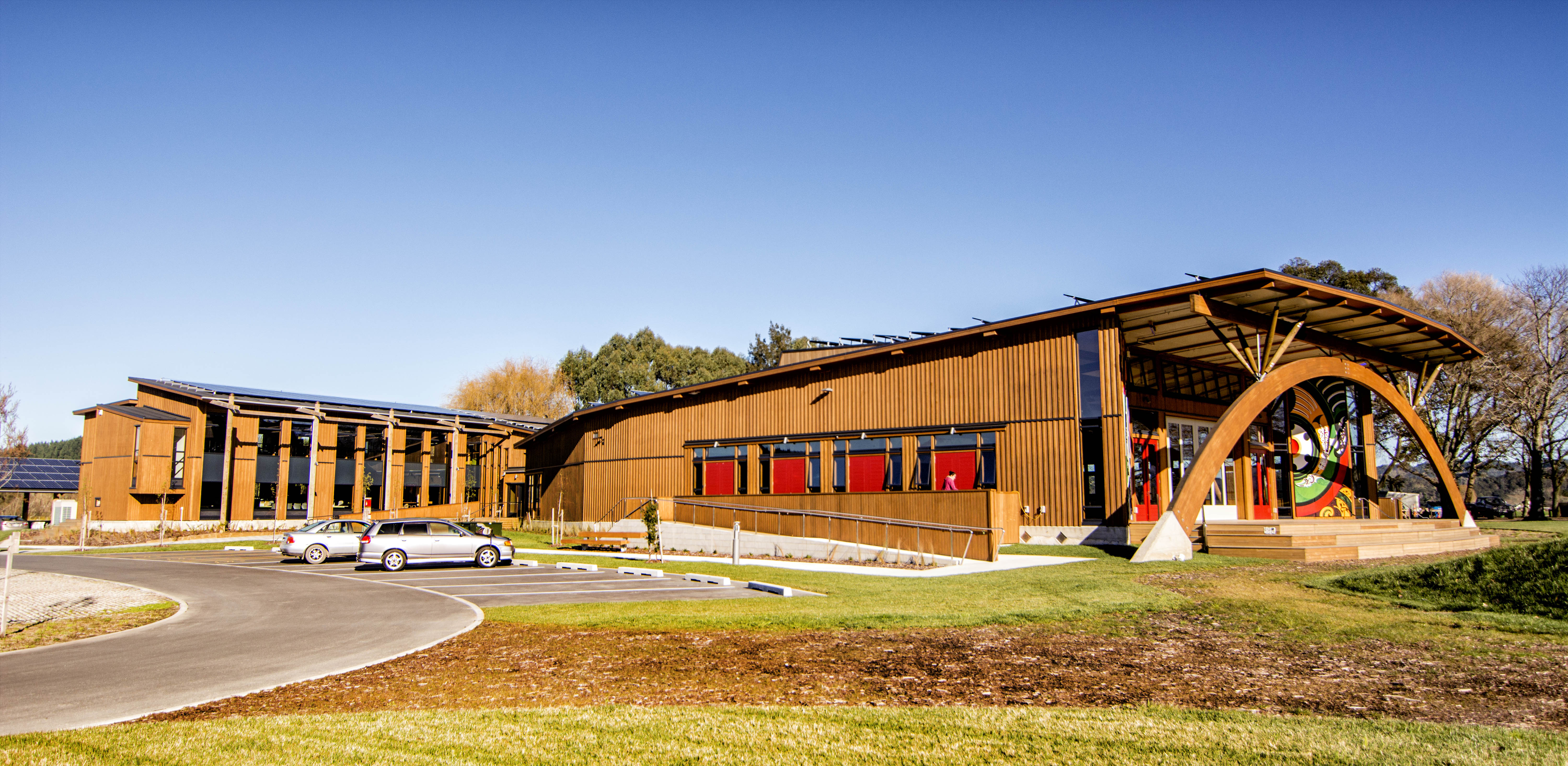
The building at Tāneatua, Te Kura Whare, generates renewable energy and collects and treats its own drinking water and greywater.
Opened in 2014, it was built by a team of around 60 locally-employed builders and 80 volunteers. Wood for the cladding was sourced from dead or fallen trees within Te Urewera.
Mud for the bricks came from nearby rivers. Soon, the grounds will feature extensive food gardens and an orchard.
The striking black tribal office set amongst the wetlands at Lake Waikaremoana, Te Kura Whenua, is another example within the tribal office network. Ruatāhuna’s Te Kura Tanata is another.
Yet despite this progress, laments Kruger, there’s still a lot of work to do.
It’s Thursday lunchtime.
I’ve driven from Wellington to Tāneatua to meet Kruger, Luke and operations manager Here Titoko to discuss their plans for Lake Waikaremoana.
Data shows more tourists than ever before are visiting the remote North Island walking track, with more than 18,000 hut bed bookings in 2017/18, up from around 13,500 in 2010/11.
That data, Titoko says, doesn’t account for the boaties, hunters, fishers and freedom campers who frequent the lake all year round. Double that number again and you’re in the ballpark, she says.
Joined by communications manager Te Ori Paki, we’re gathered in a small meeting room to reflect on both the increasing number of visitors, as well as the rising number of visitor complaints.
In my hand, I have an email to Wilderness outlining concerns about unclean huts and facilities and the unfavourable impression it left with international visitors.
Another email to Wilderness cites too few hut wardens on the Great Walk. Another notes repairs left wanting – a dodgy kitchen tap and toilets closed for maintenance. Weeds, pests, water taxi delays and sections of track closed are other concerns listed in emails.
Titoko says her office has a pile of similar complaints, many of which she received after the September 2018 storm that caused temporary and partial track closures for around six months.
The last water taxi operator calling it quits, creating delays on the water, generated a few more.
Kruger, Luke, Titoko and Paki say they’re all too aware of the disruptions and tramper concerns.
In truth, they’ve wanted to address all complaints immediately and head-on, but they’ve been distracted by other more pressing priorities such as caring for their people, managing the handover from DOC and setting a new direction for Waikaremoana.
“We admit we’ve not always been good at follow up or communicating where we’re at to outsiders,” Kruger says. “Largely, that’s because we’ve been busy concentrating on reestablishing our own connection to Te Urewera.
“We understand that for many people, the DOC system is what they know. We also know that for those same people Tūhoe has been invisible for the past 60 to 70 years while DOC has enjoyed their position at Waikaremoana at the exclusion of Tūhoe. Sure, we might’ve played a role in track cutting, as seasonal contractors and so on. We’re aware there’s probably an expectation the last five years would simply be an extension of what people have always known of the DOC scheme, but just with brown people doing it. But that’s not actually the case.”
In fact, says Kruger, Tūhoe are doing things very differently.
Te Urewera’s new direction is perhaps best articulated in a management plan called Te Kawa o Te Urewera published in September 2017.
The 66-page document explains Te Urewera, the principles that govern it, the roles, relationships and responsibilities people play in its care and the place of Tūhoe and manuhiri in relation to Te Urewera.
Right now, Tūhoe are using Te Kawa to set annual priorities, plan and develop formal “friendship” relationships with groups such as the New Zealand Fish and Game Council and local and regional councils.
But Kruger cautions Te Kawa doesn’t work the same way as other management plans by setting rules and listing stock.
“That traditional approach can frame nature as a set of discrete resources to be managed and used,” he says. “Te Kawa is different. It asks us to stop and reflect on Te Urewera and what that means as a living system that we depend on for survival, culture, recreation, and inspiration. Te Urewera has its own identity that is legal, but also physical, environmental, cultural and spiritual.
“Te Kawa sets out a vision for bringing all New Zealanders, including Tūhoe, into a closer relationship with Te Urewera, rather than setting out how to manage the land itself.”
Luke adds: “Our message to visitors is to be patient with us. We do have plans for Waikaremoana. But we also need time to rebuild, to gather our stories and revive our connection. We’re a bit out of practise. We need some time to work it through.”
In October, Tūhoe hosted its second stakeholder summit at Waikaremoana to establish formal friendships with groups who want to fish, boat and hunt in Te Urewera on an ongoing basis.
The purpose of the summit was to discuss replacing the former DOC concession regime with Tūhoe’s new friendship system and begin to introduce people to Te Kawa and Tūhoe’s vision for Te Urewera.
For example, the iwi plans to completely redesign the Lake Waikaremoana Great Walk to reflect Tūhoe stories and culture.
They’re also keen to replace the current stock of DOC huts with new huts styled on the architecturally-designed, eco-buildings seen at Tāneatua and throughout the rohe.
But Kruger and Luke say it’ll probably take at least another five years before the changes are bedded in and made clear to visitors.
In the meantime, then, where does that leave the public? And what is their advice for visitors to Waikaremoana and Te Urewera?
“My advice is to keep coming,” says Kruger. “But be prepared to do things differently and to think a bit differently about the place. Do your homework. Maybe find out a bit about us before you come. Learn who Tūhoe are, our history, our connection to Te Urewera.
“Try thinking about Te Urewera in different terms. Perhaps reflect less on the cleanliness of the toilets, for example, and more about what you can learn about this place by coming here.
Maybe use different measures to evaluate your experience in this part of the world. For example, have you learned a bit more about its history by walking the lake? Did you meet some locals on your journey here? Did you get to know some of our stories – or some of the values and principles that make up the lifestyle of the people here?”
Luke says visitors irked by things left undone are welcome to muck in to put them right.
“As Tūhoe, we don’t own Te Urewera,” she says. “We want people to know they don’t need our permission to have a relationship with Te Urewera. They can do that all by themselves. But as kaitiaki, we’re happy to suggest ways to help out. That’s why we’re now saying to people, hikers, visitors, manuhiri and the many people who love Te Urewera: ‘If you see a hut that needs sweeping, rubbish that needs picking up, then get stuck in. If it’s something more, and you have the skills and the tools to do it safely, then get stuck in’.
“We believe it strengthens your experience of the place. It moves you beyond a way of thinking that says: ‘I’ve paid my fee, I want a service’, to a way of thinking that says: ‘I love this place, I feel a connection to it, now, what can I do to look after it?’.”
According to Titoko, who manages three team leaders and eight field staff, the upcoming summer season at Lake Waikaremoana is on target to be the best so far.
She has a skilled, confident team in place working hard to fix the issues of previous years while continuing to prioritise health and safety and contribute to the visitor experience.
She plans to be out and about more this summer and welcomes the chance to talk to manuhiri about Te Urewera and Tūhoe’s future plans.
“Definitely drop in to Te Kura Whenua if you want to know more about Te Kawa or the walk itself,” she says.
“Personally, I think it’s always better to sit down with someone and talk over a cup of tea than to read a website or fire out an email to find out what’s going on.”
Keen to muck in at Waikaremoana?
Manuhiri keen to muck in at Waikaremoana are welcome to email operations manager Here Titoko with ideas or to ask what needs doing over the summer: here@ngaituhoe.iwi.nz.



