The kaka is a good flier but is still rare in native forests
Your ears are usually the best way to locate a kaka. They emit a harsh, rhythmic ‘ka-aa’ when flying above the forest canopy and a harsh, grating ‘kraak’ call when disturbed. You might also hear one of a variety of loud, musical whistles, or the sound of wood or seed fragments dropped by the bird as it forages.
Kaka are rare-to-uncommon in native forests throughout the three main islands. However, they benefit greatly in areas where intensive predator control has been implemented such as Nelson Lakes and several predator-free islands like Kapiti and Little Barrier.
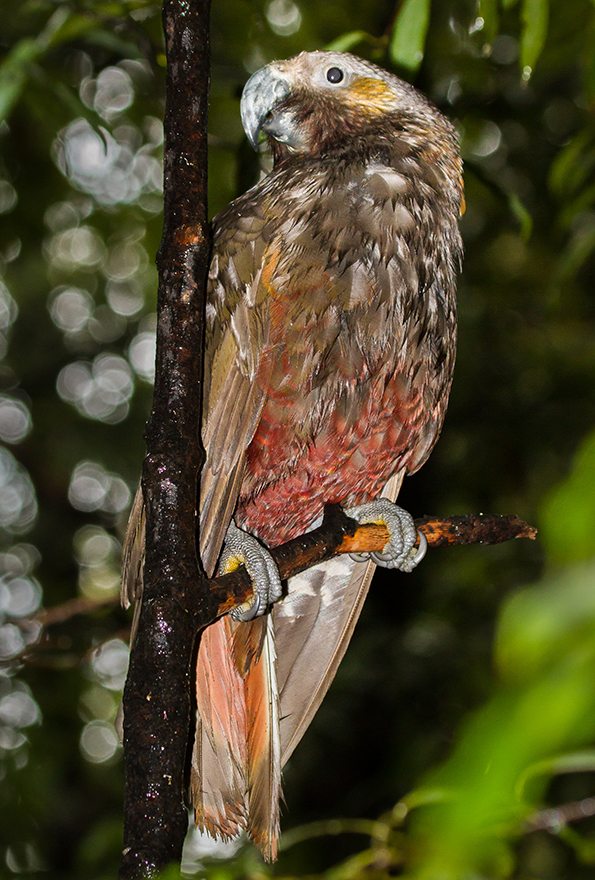
Kaka are of similar build to the kea but slightly smaller at around 45cm and 450g. Generally olive-brown with a grey-white crown, one of their most striking physical features is the bright red-orange under wing. The belly and under tail feathers are a deep crimson colour. Differentiation between sexes can be made by looking at the head and beak – males have a noticeably longer and deeper upper beak and bigger head than females.
Breeding takes place over spring and summer, and occasionally second broods can extend into winter. Nests are usually in tree cavities over 5m above the ground and lined with small wood chips where four eggs are incubated over 15 days by the female. The male feeds the female throughout the season.
The kaka’s diet has huge variety. They will consume seeds, nectar, fruit, sap and honeydew along with a range of invertebrates with a special preference for wood-boring grubs such as huhu. With their powerful beaks and dexterous claws, they can rip apart bark and wood with ease.
Kaka also have a fairly unique use for their bill – by using it as a ‘third leg’, they are able to scale tree trunks and branches with incredible ease.
They are adept fliers, capable of weaving through trunks and branches at surprising speed and can cover long distances, including over water. Radio-tracking and banding studies show that the kaka of the Hen and Chickens, Little Barrier and Great Barrier Islands are effectively one population, even though these islands are separated by as much as 25km of open water.
– Matt Winter is a Marlborough-based nature photographer
An ethical guide to visiting the Muriwai gannet colony
Trending Now
Green Point Hut, Gamack Conservation Area
The possibilities of packrafting
Every Tararua hut reviewed and ranked
The Tararua’s forgotten traverse
Leaning Lodge, Rock and Pillar Conservation Area
Subscribe!
Each issue of Wilderness celebrates Aotearoa’s great outdoors — written and photographed with care, not algorithms.Subscribe and help keep our wild stories alive.