The European Commission considers the textile industry has the fourth largest impact on the environment and climate change after food, housing and transport industries, and it is the fifth highest for greenhouse gas emissions.
Such statistics pose a conundrum for recreationalists and outdoor brands. It’s for this reason that many outdoor gear manufacturers are exploring ways to make gear more environmentally friendly and sustainable. “There is a lot of interesting work in this space … the goalposts are always moving as we learn more about the impacts of fibre production, chemical use and end-of-life solutions,” says Davidson, who notes that Macpac is working with fabric partners such as Polartec, Pertex and PrimaLoft, who are innovating in this space. “My sense is that brands and consumers are taking this seriously, and we’ll start to see change at an increasing pace, especially when it is backed up by legislation.”
A major kick up the backside came from a study commissioned by Patagonia in 2015. The company wanted to know how microfibre from its fleeces was affecting the world’s waterways. The results weren’t pretty.
The study was done by the Bren School of Environmental Science and Management at the University of California, Santa Barbara. It found that a single fleece jacket, when washed, shed about 250,000 synthetic fibres. The company did the maths: if an estimated 100,000 Patagonia fleeces were washed each year, the amount of synthetic fibres ending up in waterways and oceans was equivalent to the amount of plastic in around 11,900 shopping bags.
Patagonia is improving its fabric construction in an effort to minimise shedding, and a second coordinated study with North Carolina State University is investigating the characteristics of fibres that lead to microfibre shedding. Other companies including Macpac, Vaude, The North Face, Equip, Marmot, Montane and Patagonia are signatories to the Microfibre Consortium Roadmap, which is a global commitment to achieve zero impact by 2030 to the natural environment from fragmentation of textile fibres. The companies contribute test data on fabrics to a central hub, to help better understand microfibre shedding and its root causes.
And, there’s a lot of research and development going on. Polartec, which invented the modern synthetic fleece in 1981, has developed a method that reduces microfibre shedding during washing by encasing the fibrous material within a durable fabric bubble-wrap ‘capsule’. The company claims its Polartec Power Air fabric sheds five times less microfibre than do traditional fleeces.

Meanwhile, the Polartec Shed Less Fleece, launched in 2023, is an update to its iconic 200 Series fleece. “This technology is a proprietary, multi-step process that combines yarn construction, knitting, chemistry and manufacturing methods that retains all the warmth, comfort, breathability and durability of the original but now sheds an average 85 per cent fewer fibre fragments,” Karen Beattie, director of product management at Polartec, told Wilderness.
But microfibre’s not the only problem. The need for outdoor gear to be water repellent and waterproof also poses an environmental challenge due to the harmful perfluorinated chemicals (PFCs), known as ‘forever chemicals’, traditionally used in the process. PFCs can leach into and accumulate in the environment during product manufacture, when clothing is worn and washed, and when items go to landfill.
In 2016 Greenpeace tested 40 outdoor products by leading brands, including bags, jackets, trousers and tents. Of those, 36 contained PFCs and 18 contained the more harmful long-chain PFCs. Greenpeace challenged outdoor brands to phase the chemicals out, claiming that the four PFC-free products showed it could be done. Many brands have since taken up this challenge.
Gore, for one, has developed its PFC-free alternative ePE waterproof membrane, otherwise known as expanded polyethylene. While polyethylene is still a plastic (the type often found in plastic bags and packaging), it contains no fluorinated materials and has microscopic holes that are smaller than raindrops so water is repelled, but which are large enough for moisture vapour to pass through so the fabric breathes.
Other firms are also looking at environmentally friendly and biodegradable alternatives. Swiss start-up Beyond Surface Technologies employs a form of plant-based chemicals – the firm calls it ‘green chemistry’ – to replace PFC coatings. Using seed oil, plant wax and microalgae oil instead of PFCs, the alternative is a product with moisture-wicking and water-repellency features, which has caught the attention of brands including Patagonia and The North Face.
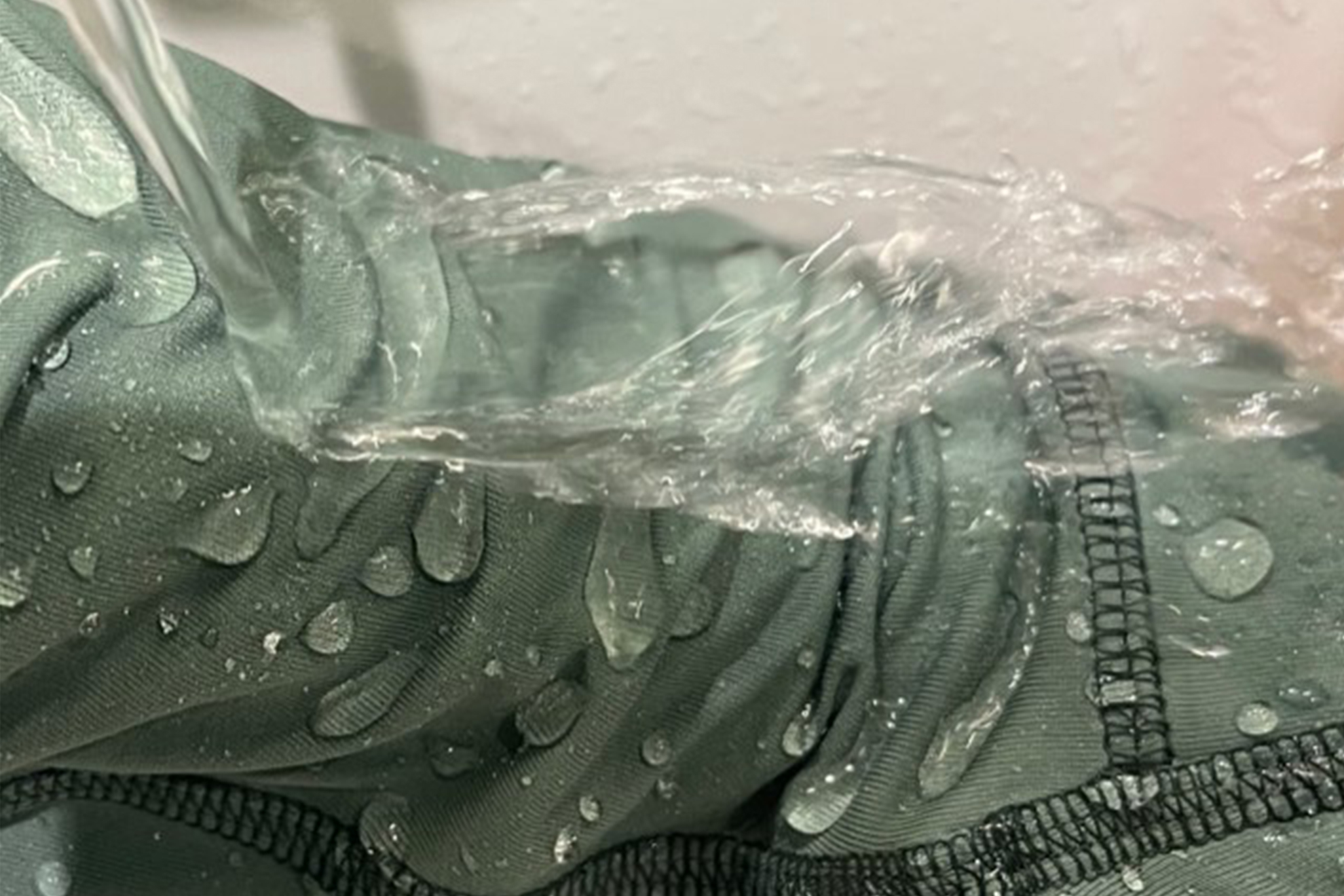
And then there is EMPEL, a new waterproofing method developed by Green Theme Technologies (GTT), which is being adopted by Marmot, Black Diamond, Nike, Gore and Kiwi brand Stoney Creek. Traditional PFC-waterproofing generally requires the treatment to be washed into the fabric with water, but EMPEL requires no water or chemicals, instead a nature-based hydrocarbon solution is employed that uses a dry-curing technique to bond the treatment to each fibre in the fabric. Common industry water repellency tests show EMPEL to outperform PFC-treated products.
“Our science is straightforward polymer science,” explains Martin Flora, co-founder and president of global business development at GTT. “EMPEL is a molecular glue that adheres high performance and environmentally safe chemistries to textiles without the use of water. Once bonded to the fibres of a material, the polymers do not come off. Water-based manufacturing creates massive amounts of water pollution, so using safe chemistry in addition to the water-free process creates a long-term solution to remove pollution from the textile industry.”
Another industry shift is the increased use of recycled content in garments. PrimaLoft, for instance, which offers a synthetic down alternative, claims it salvaged more than 84.7 million plastic bottles from landfills over a three-year period to manufacture PrimaLoft fibres. And Beattie says Polartec has manufactured recycled fleeces and fabrics for over 30 years, converting more than two billion single-use PET bottles.
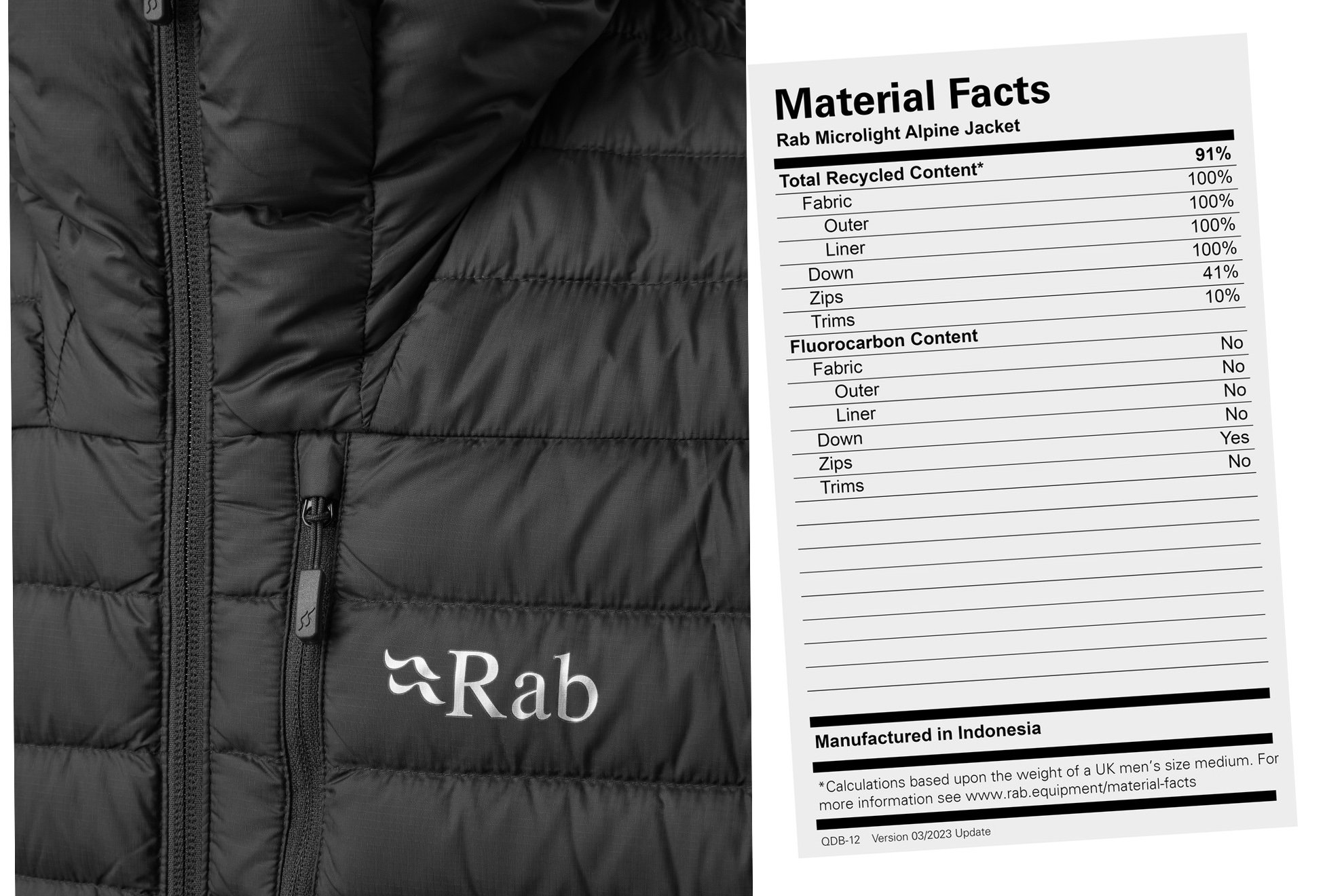
Meanwhile, Rab and Lowe Alpine, under parent company Equip, have also expanded the amount of recycled materials used to make clothes. The company claims that, in 2022, 63 per cent of all fabrics used by Rab were recycled. The brand has also introduced the Material Facts table. This shows the amount of recycled content in the garment, splitting it by fabric type and an item’s total percentage weight, while also listing fluorocarbon content by component.
“Material Facts is a monumentally important step towards transparency in the outdoor industry,” says Eric Henderson, spokesperson for Equip. “Now consumers can make a choice to purchase and use products where they can clearly view and understand the materials, processes and components – all of the ‘ingredients’, if you will – that go into making the product.”
Equip is encouraging other brands to adopt Material Facts so that information on transparency and sustainability can be exposed in a non-branded way across the industry. This process could also address claims of greenwashing. “Consumers will be able to differentiate easily between which products are made using sustainable methods and materials and which are not, and can put their purchasing power behind companies that are actually following sustainable practices, rather than merely claiming to,” Henderson says. “This trend will make more companies invest in sustainable practices and (it) will radiate out across the outdoor industry.”
There’s little doubt that many outdoor brands desire to introduce more sustainable and environmentally friendly fabrics, but questions remain around durability and performance, two gear aspects important for outdoor consumers. Colleen Ahalt-Eagle, sustainable textiles consultant and former textile development educator at Auckland University of Technology and former textile technologist at Kathmandu, says brands are in a tough spot.
“I have gone into outdoor stores globally and asked the retail staff: ‘What are the first things people look for when purchasing clothing and gear?’ And it’s usually about performance, colour and cost. I’m always surprised by this. The brands are in a tough spot: if they market environmental aspects of a product too much, the product doesn’t get the same trust from the consumers to do the job they need.”
Davidson agrees. “Our customers are looking for real performance from their gear, and the technological advances over the past 50 years have meant that expectations are very high.” Balancing that with the need to eliminate climate risks is a juggling act, he says, pointing to Macpac’s PFC-free water-repellent coatings as a case in point. “We aim to be mostly PFC-free for water-repellent coatings by our winter 2024 season. But at this stage, PFC-free does come with a requirement for extra garment care, so we will be working proactively with our customers to manage that.”
Henderson says it’s about striking the right balance. “Ideally, a next-generation fabric for the outdoors space will have exemplary qualities for its use, like breathability or waterproofing or heat retention, and be durable enough to last the wearer for many years. That ideal fabric would also require a miniscule or perhaps even net-zero carbon footprint to produce and it could be recycled easily into other fabrics once it is no longer usable.” It’s not impossible to have textiles that tick both boxes, he says, and Rab, for one, is working to improve both aspects for future gear.
Beattie notes the ‘either/or image’ is one the industry is working to shrug off, and believes textiles can be sustainable while retaining performance and durability. If anything, Beattie believes durability is part of being sustainable. “This sustainability shift will involve a comprehensive transformation away from the wasteful practices of the past, where garments were discarded after minimal use. Instead, the focus will be on designing products that are durable, repairable and recyclable.”
So, does this mean an end to synthetic fabrics?
Not yet, says Henderson. “Synthetic fabrics will continue to be used. At this point, there are no purely organic materials that can totally replicate some of the traits of synthetics that are used for technical outdoor applications, combining that sweet spot of waterproofness, light weight and durability.” That said, Henderson believes companies are attempting to make synthetic fabrics as environmentally friendly and sustainable as possible. “This is an effort that sees more progress every year.”
Ahalt-Eagle would like to see less production from virgin sources and less water and total power used in textile production, but the reality is we aren’t there yet. “I expect there will be continued ‘as is’ production,” she says, “but, while more could always be done, many great things are happening in the industry that are also great for our environment.”
Ultimately, it’s everyone’s responsibility – both brands and consumers – to do their part, she says. After all, the greatest risk lies in there being no great outdoors for any of us to enjoy.