More New Zealanders are choosing a guided option on the Great Walks. Are we getting softer, older or what? And can guide companies guarantee hut bookings?
One night in Perry Saddle Hut while we fiddled with our dehy kai, another group whipped up an amazing paella in a huge wok. Damn, it looked good. Earlier, we’d laughed as a woman looking for the hut shower threw a wee tantrum when we pointed out the track to the swimming hole and told her: that’s it. But when we saw her digging into that wok crammed with shrimps, chorizo, chicken and rice, carried in and assembled by her guides, she definitely had the last laugh.
In Moonlight Hut last summer, Grant Porter happily tucked into a steak and salad dinner followed by dessert, then woke up to porridge and pancakes for breakfast. Porter loves tramping but after a serious motorbike accident he can’t carry much. He joined a guided walk across the Paparoa Track so he didn’t have to lug in food.
Covid-19 was a turning point for the Great Walks. New Zealanders who normally holidayed overseas stayed onshore, and some went tramping. Many first timers opted for the Great Walks, looking for high-quality tracks, a guaranteed bunk and the presence of hut wardens. Others were less confident, and this is when the growth of New Zealanders going guided on Great Walks really kicked off.

Our ageing population is also a factor, says Ed Cochrane from Paparoa Guided Walks. “Most of our clients are Kiwi,” he says. “The majority are aged from 50 to 70.”
Many are seasoned trampers “and are now looking to make their experience even more enjoyable, with fresh three-course meals and a significantly lightened pack”.
Maggie Seeman agrees. Her company, Bush and Beyond, guides trips in Kahurangi National Park. including on the Heaphy Track. “Our older clientele are often strong trampers, but they just don’t want to carry weight anymore,” she says. “Our younger clients are softer; they’ve never been tramping and they want the reassurance of guides in the backcountry.”
Phil Collins of Canoe Safaris, which operates on the ‘Whanganui Journey’ (part of the Great Walk system), has also noticed people are having outdoor adventures later in life and in family groups. “What appeals to them is that all the organisation is done for them,” he says. “They just need to turn up.”
Safety is also a factor, given the Whanganui Journey involves rapids, rocks and changing river levels. Fiona Mears and her friends, aged in their 50s and 60s, have walked most Great Walks and many other tracks together but chose to use a guide on the river. Explaining this decision, Mears says, “We like the independence of just being us, but although we are all good swimmers, none of us felt confident on the river. Canoe Safaris managed the entire five-day paddle for us. The guides provided clear directions and knew where to stop to teach us about local history. We would have just gone past otherwise.”
Local knowledge also helped Wellingtonians Grant and Bridget Porter on the Paparoa Track. “Ten days before our trip, a slip closed the section between Moonlight and Pororari,” Bridget says. “The company gave us the option of cancelling or walking out via another route. We chose the latter; then, as it transpired, the track was repaired in time. If we’d been on our own we would have pulled out.”
The catering is definitely a plus. Mears said the food on the river journey was far better than their usual dehy. “There were cooked and continental breakfasts, pre-dinner crackers and cheese, wine and beer. Steaks, meringues and all sorts of things came out of the chilly bins.”

Canoe Safaris can load chilly bins into their canoes on the Whanganui, but guides on the Paparoa and Heaphy tracks carry the bulk of supplies on their backs. “Our guides usually pack in 25kg to 30kg to begin with,” says Cochrane. “We are allowed storage bins under each hut for non-perishable goods and utensils. We resupply these with one or two helicopter flights a season to landings outside the national park, and by mountain bike with a small trailer to huts inside the park.”
With no helicopter deliveries permitted on the Heaphy Track, the ability to carry a big load is definitely a guide pre-requisite, says Seeman.
But what of the hut dynamics, when independent walkers watch the paying elite being fed and feted in such style?
“The reality is, we’re there for the same reason – to enjoy the beautiful backcountry – and we provide a service to guests who may not otherwise be able to manage tracks such as the Paparoa,” says Cochrane. After 130 trips, he says he can count on one hand the negative interactions his guides have had. “If anything, it’s the opposite: independent walkers look at our food not with envy but with amazement that something so extravagant can be prepared on a gas cooker. It gives them ideas for their own trips. Also, our guides often fill the role of hut warden, providing advice for everyone when there is no DOC warden available.”
His groups are small so don’t dominate in a hut, he adds.
They are small not only by design but also by necessity. Contrary to popular belief, there is no preferential booking system for guiding concessionaires sharing DOC huts and campsites. That is their biggest challenge, says Cochrane. “For the months leading up to bookings opening we take registrations of interest from walkers. We have their names, ages and nationalities ready to input and we try to lock in spaces when the hut bookings open online to the general public. The whole success of the business comes down to that 45-minute window, until bookings sell out.
“We would love to have at least the opportunity to submit pre-reservations to DOC to give us some business surety, but this is the system we work with and we understand it’s part of operating in a public space.”
The same system applies on the Heaphy, which Seeman says has now become so popular that booking even for a small group is a nightmare.
The system is unlikely to change, according to Cat Wilson, DOC director, heritage and visitors, who suggests guides look to operate on tracks other than the Great Walks. (Many already do.)
“While DOC acknowledges the fabulous service and value these guides provide, we work hard to provide a fair and balanced booking system,” Wilson says. “Limits were put on the Great Walks to protect these special tracks from being loved to death. To care for our outdoors, we need to encourage wider use of the recreation network.”
Guides could find “fabulous, hidden outdoor adventures” outside the Great Walks to suit the needs of most clients, she says. “This is something DOC welcomes to remove the pressure on our most popular spots.”
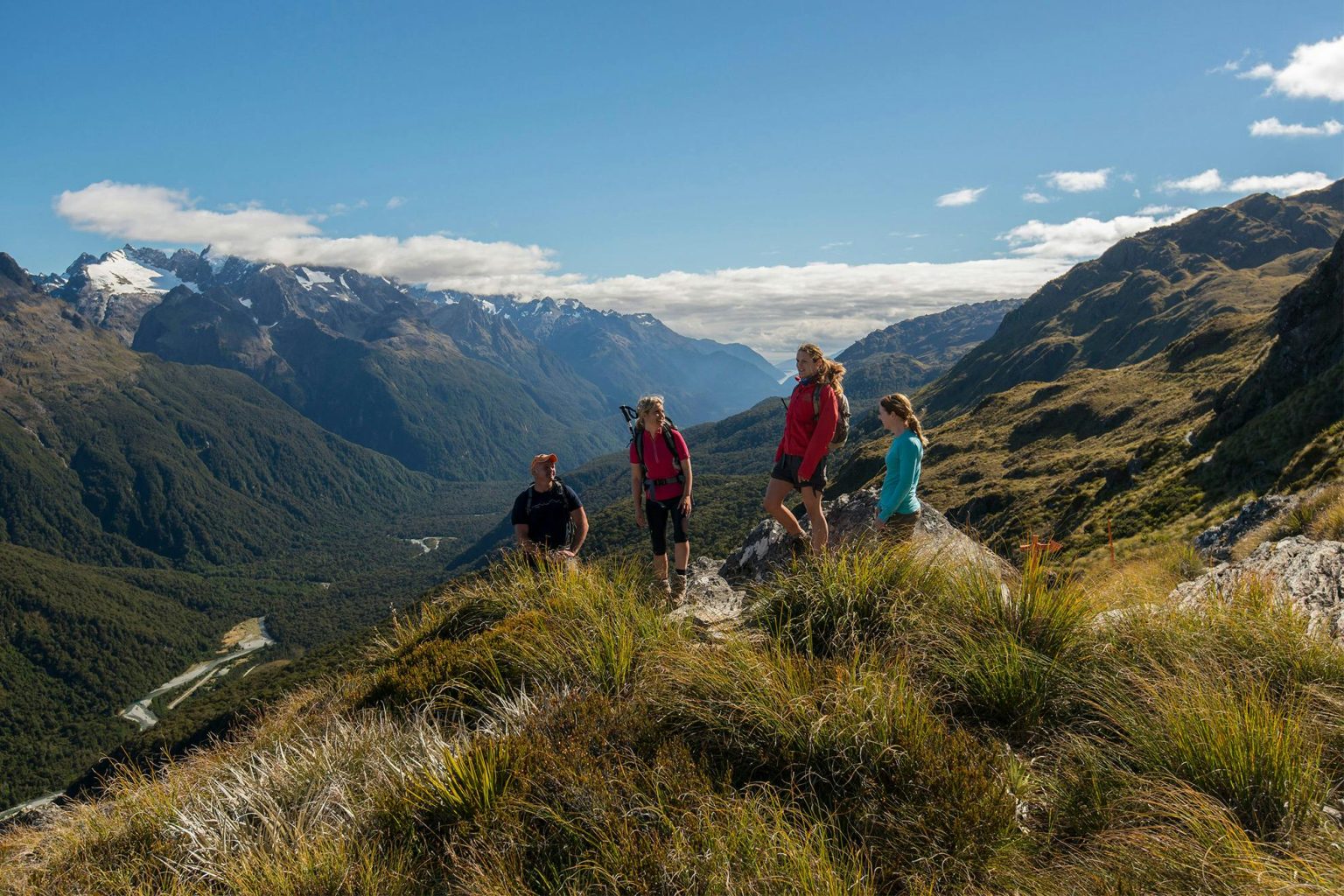
There’s no such issue on the Routeburn and Milford Tracks, where Ultimate Hikes has private lodges and manages its own bookings. Helicopter provisioning is also permitted. The lodges offer a higher level of comfort than DOC huts, with a mix of private, ensuite rooms and shared rooms, hot showers, drying rooms, restaurant-style food and a bar service. “For a lot of people, I think it’s the difference between staying in a hotel versus a hostel,” says Ultimate Hikes guide manager, Daile Foreman. “They want the wilderness experience, and they also want their own space, a hot shower and a proper bed.”

Kiwi momentum created during the Covid period has continued, she says. “Although we’ve returned to a largely international demographic, the Kiwi presence is stronger than it was, as many Kiwis have kept coming back and bring friends and whānau.”
Age is definitely a factor, agrees Foreman. “Many Kiwi trampers are getting older and don’t want to carry a heavy pack or manage logistics. We also see multi-generational groups – families with young children, or adult children walking with parents. There are people who have never done an overnight walk before, and going guided feels safer and more accessible. We’re definitely seeing more younger guests in the 30 to 39 age group; they’re often time-poor, working hard and looking for something purposeful. There’s also a rise in group bookings, particularly women’s groups. Whether they’re friends, workmates or fitness groups, more women are choosing to do these walks as a shared wellbeing experience.”
Whether sharing DOC huts and campsites or opting for the private ensuite experience, guests and guides all agree it’s the guides who make a difference.
Lavina Edwin says her Ultimate Hikes’ guides were excellent: “They left you alone if you wanted but if you were interested, they’d tell you about all sorts of things. Ours was really good at giving us information without making it sound like a lecture. We did all the little side trips they suggested and they were really worth it.”

Bridget Porter learned about the medicinal properties of native plants from her Paparoa Track guide. “She also had extensive knowledge of the geology, and pointed out fossils that were once part of the seabed. On our own, we would have missed them.”
Heaphy Track guides share the stories of the history, flora and fauna, and because they are there all the time, they know where the birds are, says Seeman. “When you do the walk by yourself, you can see that it’s lovely. Going guided gives you the why.”
The Heaphy is a healing track, she adds. “The high point for me as a guide is mentoring people as they face their fears, realise their challenges, defrag and grow, all in just over five days.”
The cost of a guided walk
Of course, going guided costs more. That comes with having everything done for you: bookings, transport, great food, comfort, security and specialist equipment.

Prices vary. Examples include: $1999 for three nights on the Paparoa (return transport from/to Greymouth), $2200 for four nights on the Heaphy and a night at Karamea (return transport from/to Nelson), $1195–$1595 for two to four nights on the Whanganui Journey (transport to/from Ohakune, canoes and tents), $2619 for two nights on the Routeburn in a private lodge with private ensuite room (transport from/to Queenstown), or $2829 for three nights on the Milford Track (private lodge and ensuite room, a night and cruise at Piopiotahi Milford Sound and transport from/to Queenstown).
The latter seems more akin to a high-end tourism product than traditional Kiwi tramping. Foreman says it reflects a change in New Zealand’s outdoor culture. “It’s really about access. If more people can connect with our natural places, in whatever way suits them best, then we’re doing something right.”
Franz Ombler has walked independently using DOC huts and with Ultimate Hikes. “There is something good about roughing it; having to look after yourself is a good experience. Going guided is a bit like travelling in business class: you tend to end up with older, richer people. One group walking with us hired a helicopter from Milford to avoid the bus trip back to Queenstown.” Regardless of any wealth factor, he adds, the dynamics and enjoyment always depend on the individuals in the group or hut.