

Nelson, late October. To my mind, this constitutes summer. And summer, obviously, involves relentlessly long, hot days; sweat trickling down calves; carrying a mandatory three-litres of water at all times; golden evenings fading into balmy nights. But huts? Why would we need huts?
“We’re taking tents,” I tell my sister. “Why don’t we just use those?”
Camping along the South Island section of the TA would give us flexibility, I thought; we’d feel properly remote in our high-tech gossamer-light tents in the middle of bloody nowhere. It would be great.
How little I knew about New Zealand tramping and about spring and summer on this strange collection of southern islands. Or rather, how much I’d forgotten.
My family arrived in New Zealand from South Africa before I started school, ushering in a proper South Island childhood: baking hot Christchurch summer days and freezing summer tramps, school camps spent under collapsing tarps in dripping beech forest, blazing sun followed by hazardous rains in Golden Bay. But I’d been abroad for close to a decade – in places with properly placid summers: Lebanon, South Africa, Spain, New York – before returning a couple of months before Covid-19 hit. I spent most of 2020 in Auckland, where I was happily sea-swimming until May. How cold, really, could this hike be?
Cut to our mid-October slog along the ridgeline approaching Mt Rintoul, rime ice glinting festively from tussock—fog slicked into frozen mohawks by the driving wind. Or to us hunkered down in Boundary Hut, in the Mavora Lakes, while a snowstorm raged in mid-December.
Oh, how I cherished the huts then. In the Richmond Range, where each new iteration of the same Forest Service design chimed like a beautiful chord of homecoming. In the tussocked reaches between the Rakaia and the Rangitata, where old tin musterers’ huts nestled into the gentle landscape, offering shelter from the fast-changing weather.
The only previous thru-hike I’d completed had been along the Spanish Pyrenees, from the Atlantic to the Mediterranean. That trail ascended high passes and was susceptible to summer thunderstorms. At one point, in Andorra, a surprise snowstorm hindered my progress, but I camped most nights and barely needed a rain jacket. Finding enough water to drink was (hilariously) a concern. After two days on the TA, once our perfect Pelorus Bridge starting weather had devolved into endless precipitation, I remembered that New Zealand’s spring and summer was a very different story.
“Weather just keeps things exciting, right?” said Bron, an adventurous mother of three who picked us up one day in the Ashburton Lakes (“Wanna skip to the interesting bit?” she asked, rolling down a window). And she was right, this was exciting. We compulsively checked our days-old MetVUW forecast, keeping an eye on river rise and freezing level. We took a double-pack-liner-and-multiple-ziplock approach, after an unfortunate soaking in the Richmond Range, which transformed the trail into a knee-high river and seeped into our gear.
Even with all our planning, the weather still surprised us. The high-speed mist and rime-ice fantasyland approaching Mt Rintoul miraculously gave way to brisk blue skies as we neared our high point. Over Martha’s Saddle, in the section between Ohau and Hāwea, we had sticky sunshine, necessitating a skinny-dip in the beech-shadowed plunge pools opposite Top Timaru Hut. The next day, we walked through a bone-chilling downpour as snow fell to low levels.
With the challenges of spring, though, came unexpected delights. White sprays of native clematis spangle the beech firmament, perfuming the damp air of the forest. Walking down the Harper River, we realise – with shock – that the delicate, sweet scent on the breeze is matagouri blossoms. In the Canterbury high country, we dodge through forests of Spaniards, their magnificent yellow flowers towering to head-height and thrumming with insect life. Edging around Hokakura Lake Sumner, we’re dive-bombed by nesting kārearea, their yellow talons outstretched, siren calls bouncing from trees.
Zoom in: the trail, if you look carefully, is laced with remarkable fungi – hot pink, brilliant orange, bubblegum purple. Zoom out: see the landscape transform daily as complex weather systems sweep through. Thick snow on Anne Saddle; high winds buffeting the narrow ridge that plunges to Hāwea from Breast Hill; a salting of hail over Stag Saddle (the trail’s highest point) gives way to buttery evening light. Charcoal clouds race across lilac skies as we prepare for bed, and we’re asleep before the stars are properly out, tucked up in huts we know will always have space because we’re some of the only lunatics on the trail.
We stay in big huts and small huts; huts with dirt floors and huts with flush toilets. I am amazed by the extensiveness of the hut system, by the fact that materials and manpower have been secured to build shelter in the most unlikely places, by the sheer scale of the wilderness under DOC’s mandate. As a kid, I took this accommodation for granted; as an adult, I can’t believe that in nearly two months of walking we use tents only three times. It is a relief to find a place to hide from the sandflies and the weather and to stretch rigid muscles after a hard day’s walking.
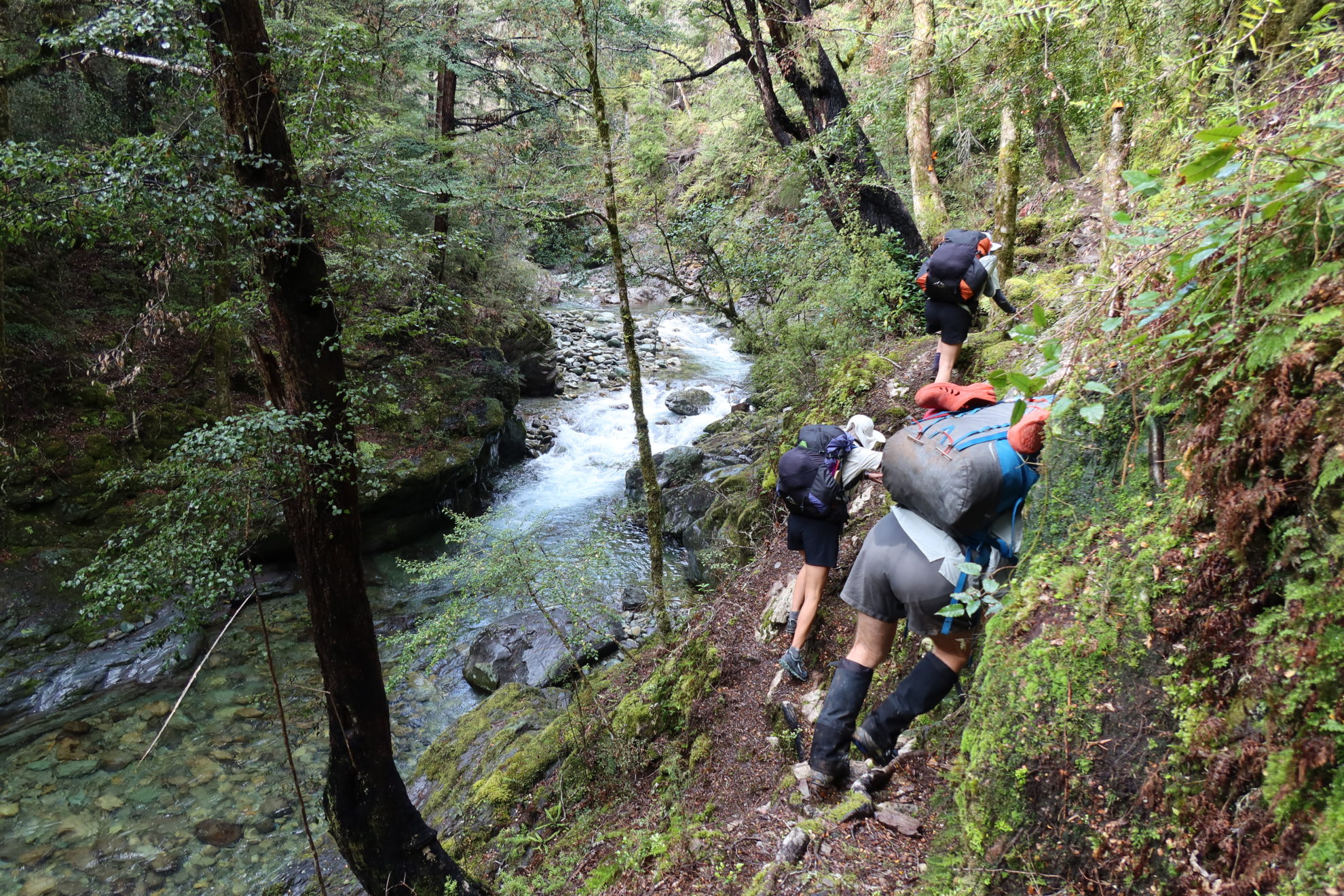
And the walking is hard – the hardest I’ve done. After climbing and dropping thousands of metres a day in the Pyrenees; hiking under a scorching sun in South Africa’s Cederberg; snow-running, thigh-deep, along the high plateaus of Mt Lebanon, I thought I was seasoned. ‘Some people may find this section challenging,’ the TA trail notes opined, breezily, of the vertiginous sidle-scramble between Mid Wairoa and Upper Wairoa huts. Some people?! was all I could think, as we toiled for five hours along a mud-slicked 7km of ‘trail’, clinging for dear life to the vegetation as the slope flirted with becoming a sheer face.
An old-style DOC intentions book at Kiwi Hut, in the Taramakau Valley, requests that hut users state the main activity of their trip. Sliding, stumbling, falling were all repeat listings. I am not prone to injury, yet here I was, after a particularly thrilling hike up Bush Stream (ahem, Torrent), with tendonitis in my foot and bursitis in my knee. The next day, I sprained an ankle. Bogs became so commonplace that my companion developed a new form of sports commentary (‘boggentary’), awarding and detracting points for innovative manoeuvres and wet socks. Of 51 days on the trail, we completed about three with dry feet, and only then with some extremely athletic bog-navigation techniques.
Most days, we cross rivers. We perfect several methods to be deployed depending on the flow. I learn to look at the water and pick a line: Is the runout good? Are the rapids shallow? Can I hear rocks rolling? Is the depth discernable? I learn what a catchment is. We start carrying staffs of water-smoothed wood. In our strange hiking duo, my little sister is the brains, while I (all 166cm, 50-ish kg of me) am the brawn. What could possibly go wrong? We develop a respect for the water and a real knack for taking the most cowardly route possible. When we meet some tall lads on the north side of the Ahuriri, they tell us the river had been up to their navel, flowing fast. The line we choose keeps our shorts dry, our pride intact.
In the Spanish mountains, rivers are mostly forded by bridges that villagers have used for generations. In Aotearoa, human history is less apparent, maybe, but no less vital. It’s very clearly there in the abandoned gold mining settlement of Macetown and also in the trail over Harper Pass, forged by Māori long ago to facilitate the pounamu trade from Te Tai o Poutini, and, no doubt, in many other trails, their origins obscured by colonial monickers.
Tramping down the island that I was raised in, I learn to look a little differently. I know the names for some plants and animals, but I learn a whole lot more and as I gain the language, I gain new layers of vision, too. I notice the flora changing; almost West Coasty as we crunch down the Taramakau, then arid and dracophyllum-dense over the passes. I assess my surroundings a little differently, knowing the particular challenges these ecosystems face. Our conservation strategy in Aotearoa is so different, our ecology so particular.
We’re shocked to stumble on a wallaby in the tussock above Tekapō and thrilled to see kea over the alpine passes. We learn the habits and status of welcome swallows, robins, kāhu. We realize all over again how beautiful and how delicate this landscape is. And just how big. Fiordland, alone, is larger than Yellowstone and Yosemite national parks combined. As we walk, we notice wasp-bait structures and 1080 pellets, areas of deforestation and new growth, the presence of riflemen and the absence of rock wrens.
There is beauty in the stripped land of the plains, in the coconut-scented gorse and the UV glow of the lupins. The noise and mess of Canada geese, though, the squidge of didymo, the devastation wrought by pigs are less charming. We pay attention to stone, watch the scree cycle through different shades and sheens as we move south. We track the way this land fits together and recognize the strange processes that have contributed to its formation.
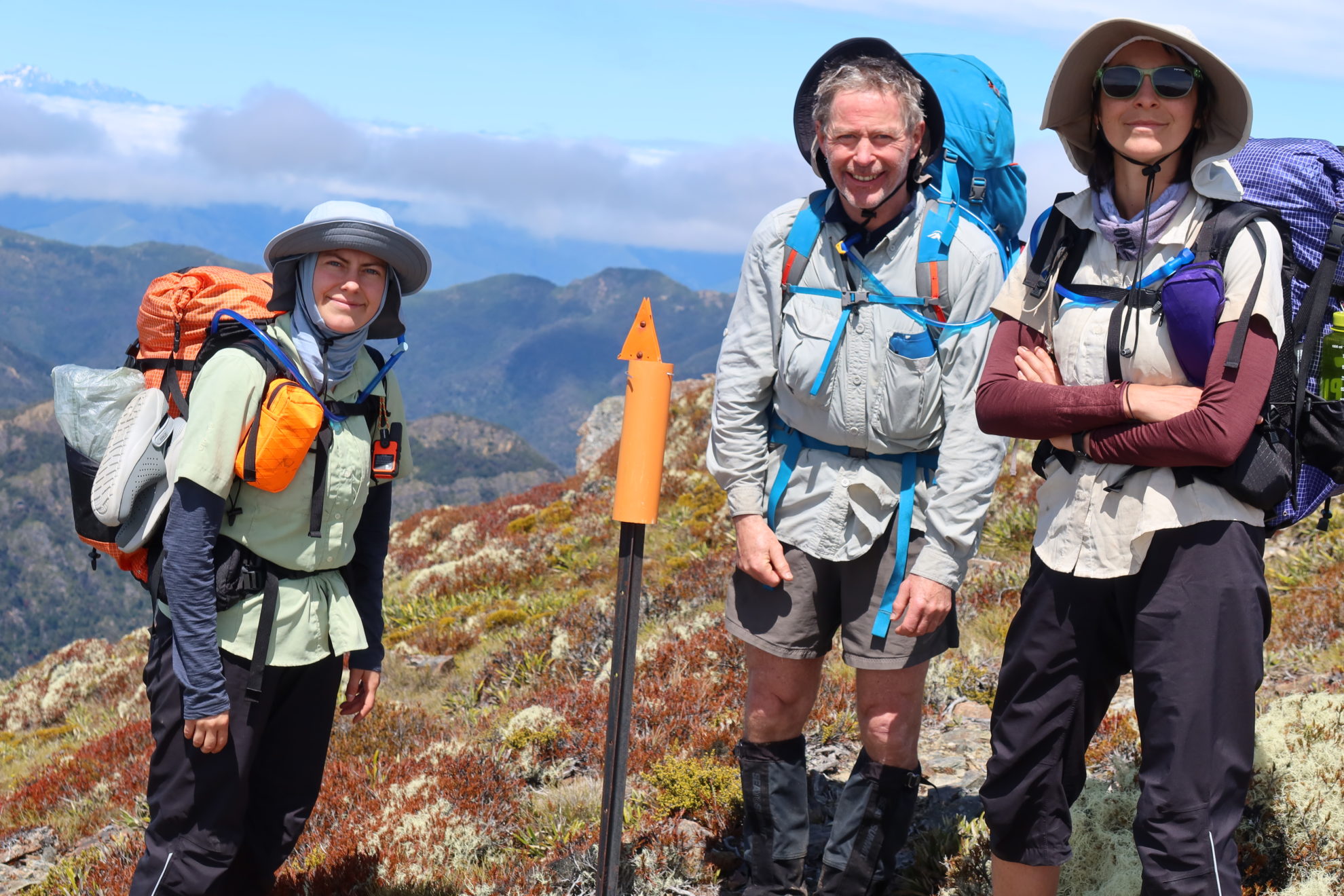
By the end of our trail, I’d gained a pair of possum socks and some respect for the New Zealand weather and wilderness. Tramping here is a serious business, but everyone we met has made it their own. Paul is a meticulous planner and a steady walker; he carries a tiny, ancient flip phone for calls and a sizable iPad for everything else. Quinn is recovering from giardia and carrying a guitalele, on which he plays melancholic Russian folk songs. Matt’s wife is travelling alongside him in a campervan; they meet whenever he passes through civilisation. “I’m doing the TA the easy way,” he tells us.
But I’m not sure there is an easy way to walk this trail. Just many different ways to stumble through, keeping a weather eye on the forecast and your gear in waterproof compartments, remembering to look up, now and then, and realise how implausibly, achingly glorious this place is.
34 years of inspiring New Zealanders to explore the outdoors. Don’t miss out — subscribe today.

Questions? Contact us



