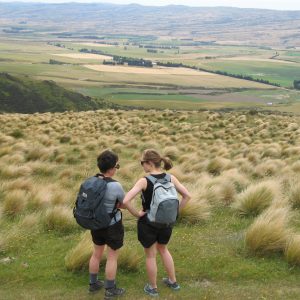
The second major fire in the last month at Tongariro National Park has been contained. DOC is reporting that visitors can safely return to tracks and huts in Tongariro National Park, but are requesting people continue to use shuttle operators for the Tongariro Alpine Crossing.
The latest fire affected around 300 hectares in the park and was in an area near the 3000-hectare November fire. Fire and Emergency New Zealand have declared the fire completely contained, and the Park’s tracks and huts are safe from the impacts of fire.
DOC Tongariro Operations Manager Libby O’Brien says the news is a relief for the community. “Our community have been feeling it, both the loss of these beautiful parts of the park, and also the loss of tourism so many rely on.”
Ngāti Hikairo ki Tongariro spokesperson Te Ngaehe Wanikau says the latest fire has placed continued strain on the whenua, taiao, and people.
“As mana whenua and kaitiaki of Tongariro, it is our responsibility to respond in a way that upholds the mauri of the land and ensures its healing for generations to come,” says Te Ngaehe. Read more from DOC.
Car park fees to begin at three popular South Island DOC sites
Starting 15 December, DOC will begin charging for car parking at Punakaiki, Franz Josef and Aoraki/Mount Cook.
Director of Heritage and Visitors, Catherine Wilson, said the pilot will run over the next seven months at the popular sites as a way for visitors to contribute to the nature experiences they enjoy.
Parks at all three sites would be set at an hourly rate of $5. A daily rate of $20 would be available at Punakaiki and Franz Josef, and $25 per day at Aoraki/Mount Cook.
Parking would be free for 20 minutes to allow for pick-ups and drop-offs, or staying a short time.
An annual permit would also be available for residents within local council boundaries of $10 per vehicle per site for one year with unlimited access. For visitors, a similar permit option would be available for $60 per vehicle per year.
A revenue of approximately $1.5 million was expected. After the pilot, it will be decided if paid parking will continue or be extended to other sites. Wilson said paid parking is “standard practice” at many national parks overseas. Read more from One News.
2025’s sustainability award-winning outdoor gear
Suston, a media platform for sustainability and outdoors content, has awarded five new products from 2025 for setting new industry benchmarks in durability, material sourcing, and product longevity.
Icebug was awarded the Scandinavian Outdoor Award for Sustainability for its initiative to integrate Forest Stewardship Council–certified natural rubber into its footwear outsoles. The project resulted in a supply chain that ensures no deforestation and reduces dependence on fossil-based rubber.
YKK’s 3D Composite Puller won Best Product for its use of recyclable bio-based TPU, enabled by an on-demand 3D printing system that avoids traditional moulding and minimises production waste.
Fjällräven’s Kajka X-Lätt 45 trekking backpack earned an ISPO Award for its combination of low weight, renewable materials, and longevity-focused design. The sub-1 kg pack features a laminated birch wood frame, offering a renewable and lighter alternative to plastic or aluminium structures.
The Rab Mythic -6 sleeping bag, recipient of the ISPO Award 2025, is engineered for cold conditions with a focus on thermal efficiency and reduced environmental impact. It weighs just 700 grams, thanks to 900 fill-power goose down and a patented baffle construction that reduces cold spots and pack size. See more from Suston.
Hikers risking lives on Hooker Valley Track
Up to 20 people a day are risking their lives venturing into closed areas of a popular Aoraki/Mt Cook National Park track, where construction and explosive work is underway to build a new bridge, according to DOC.
Staff working on the 189-metre suspension bridge on the Hooker Valley Track had repeatedly seen people ignoring safety barriers and gates and were often downing tools to tell people to leave.
On one occasion, staff had to stop a helicopter pouring concrete to tell walkers to go, DOC said.
DOC Aoraki/Mt Cook operations manager Sally Jones said, “People are taking real risks by climbing fences and in some cases even attempting to cross the Hooker River – its bloody freezing let alone fast and furious,” she said.
“People are putting their lives at risk. We all want the new suspension bridge on the Hooker Track open as soon as possible and the construction workers need to be able to get on with the job without having to worry about the public,” she said.
She said as the upper section of the track was a restricted access site, so trespass notices could be issued. Read more from RNZ.
Thieves steal newly-installed table at DOC campsite
A 3m macrocarpa picnic table at Bucks Road Campsite west of Greytown was installed for just two days before most of it was sawn off and stolen.
The table was found with around 2.4m missing – an amount of dressed wood worth an estimated $4000. DOC principal ranger Briggs Pilkington said the theft was “hugely disappointing” and “disheartening” for staff and volunteers who worked on the table.
“This wasn’t a purchased table; the locals built that table themselves, and it wasn’t even finished. This was hard work, and means we have to really think about what we do in the future.”
Pilkington said it was the latest in a string of thefts of materials from Wairarapa conservation sites, with corrugated iron stolen from a shelter at Western Lake Reserve earlier this year.
“Anyone with any information should call 105 or go online to 105.police.govt.nz and quote reference number OR-2321290N,” a police spokesperson said. Read more from One News.
Artist walking 144km in vintage clothes to raise money for wildlife sanctuary
Artist Jacqui Madelin is walking 12km a day to raise money for Project Island Song, a pest-free wildlife sanctuary spanning seven islands in the eastern Bay of Islands.
But there’s a twist, Madelin is completing each day’s walk, for the first 12 days in December, dressed head-to-toe in pieces from her extensive vintage wardrobe.
One outfit is an Edwardian swimming suit, she says. “It’s a navy blue, all-in-one with a sailor collar that goes down to the elbow, goes down to the knees and has a skirt to button over it.
While the top is vintage, she went for more practical options on her feet. “I don’t normally walk that far so I figured it would be crazy to wear fancy shoes. My feet would expire on day one, so I have some hiking boots that are pretty elderly.
Another outfit getting an airing in her charity walk is a navy and pink suit from the 1940s that she had to do considerable remedial work on, she says. Read more from RNZ.