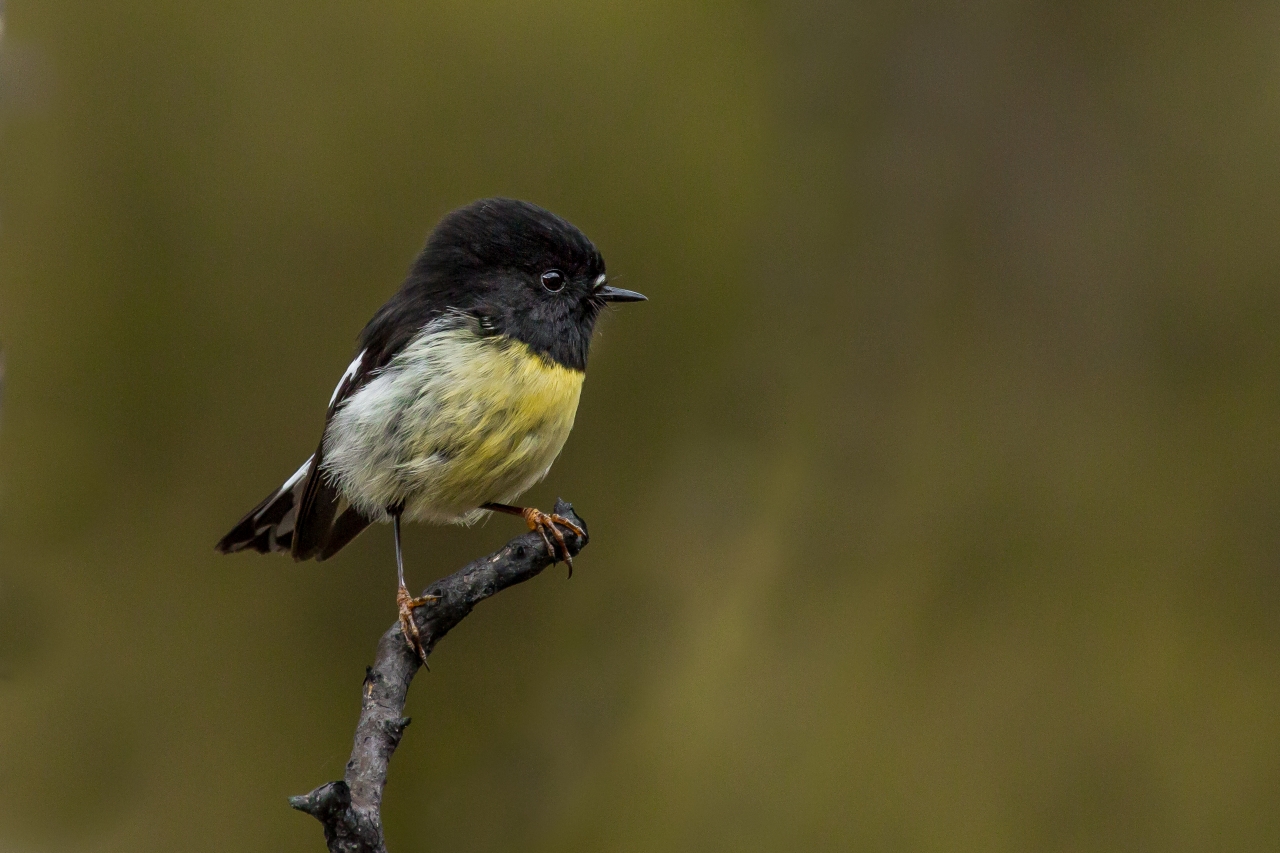
A curious and inquisitive nature makes the tomtit/miromiro an endearing bird.
With their petite, adoring facial features amplified by the ‘whiskers’ protruding from the base of their bill, I find miromiro to be one of the cutest New Zealand birds. Their curious and inquisitive nature also makes them endearing.
The male has a black head, back and wings with a white wing bar and a white belly, and a distinct white spot at the base of the upper part of the bill. The only difference between the South Island and North Island males is a yellow/orange band across the breast on the southern variety. Females are brown over the head, back and wings, and a fawn colour on the upper chest which fades to white on the belly.
Miromiro are found from Northland to Stewart Island, particularly in the forests of the central North Island and along the west coast of the South Island. Preferred habitats are forest and shrub land of both native and exotic areas.
Their diet consists mainly of a wide range of small invertebrates, including spiders, beetles, flies, moths (adults and larvae) and weta, which they forage for by scanning the surrounding area perched on a branch or clinging to a trunk, and then flying forth to snatch up the prey. They occasionally eat small fruit which are swallowed whole.
Nesting between September and February, the female alone incubates the eggs and is fed by the male 2-3 times every hour. During this period, pairs are able to rear three broods although predation ensures very few achieve this.
– Matt Winter is a Marlborough-based nature photographer
An ethical guide to visiting the Muriwai gannet colony
Trending Now
Apply for the Shaun Barnett Memorial Scholarship
Carrington Hut, Arthur’s Pass National Park
Harris Saddle and Routeburn Falls Hut, Mount Aspiring National Park
The past beneath our boots
Dobson Loop Track, Tararua Forest Park
Subscribe!
Each issue of Wilderness celebrates Aotearoa’s great outdoors — written and photographed with care, not algorithms.Subscribe and help keep our wild stories alive.