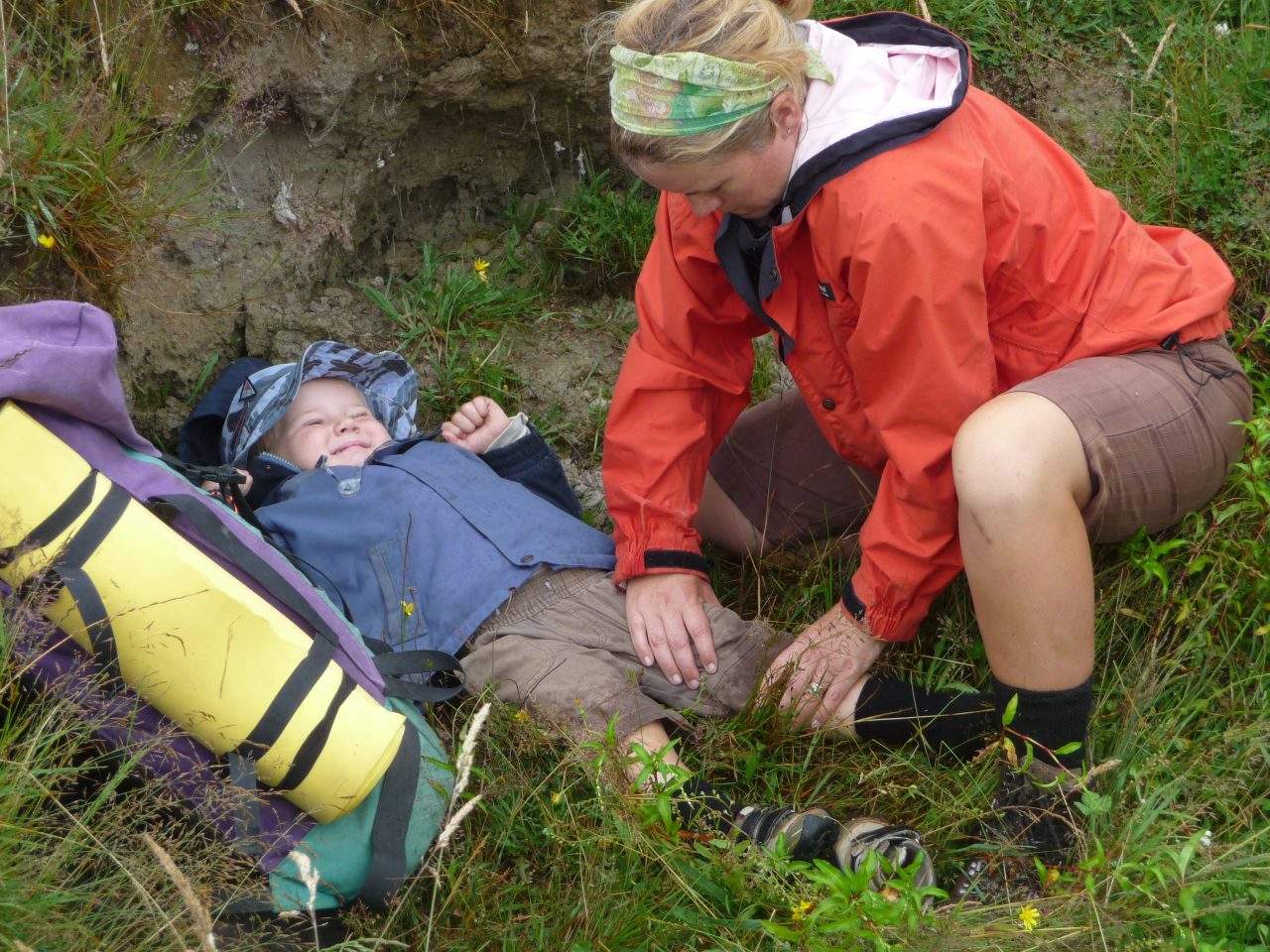
The ‘secondary survey’ involves physically moving our hands over the patient’s body in an attempt to identify an injury that the patient may or may not be aware of. It is common for a major injury to mask another less painful injury that may even be more life threatening. To do this, we must first gain the trust and consent of the patient by explaining what we are doing and why.
The secondary survey can be conducted on any patient regardless of whether they are conscious or not, sitting, standing or lying prone or wearing bulky clothing. Use your common sense regarding whether this assessment is necessary – if a friend sprains their ankle walking slowly across a streambed and does not fall significantly, you may choose to only examine the lower leg on the injured side. But if the mechanism of injury is such that multiple injuries may exist then conduct the following assessment.
Spine While keeping the patient’s spine still, examine it by pushing with moderate pressure on every single bump on their neck and back right down to their tail bone.
Head Check the head and face for fractures, bruising, blood or fluid from the ears and inspect the patient’s pupils for equality of size and reactivity to light.
Shoulders Push on the shoulders and ribs while looking for areas of pain or deformity.
Abdomen Divide the abdomen into four quadrants and palpate each firmly to determine if there is pain. If there is and the patient’s pulse is weak and getting faster while they are at rest we should assume internal bleeding is present.
Legs Push in on the hips and pelvis, then work your way firmly down each leg. Get the patient to push their foot up then down against your hand to check for spinal cord integrity.
Arms Lastly, move to the arms, doing a similar assessment to the legs but getting the patient to squeeze your hand. The limbs can also be moved to check for joint operation if there is no obvious injury present.
Until we have finished this examination, we should assume the patient has a spinal injury if their impact has been big enough. If you are not sure whether a secondary survey is necessary, then it probably is and if you can’t remember everything involved, just think of your hands as paintbrushes that you will use to paint the patient from head to toe.
By following the entire patient assessment approach we are significantly less likely to miss an injury and have a comforting step-by-step process to follow in times of increased stress.
– Henry Worsp is a director of Peak: Outdoor Safety and Emergency Management

34 years of inspiring New Zealanders to explore the outdoors. Don’t miss out — subscribe today.

Questions? Contact us