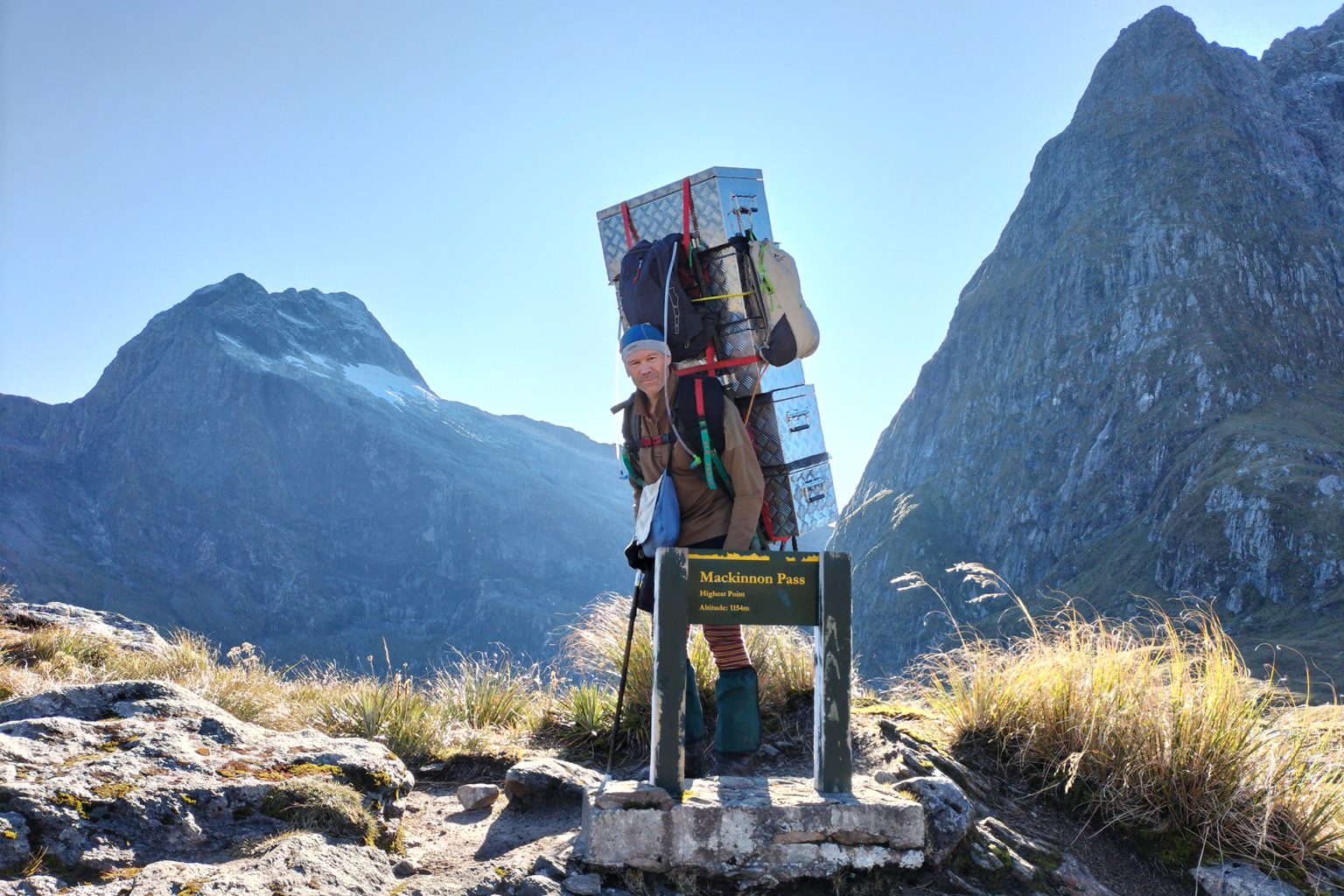
While most trampers do all they can to cut weight from their pack, Regan Bridge is going in the opposite direction and aiming for the heaviest pack he can carry.
Regan Bridge does what you probably don’t want to: he goes tramping with 50kg-plus strapped to his back – and he does it for fun.
“Most people are really impressed, or they take the mickey out of me – have you got a fridge, TV, kitchen sink, house on your back?” he says. “I like to say it’s like running into an elephant on the track – you don’t expect it.”
For the past 10 years Bridge, a 52-year-old truck driver from Motueka, has been experimenting with load carrying after volunteering for Friends of Flora and carrying trap boxes. It was through this and his trapping near Asbestos Cottage in Kahurangi National Park (famously occupied by prospector Henry Chaffey for nearly four decades) that Bridge discovered how, back in the day, it was common for New Zealanders to carry “the old English hundredweight” – the equivalent to the British imperial eight stone or, in our language, 50.8kg.
Back then it was all pack horses and pack tracks. “Because they could do it, I thought, why not me? What’s the difference between them and me?” says Bridge.
And so a love affair with carrying heavy loads began. It started with 50.8kg, then up to 75kg. Now Bridge is training to carry 100kg.
His first attempt with 50kg was a 100m walk along his gravel drive with an average incline. “That nearly killed me,” he laughs.
His initial goal was to carry 50.8kg to Asbestos Cottage – 20km with a 700m vertical climb – just like Henry Chaffey used to do. He trained for a year before attempting it. “I was surprised how I achieved it. It wasn’t impossible and it didn’t make me want to quit.”
Since then, he has walked all the South Island Great Walks, including a there-and-back of the Heaphy Track – 156.8km over 10 days with a start weight of 75kg and finish weight of 70kg.
But he is reminded of the Sherpas in Nepal who carry 100kg. Bridge weighs just 86kg, so that would be like carrying 116 per cent of his body weight.
“It sure would be cool to do the Heaphy one way with 100kg,” he says. “It’s a surprisingly big jump from 75kg to 100kg, so I will see how training goes. You have to set big, hairy, audacious goals.”
Bridge laughs when asked if he is insane and explains that load carrying is an “adventure sport” like ultra-running. It’s about the challenge and seeing what the body can do. “I’m not a recreational tramper with sandwiches and thermos. I’m out there training. It’s about mindset. Once the body adjusts, it’s all in the mind.”
He admits to having some wear and tear and his wife occasionally looks sideways at him. “Do I hobble around and hurt the next day? Yes. But we all have to live and be happy. Other people smoke and drink or drive fast cars. This is my thing. I know a heavy pack may not be the best for me but I love it. It’s like my yoga – and I get bored walking with a light pack. I joke that when I’m older I’ll continue to do it with a Zimmer frame.”
He thinks other people could find enjoyment in load carrying and is keen to inspire others to do it – but admits he hasn’t had many takers.
And the ultralight movement? “Each to their own,” he says, “but not my cup of tea.”
He describes his pack set up as a “hobby on its own” and is now on “version 10 plus plus”.
It’s designed around packs used by Tatra mountain porters in Europe and includes a Tatonka Lastenkraxe Load Carrier reinforced pack frame with wide shoulder straps to spread the load, and it’s all held on with 200kg break-strength tie-downs.
Bridge carries a spare of pretty much everything to make up the weight. “I’m probably the only tramper out there with two sets of boots.”
He carries seven metal toolboxes – based on the method of carrying trap boxes – which together weigh 50kg – and a small ladder.
“I need the ladder legs to get the pack on and off. The ladder also extends the pack frame so I can load higher. It’s all to do with the centre of balance.”
While it’s essentially about the challenge, Bridge also notes there is an environmental and economic aspect behind carrying heavy loads. He says it could create mountain porter jobs and reduce reliance on helicopters ferrying in loads. “It works in other countries and there’s already a push to use less fossil fuels. It’s a no-brainer.”
So, is a Guinness World Record up for grabs? Bridge is not sure about that yet.