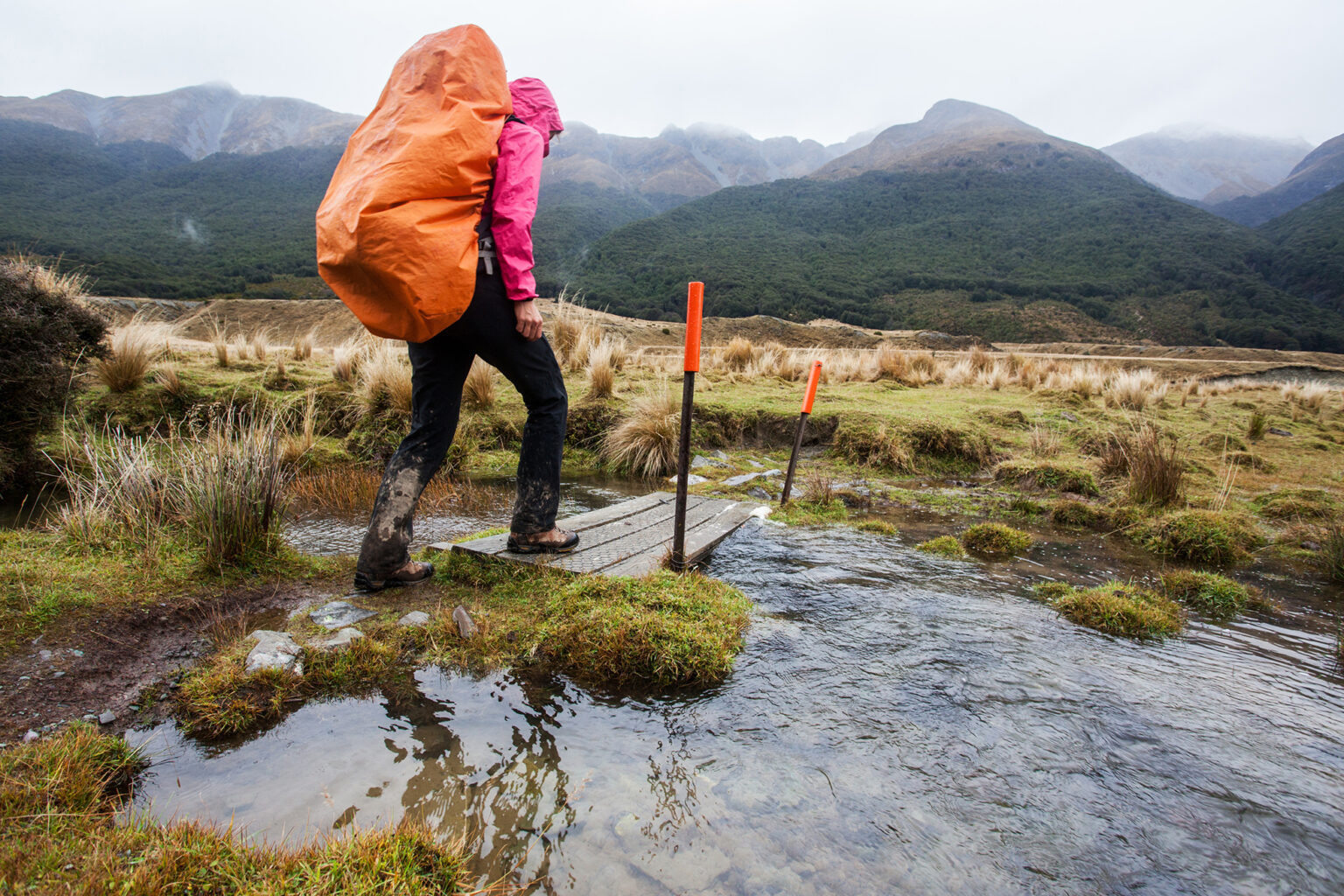
Rain can be a real spoiler for a tramp. But how much rain will it take to affect your trip?
We all check the weather before heading out for a tramp – don’t we? If rain is forecast, will it affect the tramp? Should the trip be cancelled or changed, or is the predicted rain not likely to be a problem?
Research the crossings
What can you find out about the track? Check the map: does the route cross main rivers and streams, and does the map show bridges across these? Check at the local DOC office, the DOC website, or search for trip reports online. Although well-formed walking tracks often have bridges across sidestreams, maps may not show these. On a typical backcountry track, sidestreams, streams and rivers will likely be unbridged.
Rivers and side branches
Not all rivers and streams are equal. The watershed that feeds a waterway will determine how much it is affected by rain. When reading a map, look at the blue line(s) representing the watercourse upstream of your crossing point. If there is just a single blue line, there will not be much water feeding into the stream when it rains. The bigger the blue ‘tree’ upstream, the bigger the watershed and the greater the amount of water feeding into the stream when it rains.
A stream that sits in a tight ‘V’ formed by contour lines will have steep sides and rise more than one that sits in a wide ‘U’.
Don’t forget that sidestreams will also rise. A stream you can normally step over can quickly become a raging torrent.
Speed of rise
Rivers and streams can rise incredibly fast – in 20–30 minutes they can change completely. A stream crossed with ease on the way in may be unmanageable on the way back, so that you become trapped.
If the waterway is in hard, rocky land, the water is likely to rise fast and fall quickly. Land covered with soil acts as a sponge: the sponge fills first, slowing down the speed of river rise, but will continue to release water long after the rain has finished, so that the river remains high for longer.
When and where the rain will fall
Rain that falls before a trip may mean that streams are already high: consider whether levels are likely to have dropped by the time of your trip. Rain forecast during a trip has a higher chance of trapping you between rising waterways. Bear in mind that rain forecast to come after your trip may come early.
Consider also on which side of the ranges the rain is expected to fall. A trip might be unsafe on one side and pose no issues on the other.
The group’s skills
Does your group have the skills to determine if a stream is safe to cross? Are any members likely to feel scared? How short or tall are they? When deciding to cross a waterway, base your decision on the weakest member. Remember: if in doubt, keep out. The hills will be there for another day.
Heather Grady is an instructor with Outdoor Training New Zealand