New Zealand’s most melodic bird can be found everywhere but the upper North Island
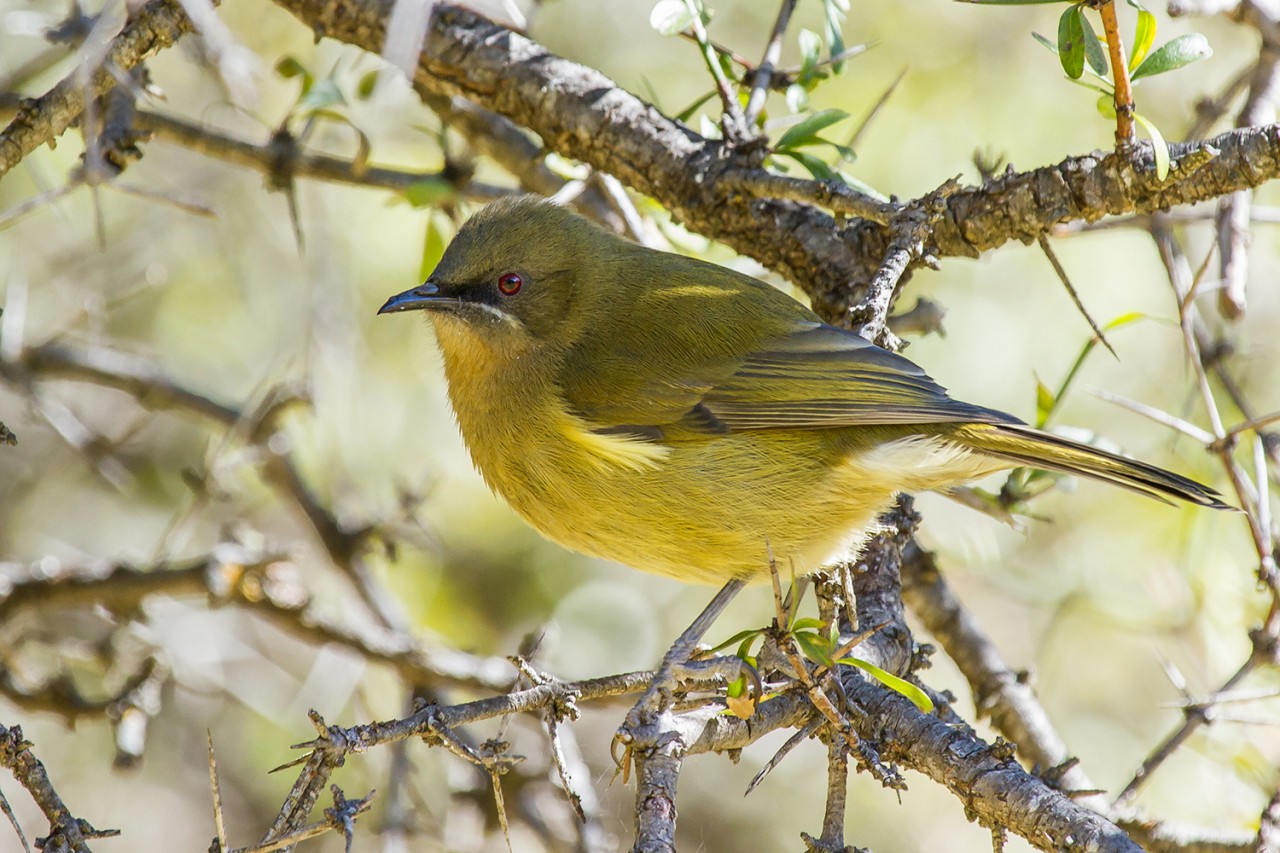
Bellbirds, or korimako, are the most widespread and familiar honey (nectar) eater in the South Island and are also common over much of the North Island although completely absent north of Hamilton other than on the Coromandel Peninsula. They are found in a wide range of habitats including native and exotic forest, urban parks and gardens.
Bellbirds are green with a short, curved bill, slightly forked tail and a noisy whirring, fast and direct flight. From a gender perspective, males are olive green, slightly paler on the under parts, with a head tinted purple. The females are browner with an obvious narrow white-yellow stripe across the cheek from the base of the bill and a bluish gloss on top of the head. The most distinctive feature of both sexes is the beautiful wine-red eyes.
Males are larger (and rather more bossy and aggressive) than females, weighing in at 34g with the females weighing 26g. Juveniles are similar to females but have brown eyes and lack the bluish gloss on the head.
The bellbird possesses one of the truly beautiful sounds of the New Zealand bush. The song, though it varies from region to region, is a series of three distinct sounds, resembling the chiming of bells.
The breeding season extends from September through to February. A loose nest of twigs and grasses, lined with feathers and fine grasses will be constructed in the fork of a tree under dense cover anywhere from near ground level to seven or eight metres. A typical clutch is 3-4 eggs incubated by the female (14 days). Both parents care for the young. A breeding pair return to the same territory each year and they can raise two broods in a season.
The bulk of the bellbird’s diet consists of nectar from native and introduced plants but in late summer and autumn they may take fruit and occasionally also eat insects and spiders by gleaning trunks, branches and leaves. Young birds are fed protein-rich insects almost exclusively.
Update (June 28, 2021): Since this article was published, Korimako have re-established themselves back onto the mainland of the upper North Island. Korimako re-established themselves naturally at the Tawharanui Open Sanctuary, flying in from Hauturu (Little Barrier Island).
An ethical guide to visiting the Muriwai gannet colony
Trending Now
Green Point Hut, Gamack Conservation Area
The possibilities of packrafting
Every Tararua hut reviewed and ranked
The Tararua’s forgotten traverse
Leaning Lodge, Rock and Pillar Conservation Area
Subscribe!
Each issue of Wilderness celebrates Aotearoa’s great outdoors — written and photographed with care, not algorithms.Subscribe and help keep our wild stories alive.