

The family all made it across the narrow crumbling section without incident, but she says they would have avoided the track had they known the risk. “It was definitely the scariest part for us.”
Karen Griffiths walked the trail in 2019/20 and agrees, saying her day on the Timaru River Track was the most frightening of her journey. It wasn’t only the exposed sections that worried her, but also the numerous crossings through a river with a strong flow.
“If you fell, you’d be swept off and down,” she says.
Griffiths completed the trail three days before the 2020 Covid-19 lockdown and in 2022 decided to walk the trail again, this time going northbound (NOBO).
However, when she reached Hāwea she decided against repeating the Timaru River section.
“I decided I needed to live for another few years. I wasn’t going to risk doing that section again. And that’s when I decided that I wasn’t going to continue going NOBO.”
She got a job at a backpackers in Lake Tekapo afterwards and recalls numerous NOBO walkers coming in with injuries sustained in that section.
Figures from Wānaka Search and Rescue (Wānaka SAR) record eight rescues along the section of track since 2019, but Wānaka SAR member Gary Dickson says this is far from a comprehensive list.
“It’s definitely one of our hotspots,” he says.
Dickson says they’ve rescued people who have fallen from the track and managed to stop themselves at the top of a cliff face, only to find they’re unable to climb back up to the track.
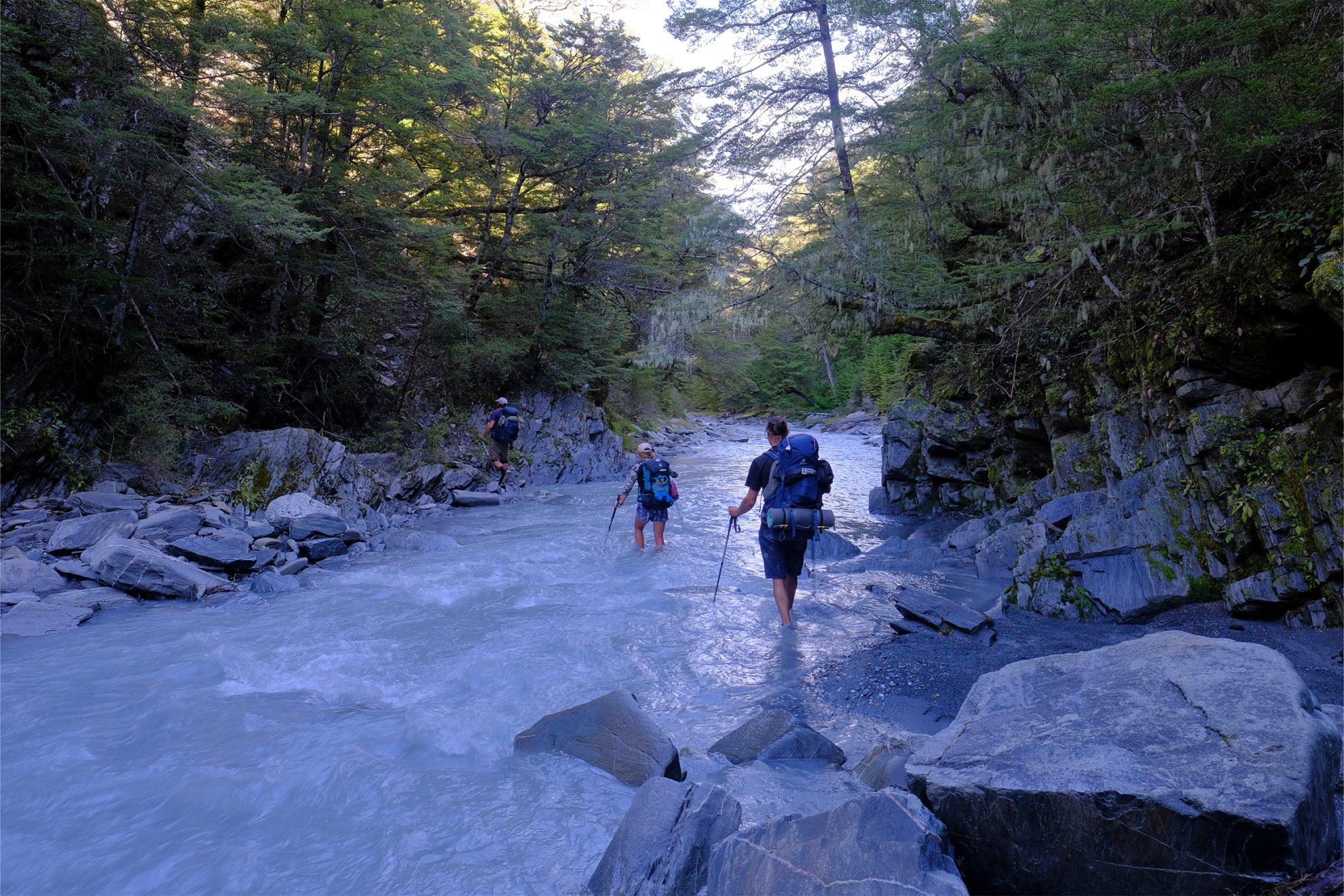
A number of people have also been rescued after falling while walking along the riverbed, Dickson says.
Te Araroa Trust’s trail notes say the track involves about a dozen river crossings, and walkers report that the water becomes silty following rain, making it difficult to assess its depth and the presence of rocks.
The high wet-weather track is challenging and requires ‘hard scrambling along steep banks’.
In dry weather, trampers may choose to follow the riverbed for significant sections of the track. A gorged section of the river has strong currents that cannot be traversed even in low flows, however, which can catch trampers out.
Numerous sections require important judgement calls and Dickson says a number of the rescues have involved people who are walking alone.
“Being on your own is not great because there’s no one to bounce ideas off, which impairs decision-making. If there’s one message to get out there, I’d say to band together for that section at least.”
He also says many Te Araroa Trail walkers tend to wear running shoes, which can be okay for much of the trail but compromise stability in river crossings and on unstable terrain.
Dickson suggests the track needs to be upgraded or an alternative route developed.
“It’s not really a track – it’s more like a deer trail where I’ve picked people up. Someone needs to put a track in that works.”
Tania Henwood also contacted DOC after completing the section, raising concerns about the condition of the track.
Te Araroa Trust has recently been investigating issues relating to the Timaru River Track as part of the coronial inquiry following Claire Frances’ death.
Executive director Matt Claridge says the trust is “gutted” to have lost a Te Araroa walker. He says while the circumstances around her death are still being pieced together, Frances was seen to be off the marked trail earlier in the day.
“It was basically a slip in the wrong place,” Claridge says.
He says some minor changes will be made to the track notes following the review, and the trust is considering an alternative route.
“Generally, however, we think the route is suitable.”
This section of track also isn’t one of the main areas that trail walkers raise concerns about, he notes.
“Everyone has a different understanding of risk. I hear more about the conditions and difficulty with the Richmond and Tararua ranges than I do about this particular part of the track.
“But I’m totally committed to making sure that we learn from the benefit of hindsight and that the information for walkers is clear so they can make the right decisions around their personal safety.”
The track is almost entirely in Hāwea Conservation Park and is categorised as an advanced tramping track.
DOC standards and visitor safety manager Andy Roberts says Frances’ death occurred off the DOC track, on an alternative route that follows the riverbed.
“This isn’t managed or marked by DOC but is followed by some Te Araroa walkers looking for a more direct route instead of the DOC track, which involves significant elevation change.”
Roberts says DOC is aware that “some users do have difficulty with the steeper sections of track”. The department intends to upgrade some sections, including benching narrow parts.
“Improving sections of the track will hopefully lead more Te Araroa Trail walkers to use the DOC track rather than the alternate route.
“DOC will also update its visitor information for this section of track to support trampers in their decision making.”
Mark Woods hopes to finish the last month or so of the trail in spring, once he has recovered. He is skeptical that upgrading the track will help, however, because of the crumbly geology in the valley, and believes an alternative route should be developed.
“It might make the trail longer, but at the end of the day you want people to arrive safely.”
Karen Griffiths disagrees.
“It’s part of the trail. If you want a walk in the park, go and do an American walk or the Bibbulmun Track in Australia or something. But if you want an adventure, do Te Araroa.”



