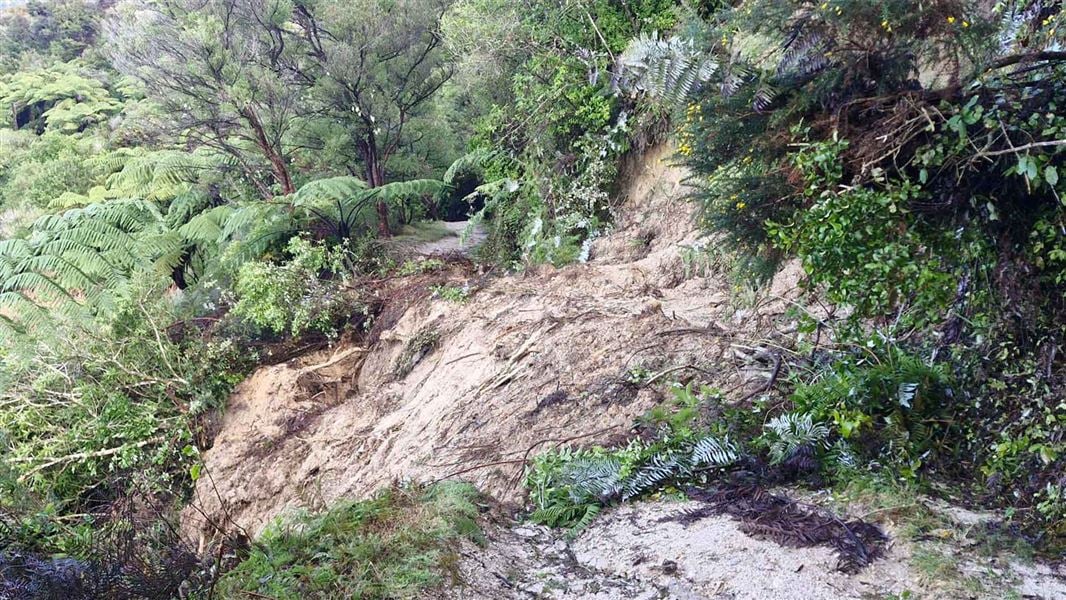
Access to the Kahurangi National Park from the Tasman District has been cut off by recent storm damage, while part of Abel Tasman Coast Track is temporarily closed.
DOC Northern South Island Operations Director Martin Rodd says storm damage to DOC-managed sites is widespread and it will take time to understand the full extent across conservation areas and facilities.
People are asked to delay their trips until the tracks have had a chance to dry out, Martin says. “DOC staff are out assessing tracks and other sites where it’s safe to do so. This will take some time, as many roads are closed.”
DOC knows about some significant damage already, with the Motueka area seemingly the hardest hit, Martin says. “In Kahurangi National Park, there’s no access to Flora car park as Graham Valley Rd is closed as a section has been undercut by the river. This closure is expected to be in place for some time.”
Martin says Abel Tasman Coast Track is being assessed as a priority, and one section has been temporarily closed. Access on the northern end is closed due to slips. The Heaphy Track is currently still open. For up-to-date information about particular huts and tracks check DOC’s website.
Little spotted kiwi found on NZ mainland for first time in 50 years
Conservationists are delighted after a unique kiwi was rediscovered in Aotearoa for the first time in 50 years. The little spotted kiwi, or kiwi pukupuku, was first spotted in the remote Adams Wilderness Area in the West Coast by a DOC hunter.
It prompted DOC biodiversity ranger Iain Graham, alongside his conservation dog Brew, to fly in to locate the bird. “I heard kiwi calling the first night – two of them duetting – and immediately knew they didn’t sound like other kiwi. It was exciting, but it took a few days to narrow down the area,” Graham said.
“I was stoked when we finally caught up with the female on our final night, the absolute last chance before getting flown out.” Tiny feathers were collected from the small spotted kiwi to confirm the bird was a kiwi pukupuku, the smallest kiwi species.
Kiwi pukupuku are extremely vulnerable to introduced predators. Despite years of searching, the last known sighting of a kiwi pukupuku on the mainland was in 1978. DOC is gathering information to work with Kāti Māhaki ki Makaawhio to explore the future protection and management of these birds. Read the full story from RNZ.
The Japanese walking method that offers ‘10 times the benefits’ of walking 10,000 steps per day
Walking is an accessible form of movement with impressive health-boosting credentials. Those who are doing our Walk1200km challenge are already reaping these benefits (if you’re not signed up, you can enter anytime here).
But time is precious, and hitting the ‘gold standard’ of 10,000 steps a day can be hard to fit in your busy schedule. Enter the alternative walking protocol, termed “Japanese walking” that has been trending online. It takes just 30 minutes per day, and fitness coach Eugene Teo claims it offers “10 times the benefits” of walking 10,000 steps per day.
The “Japanese walking” walking protocol works by alternating between three minutes of walking at a low intensity (40 per cent peak aerobic capacity, or a relaxed pace) and three minutes of walking at a high intensity (70 per cent peak aerobic capacity, or a brisk pace) for 30 minutes.
The protocol comes from a study published in the Mayo Clinic Proceedings journal in 2007. It was designed to test whether high-intensity interval walking training can offer greater benefits than moderate-intensity continuous walking training, in terms of improving thigh muscle strength, peak aerobic capacity and blood pressure.
The conclusion states, “High-intensity interval walking may protect against age-associated increases in blood pressure and decreases in thigh muscle strength and peak aerobic capacity.” So if you’re looking for a quick way to get a workout in, Japanese walking could be just the thing for you. Read the full story from the Independent.
Missing surfer swept away to uninhabited island
Nineteen-year-old Darcy Deefholts went out surfing on the afternoon of July 9 at Wooli Beach in New South Wales, Australia. When he failed to come home that night, his parents raised the alarm, calling the police.
SAR found his discarded clothes, shoes, and bicycle on the beach. It was obvious that southward currents had swept the young man out to sea. The only source of hope was the absence of his long board.
The next morning, a crew of volunteers found Darcy alive on North Solitary Island. Deefholts spent the night adrift, clinging to his longboard, before reaching the relative safety of the island. When searchers found the missing surfer, he was cold and suffering from exposure, but otherwise uninjured.
Dacry’s father, Terry Deefholts, spoke with the Australian Broadcasting Corporation, expressing his relief and amazement that his son had been found. “It’s a one in a million. Who survives this?” Read the full story from Explorers Web.
Great Walks popularity supports tourism growth
Opening day bookings for each of the Great Walks were up by over 10,000 bednights compared to last year, totalling more than 140,000 bednights and bringing in more than $9 million to the Department of Conservation – Te Papa Atawhai, says Mr Potaka.
“Booking system upgrades – including a new online lobby – successfully processed a peak of nearly 12,000 people waiting to book the Milford when it opened on 28 May in an hour.
In 2024 nearly three-quarters of international visitors said they did a hike, walk or tramp while in Aotearoa New Zealand, and around half visited a National Park. Conservation-related tourism is worth around $3.4 billion a year.
“This is great for local businesses, local jobs and incomes. Before and after their walk they stay, eat and adventure locally, injecting money into local economies.” All Great Walks increased their bednights booked, except for Heaphy and Whanganui River Journey. Read the full press release from DOC.