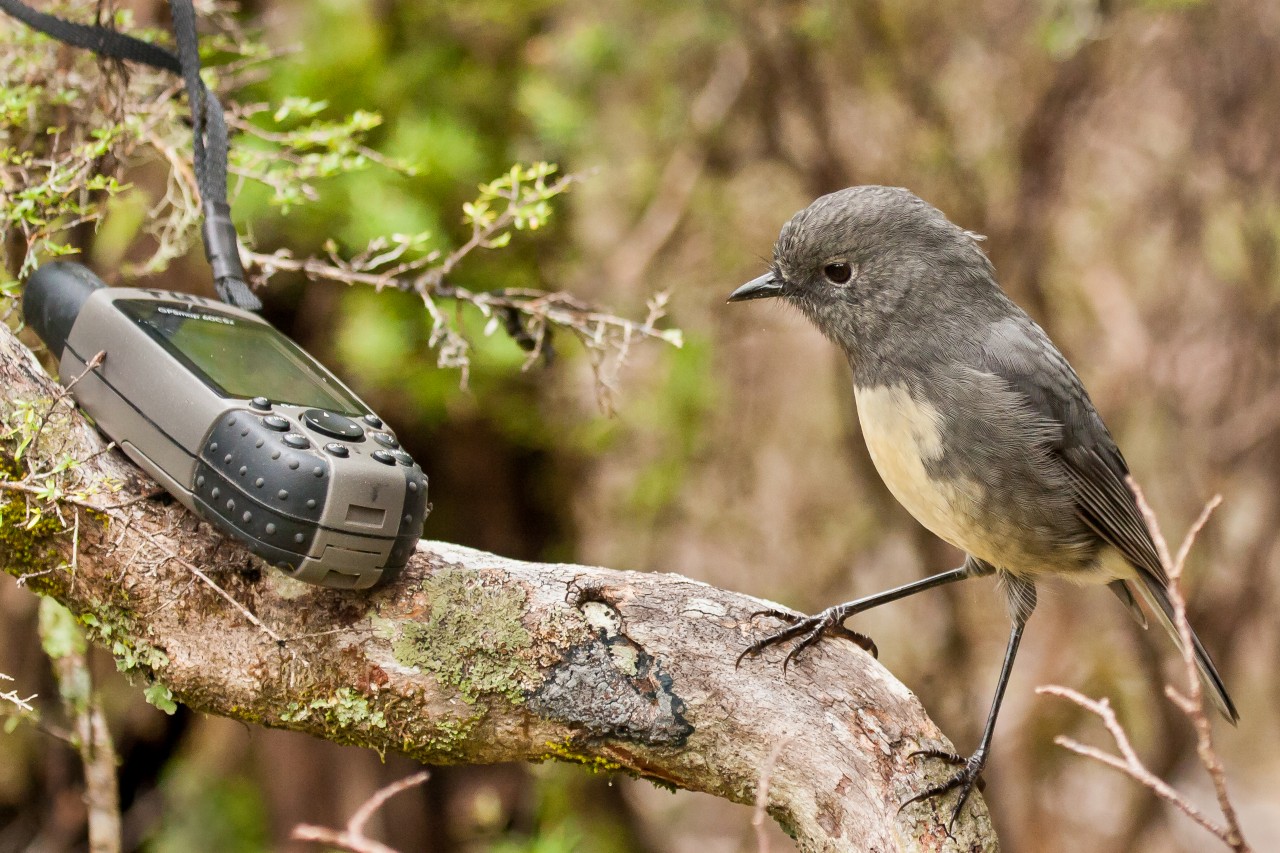
Keep an eye out for this bird in July, as it begins building its nest.
I think the South Island robin (toutouwai) would have to be our friendliest native bird. I once had one jump up onto my shoulder, peck at my earlobe then proceed to attack the hair on top of my head.
The attraction to us is not so much the human company, but the invertebrates disturbed by our movement.
The South Island robin is found in mature forest, scrub and exotic plantations and seems to favour moist areas where there is an open understorey beneath a closed canopy, on fertile soils. There are strongholds of the bird’s population in Marlborough, Nelson, the West Coast as far south as Harihari and throughout Fiordland.
Adult males are a dark grey-black over the upper body with the lower chest and belly white to yellowish-white. Females are a lighter grey over the upper body and further differ in the white chest and belly area being smaller and with a less distinct demarcation between grey and white.
The breeding season runs from August to March with nest building beginning in July and the last clutches laid in December. Only the female incubates the two to four eggs, over an 18-day period with both parents feeding the nestlings.
Chicks leave the nest when about 19 days old but are fed by the parents for a further five to six weeks. A pair may produce two clutches each season; the male will feed the fledglings while the female builds another nest and incubates the next clutch.
Much of the South Island robin’s diet consists of invertebrates and large prey items, including earthworms, cicadas, stick insects, tree weta and slugs. Before eating, slugs are wiped on the ground from side to side, presumably to remove slime. They spend most of their time foraging on the ground using a variety of activities to flush hidden or camouflaged prey, such as foot trembling, and wing- and tail-flicking.
An ethical guide to visiting the Muriwai gannet colony
Trending Now
Every Tararua hut reviewed and ranked
Apply for the Shaun Barnett Memorial Scholarship
Five ways to Lake Angelus
Mt Somers via Te Kiekie Route, Hakatere Conservation Park
The Tararua’s forgotten traverse
Subscribe!
Each issue of Wilderness celebrates Aotearoa’s great outdoors — written and photographed with care, not algorithms.Subscribe and help keep our wild stories alive.