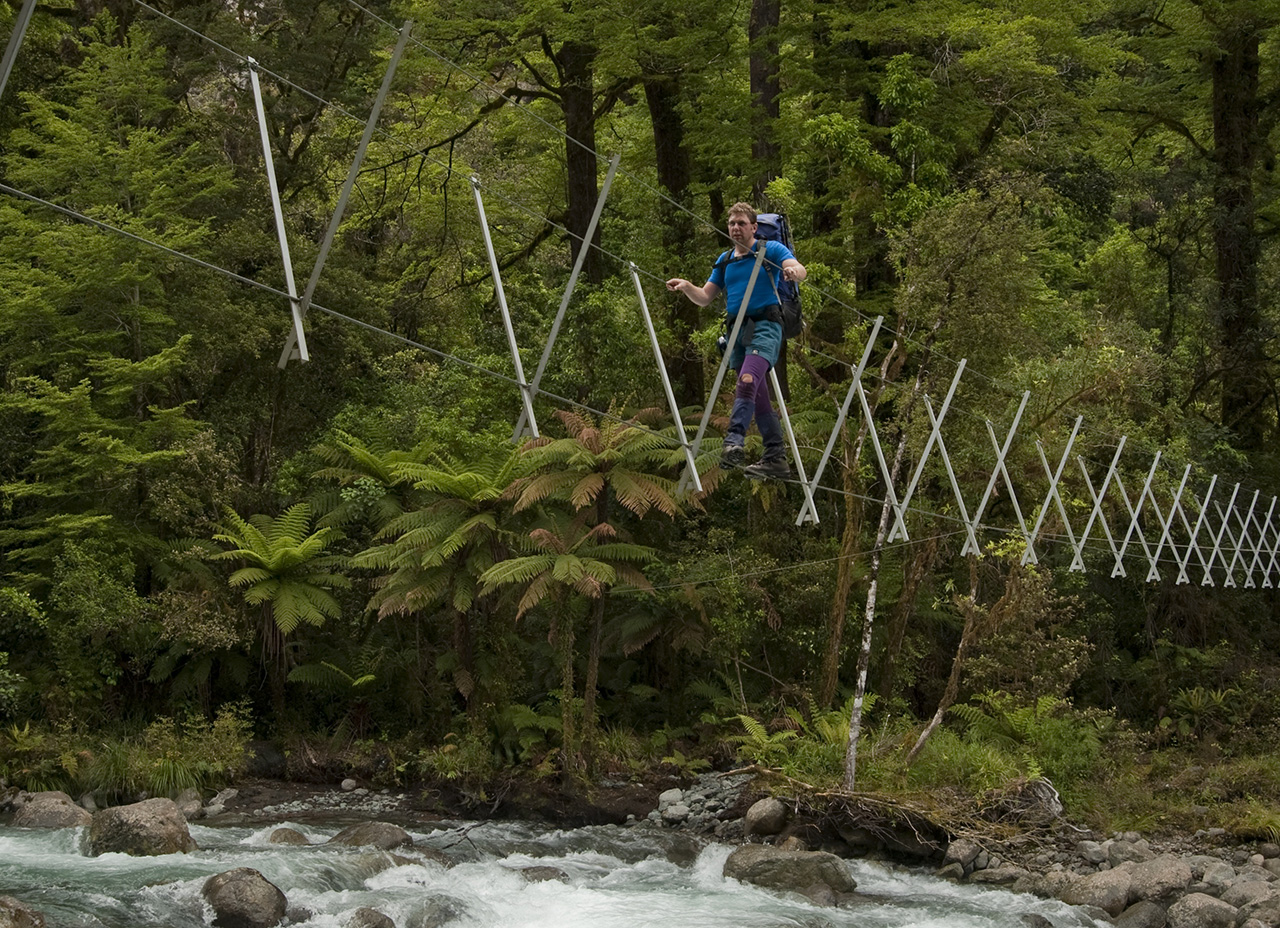
There’s a river below, discoloured and violent, and you’re about four metres above it, hanging precariously onto a flimsy-seeming structure made of a few wires and struts. Every time you move, it wobbles and your pack lurches, threatening to throw you off balance. Progress requires a sort-of duck-legged manoeuvre, planting your boots at an odd angle while wedging your heels hard against the bottom wire. The struts require some negotiation too, lifting your legs high to avoid the tight ‘V’ at the base. But, at last, you’re across – and safe.
Crossing a three-wire bridge is not every tramper’s idea of a good time, but these simple structures have saved lives – or more often – prevented a cold, wet night out. What’s more, they feel considerably more stable than a two-wire bridge.
Wire bridges have been in use since the 19th century. During its heyday between the 1950s and 1970s, the New Zealand Forest Service built a number of two- and three-wire bridges, as they were cheaper to construct than a conventional swingbridge or footbridge. Wire bridges, sometimes called a ‘walkwire’ on topographic maps, aren’t suitable for long spans, but work across smaller rivers or side creeks.
DOC has replaced many walkwires with sturdier structures, but they do remain in a few places.
Once you get used to them, a three-wire can be quite fun to cross.
Tutaekuri River, Kaweka Forest Park
Access to Mackintosh Hut in the Kaweka Range requires a crossing of the Tutaekuri River. From Lakes Road, it’s a steep descent to the river, where a three-wire bridge spans the infant Tutaekuri. Then it’s a steep grunt up to a forested plateau, where the travel becomes flatter. Mackintosh Hut sits at the edge of a pleasant clearing. It’s a good destination for school-age kids; if they balk at the walkwire, the river is usually fordable anyway.
West Matakitaki River, Nelson Lakes National Park
The West Matakitaki River passes through a narrow gorge a short distance above its confluence with the East Matakitaki, and this would be quite a challenge to ford without some sort of bridge. When I first tramped in the park during the late 1980s, the crossing was made on a two-wire bridge, but this has since been replaced by a three-wire one. Crossing is still quite an exhilarating experience, as you’re some height above the river. About a kilometre away, there’s another walkwire over the East Matakitaki River.
Moraine Creek, Fiordland National Park
The Moraine Creek Track provides access to one of the most spectacular valleys in the Darran Mountains, or, indeed, anywhere in the backcountry. Although Moraine Creek doesn’t have a huge catchment, much of the headwaters are glacier-fed; and when in flood the creek is not to be trifled with. Hence this useful three-wire bridge that spans the creek’s lower reaches, where the track continues on up the true left, providing access to the upper valley.