Crossing a river requires planning and careful assessment. Learning to read the hydrology of a river will help you determine the best place to cross.
Where is the best and safest place to cross a river? In the January issue,we discussed tracks, signs, shape, width, depth and hazards downstream. This month we explore further considerations.
Riverbed
Where you can see the riverbed is even, is the easier place to cross. This will be preferably shingle or sand, although care should be taken with soft, deep shingle or sand which could shift under your feet. Avoid rocks which could shift when they are stood on, trap a foot, or need to be negotiated.
Algae may make surfaces slippery. This will be more likely at the edges or in shallow water. Sometimes, in algae-prone shallow water, the mutual support method could be safer rather than walking alone, even in minor river flows.
It is generally safer not to rock-hop to keep feet dry. Rocks may be slippery or move and if you slip you may end up wet from head to toe. You could also injure legs or head, and, worse, may not be able to get up if you land face down in water with a pack on.
Hydrology
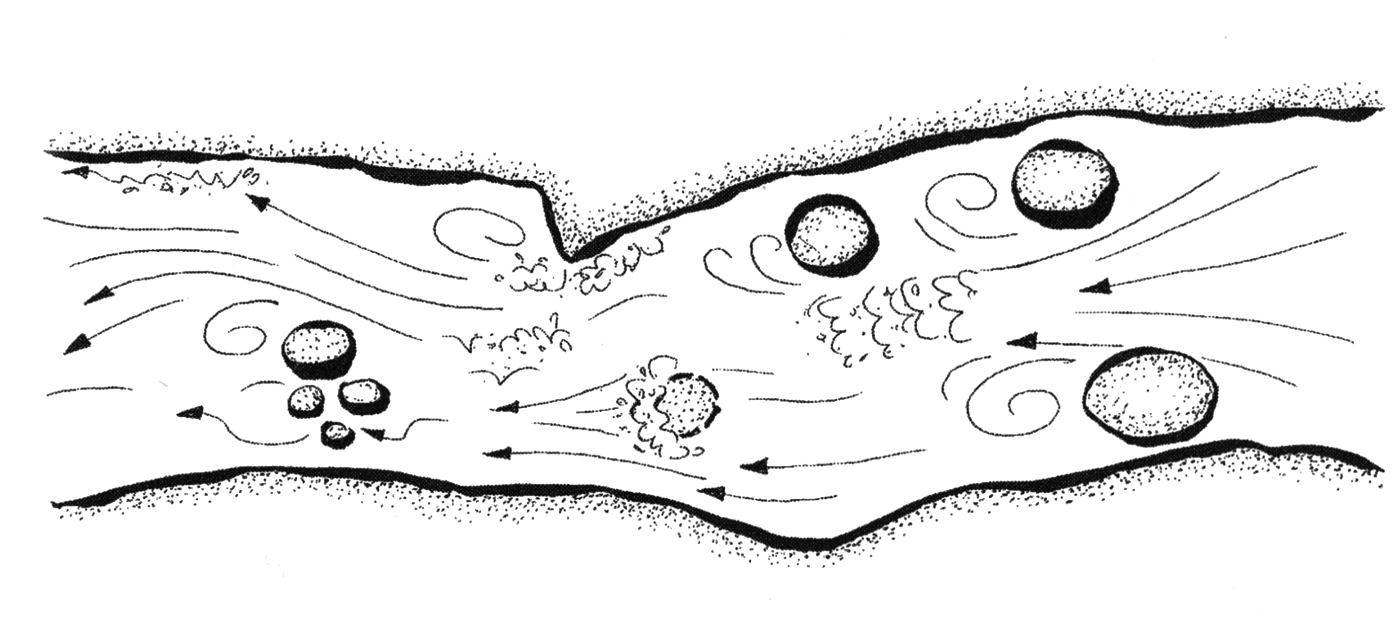
Learn to recognise hydrological features which may indicate a dangerous or safe place to cross.
Eddy: An eddy is swirling water which forms downstream of a boulder, other obstacles, or around corners. Eddies flow in the opposite direction to the main river flow. The line between the downstream and upstream flow is known as an eddy line. This is turbulent and requires effort to cross.

Standing wave: A standing wave stays in the same place in the river and may be breaking or smooth. Such waves form downstream of a sudden narrowing of the river or a submerged rock or another obstacle. There may be several standing waves, diminishing downstream. A person can be pushed under if a wave breaks over them.

Recirculating wave: These waves are always breaking and are full of air bubbles, reducing buoyancy. Water here does not support a person as well as normal water would. These waves can be death traps.
Holes or troughs: These can trap feet or could mean you’re suddenly stepping into deep water. Holes are commonly formed near boulders or obstacles.

Rapids: These are areas of turbulent water from multiple disruptions, such as rocks, that block a river’s flow. People can be injured by hitting these or be trapped against objects. The white water is full of air bubbles and is not very buoyant.

Waterfalls and weirs: These can pull people over them. There is also danger of becoming trapped at the falls’ base in a strong recirculating wave and deep hole.
Entry and exit points
Be sure you can get out of the water at the end, so always consider safe entry and exit points. Avoid a steep climb onto a bank especially if it is undercut or has a slippery or crumbling side. Remember, the force of water will angle you downstream; the exit is not directly opposite the entry point. Also, consider where you would exit if you decide part way through that you need to back out, this will be downstream of your entry point.
What next
Once you have identified where to cross, the next action is to consider how to cross. We will discuss this next month.
Heather Grady is an instructor with Outdoor Training New Zealand