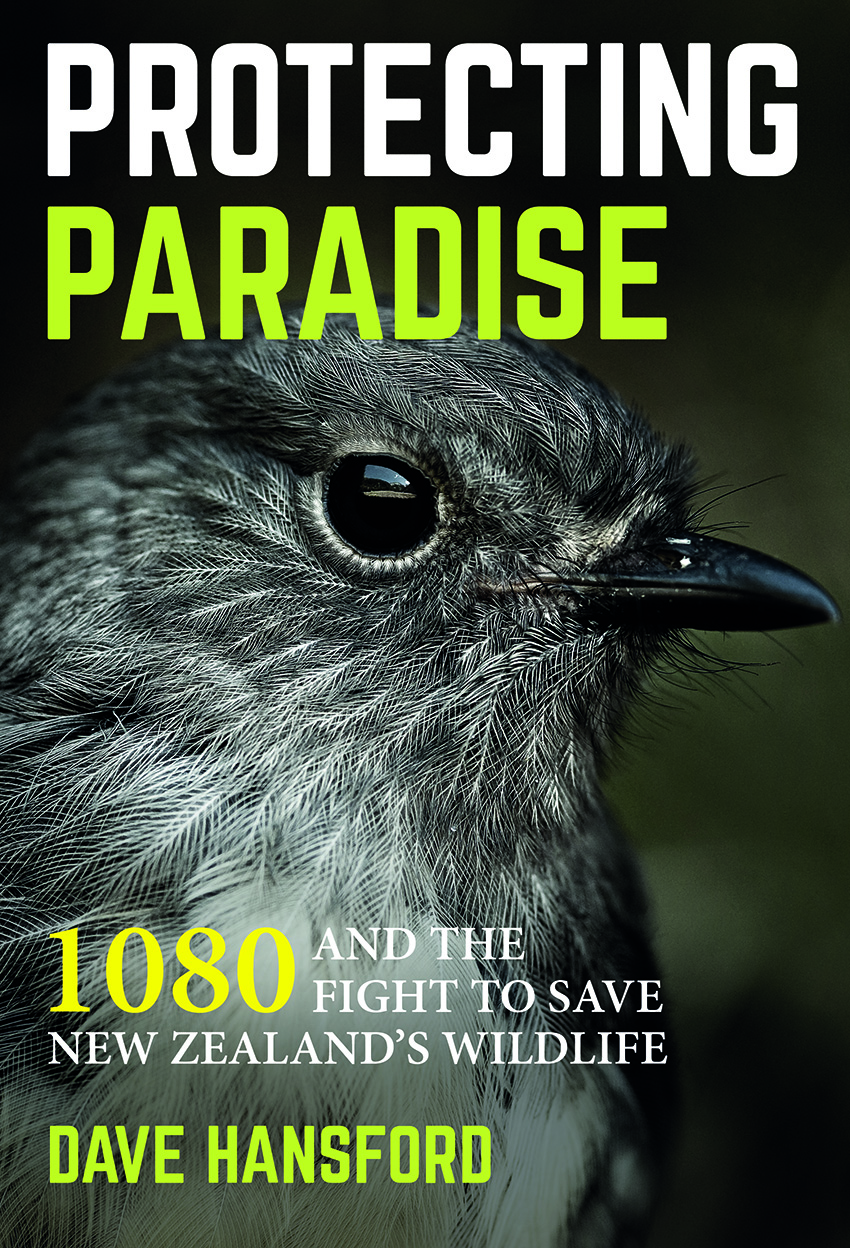
Protecting Paradise
1080 and the fight to save New Zealand’s wildlife
By Dave Hansford
$34.99, Potton & Burton
It’s interesting that books, or films, even peer-reviewed scientific papers, that promote a position antagonistic to your own can be derided, flicked away even, shown to be subjectively biased, bought or influenced by entities with something to gain or hide. It doesn’t seem to matter how strong or weak the evidence; if you simply believe Neil Armstrong and Buzz Aldrin didn’t walk on the Moon on July 21, 1969, or that possums don’t eat meat, or that sodium monofluoroacetate (1080) does more harm than good to New Zealand’s wildlife; that’s pretty much it.
In this book, Dave Hansford takes over 260 pages, plus 30 pages of referenced material, to prove what is self evident to him: that the use of 1080 to control recognised pests does more good than harm and is indeed essential to ‘save New Zealand’s wildlife’.
He does so eloquently and with a refreshing openness that allows plenty of text for detractors, not only of 1080, but also of Hansford himself. He takes a withering storm of slings and arrows from people who accuse him of being a ‘DOC acolyte’, ‘unqualified to judge’, ‘self righteous’ and ‘frankly, a disgrace to New Zealand’ – and they are the more palatable criticisms.
Hansford is a true blue believer. He explains the values of 1080 in great detail, but also allows the other side their say, even if that ‘say’ comes across, mostly, as slightly hysterical and mainly as derision of peer reviewed science, which to Hansford is the Holy Grail.
Yet, what may sway non-believers is Hansford’s ineffable journalistic ethic, which forces him to admit that there are inescapable and daunting issues around the use of 1080.
There are two sides to every story, and Hansford tries hard to unpick them. He recognises that finding the truth about the use of 1080 in New Zealand is no easy task – a problem this book should help resolve.
He can, of course, be accused of extreme bias for pretty much all objections by the anti-brigade are rebuffed. He has answers to all the regulars: 1080 may kill rats, possums, mice, stoats, weasels, ferrets, deer, pigs, goats but it also kills birds, insects, cats and dogs. Carnivores – dogs, for example – are more susceptible to being poisoned by 1080 than herbivores. Omnivores – possums – are quite susceptible. Birds are comparatively tolerant, as are fish. It largely depends on the dose and the body weight of the imbiber. Hansford explains how, why and how quickly 1080 is eliminated from the body. He explains how it deteriorates or disperses in a dead animal’s body, and in water and, for a human, how much meat from a poisoned animal would have to be eaten, and how much water, where 1080 has landed, would have to be drunk to cause distress, let alone death.
Hansford also describes how dosage rates have fallen drastically over the years and how new GPS tracking allows extremely precise drops. He argues that scientific evidence is practical and objective.
He admits the difficulty of arguing against ethical or philosophical objections. Those people who accept that in New Zealand’s unique ecosystem, animal predators and scavengers are wreaking havoc on native birds, reptiles and insects and they would vote to eliminate those predators, but for whom the use of any poison at all to do the job is unacceptable.
Whichever side you come from, this well-researched book, from a journalist who can write, will undoubtedly provide hours of argumentative material.