

Another of Clearwater’s techniques is to analyse and compare the worst-case scenarios of crossing the river and staying put. “The worst thing that can happen if you cross is that someone could be swept away or killed,” he says. “If you have no warm gear and you’re saturated, you could die of hypothermia if you stay put, so it’s not clear cut, but if you bothered to plan and take a tent or survival shelter, you’ll probably have a miserable night, your family might be a bit worried and your boss might be pissed off, but you’ll walk out with a pretty cool story to tell.”
Mountain Safety Council operations manager Nathan Watson has studied New Zealand’s river fatalities extensively, and many of the findings are published in the organisation’s accident insight publication A Walk in the Park?
Since 2008, the council has recorded 21 known river crossing fatalities – though the four most recent cases await final coronial ruling and are subject to change. The most consistent factor discovered in these fatalities has been of trampers attempting to cross rivers they shouldn’t have crossed.
“It might sound obvious, but the most common factor in the last decade has been that element of crossing a river in a dangerous state,” Watson says. “It’s one thing to get into a river that’s running at a low flow and make a mistake or have bad technique, but it’s another thing to get into a flooded or dangerous river in the first place.”
This finding reinforces the importance of river assessment, Watson says, and trampers are advised to stop and think, rather than charge on regardless of consequence.
“Take your pack off, have a drink and something to eat and talk to your group members – you’ve got to take that time and make sure everyone understands what they are comfortable with,” he says.
“In all cases, if a party had decided the river did not look safe and waited or turned around, we would have a bunch more people still with us.”
Watson believes that every river crossing fatality is preventable, as it’s very rare that trampers are put in the position where it’s safer to risk a river crossing than to stay put.
The four questions to ask before crossing
When teaching river safety, Outdoor Training New Zealand encourages trampers to ask four questions before crossing a river.
Do you need to cross? Consider first the necessity of your river crossing. Is there a bridge you can detour to? If so, use it. If not, consider the worst-case scenario of crossing and staying put, and what your options are. Stop, sit, make a plan, and make the decision as a group.
Is it safe to cross? Learning how to read a river is a vital skill for any tramper. How deep are the channels? How fast is the flow? Is the river in flood? Do you have a long run-out in case you’re swept off your feet. Are there any submerged dangers, such as strainers or obstacles you could get stuck on?
Where do you cross? If the river looks safe to cross, it’s important to choose a safe entry and exit point. Avoid under-cut banks, white water and obstacles, and cross where the river is wide and slow.
How do you cross? Finally, consider how you and your party should cross. The mutual support method is encouraged, though not always possible. Practise your technique before attempting a crossing.
“It’s inconvenient to turn around, and it’s not nice to spend the night on a riverbank, but the alternative – even if it eventuates one in 100 times – is tragic.”
Watson says that for experienced trampers, a river crossing should never come as a surprise.
“You should have a good sense of where the known river crossings might be and, if you can, check with people who have been there before,” he says.
“Pay close attention to the weather leading up to a trip – it’s not just about the weather on the day, as you may have had rain over several days falling on large catchment areas.”
If a crossing is necessary, the safest technique is the mutual support method, he says.
As taught by Outdoor Training New Zealand (OTNZ), the technique uses the collective strength of the group to achieve balance and resistance in the flow.
OTNZ volunteer trainer Alex Warriner says the technique is the industry standard for New Zealand.
“It uses the tools that trampers have available with them, it’s simple, it’s safe and it’s effective,” he says.
After checking it’s safe to cross and choosing the safest crossing point, trampers should arrange themselves hip to hip, with the tallest and strongest party members at the upstream end, and the shortest members in the middle.
Chest straps should be unbuckled, but hip belts should remain tight – if you’re swept off your feet you don’t want to lose your pack and it’s an incredibly effective floatation device. Shoulder straps should be loosened enough for members to reach between the back and pack of the person next to them, to hold on to their pack at the hip belt or shoulder strap. If not wearing packs, trampers can grab hold of waistbands, though this isn’t as stable.
When crossing, trampers should remain parallel to the river’s flow to limit drag, and take short, shuffling steps, aiming for a point downstream on the opposite bank.
A solo tramper’s safest option – apart from staying put – may be to wait for assistance from other trampers, though this may be unlikely to occur, depending on the track.
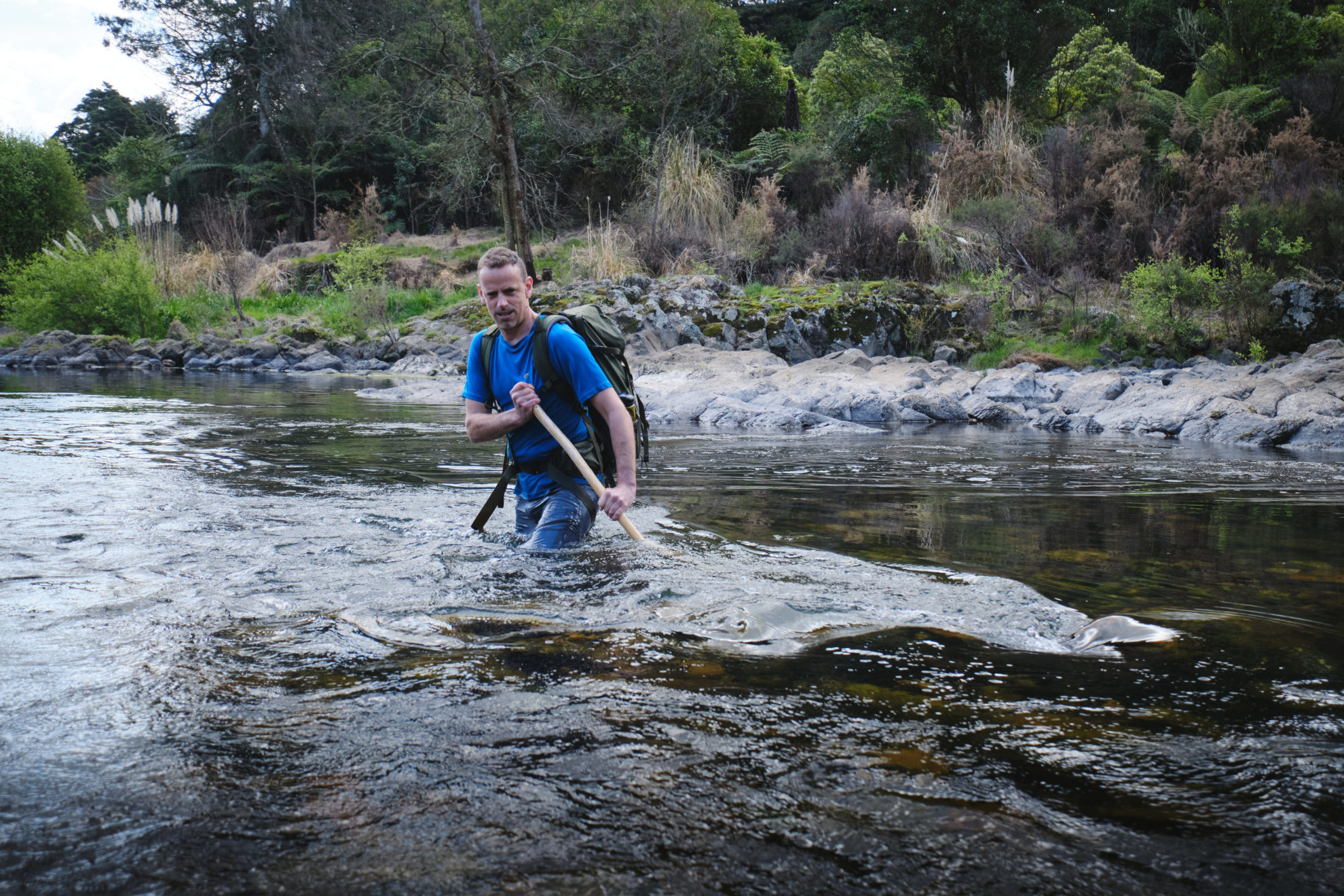
If a long, stout stick is available, solo trampers can use this as a third point of contact to the ground. The stick should be held on the upstream side of the tramper, so they are leaning into the current, and two points of contact should be kept at all times with the riverbed. Warriner says walking poles are not as effective as they are designed for downward pressure and can buckle when weight is applied at an angle. If using walking poles, it’s best to grip both poles together to double their strength.
Warriner says the OTNZ courses emphasise river safety, as crossing a river is rarely ever the safest option available to trampers.
“We don’t want people to think they’ve done river crossing training, so they can go out and do it – we’d rather people have a good look at the river and make decisions based on the tools provided,” he says.
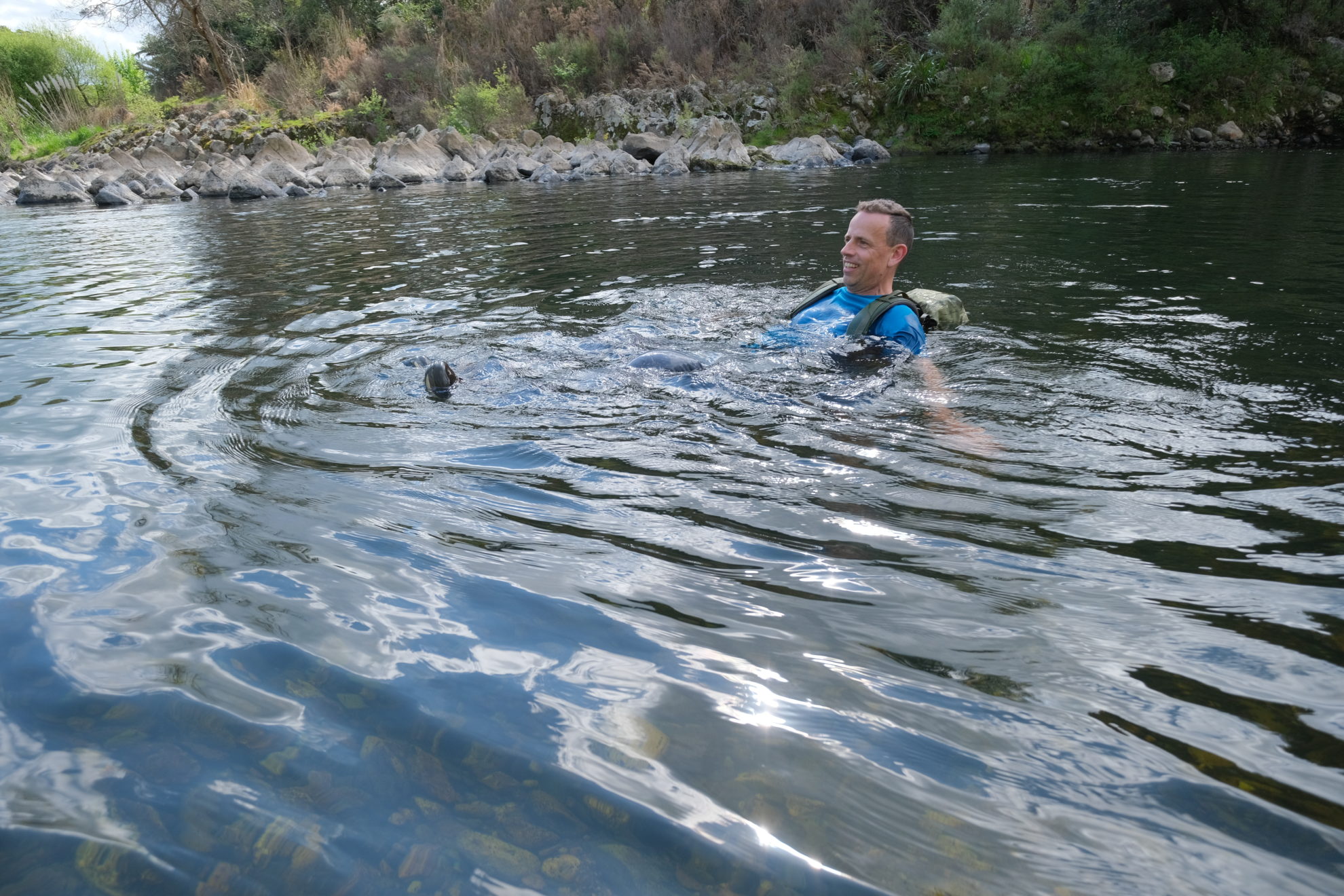
Wilderness attended an OTNZ river safety course in Karangahake Gorge to learn the basics of river safety and river crossing skills. The one day course covered the dangers of river hydraulics, solo and group river crossing techniques, how to safely turn back mid-flow, and what to do if swept off our feet. It also included a submersion exercise and pack floats. The courses have proved particularly popular with Te Araroa Trail walkers, keen to upskill before taking on the 3000km trail.
“We have people who arrive in the country on a Friday, and come down for the course on the Saturday,” Warriner says. “At this time of year, we could run a course every weekend if we had them advertised.”
Nathan Watson encourages trampers to put aside time to upskill themselves, whether through a course or online resources.
“If you’re sitting at home, turn Netflix off for half an hour and engage in an online tutorial,” he says.
And while practise in a river is ideal, it’s not essential for developing the basic techniques.
“Find a quiet road, pretend the footpath is the bank, link up with your party and talk about the process,” he says.
Any preparation that can be made before a party stands on a riverbank is worthwhile, as it’s hard to back out once you’re in the water.
“If things start to go wrong, it’s so hard to correct it,” Watson says.
“Rivers are so powerful, and once you’re swept downstream, you’re at the mercy of the water, rocks and logs. Regardless of how good you are in a swimming pool, people aren’t able to handle river hydraulics – there’s so little you can do.”
As the saying goes; if in doubt, stay out.
Preparing to cross a river
When submerged in a river, tramping gear turns from friend to foe in seconds. Your lightweight down jacket becomes waterlogged and heavy, its insulation properties gone. The pack cover keeping the rain at bay can slip off, fill with water and further weigh you down. Taking precautions before you cross, could be a lifesaver.
Boots: Keep your boots on. Riverbeds are rarely flat and can be slippery, sharp and uneven. Though you’ll have to endure the discomfort of wet boots, damaging your feet is a greater consequence. Removing boots also runs the risk of losing them to the river if you take a plunge.
Gaiters: Worn correctly, gaiters can prevent water from making its way into your boots – especially when crossing shallow rivers where the water does not rise above the top of the gaiter.
Clothing: Wear minimal form-fitting layers on the torso to reduce drag and avoid wearing baggy trousers and raincoats which create drag. Such clothing will also have pockets which can fill with water.
Accessories: Watches, bracelets and rings can get caught on clothing or packs when using the mutual support crossing technique, and should be removed. Hats, sunglasses and electronics should also be stowed in the pack.
Pack cover: In a full submersion, a pack cover can balloon with water and create a huge amount of drag. They can also get caught on obstacles in the water. Stow the cover in your pack.
Pack liner: A waterproof pack liner is the best defence against soaked gear and will provide a great deal of buoyancy in the water. The liner should be compressed as tightly as possible, with the opening twisted and tucked away securely.
Sleeping mats: Foam sleeping mats should be moved to the top of the pack to provide buoyancy around the shoulders. If the bottom of the pack is too buoyant, it can push a person’s head beneath the water.
Sleeping bags: Even if stowed in a dry-bag, sleeping bags should be secured in a separate waterproof bag.



