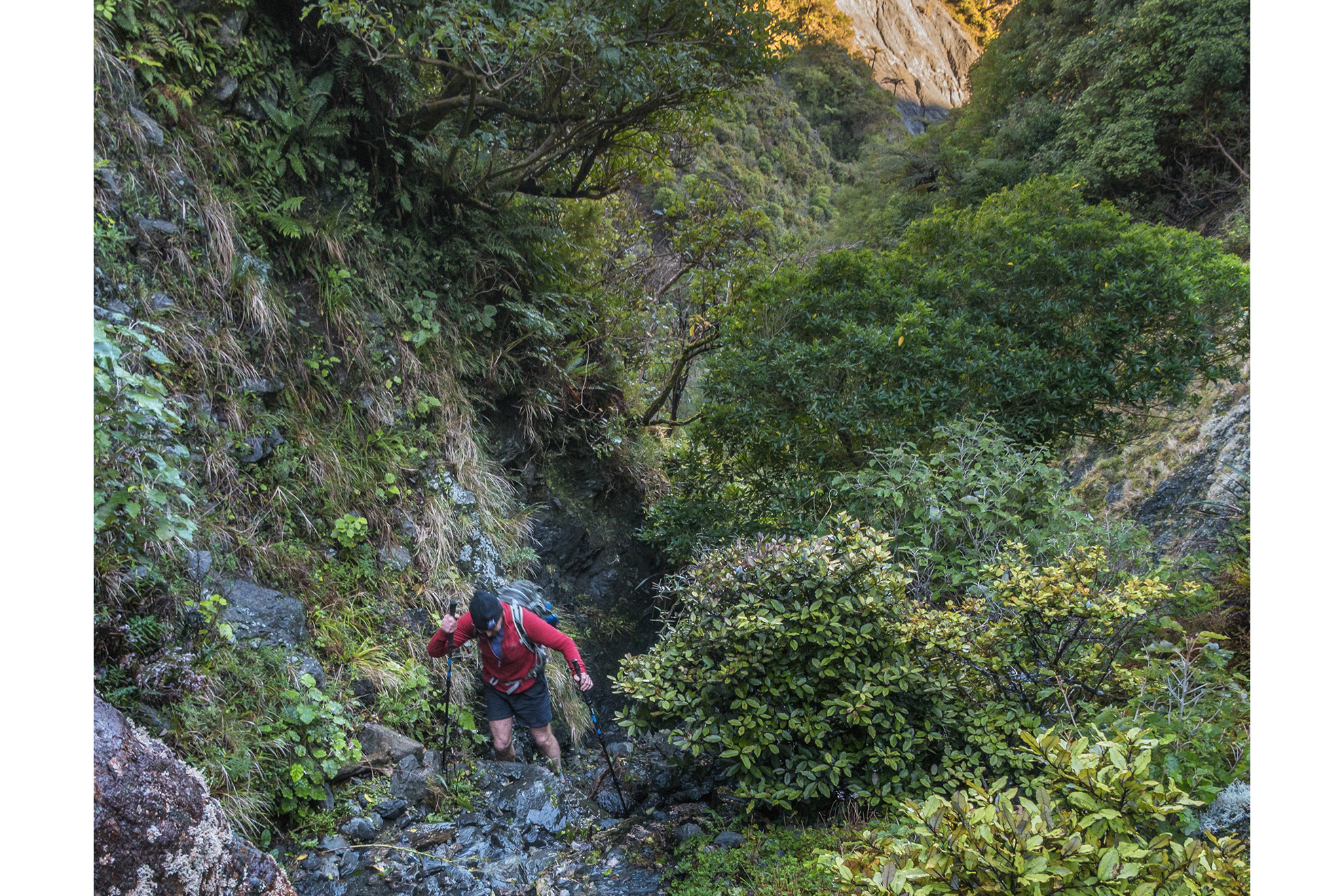
Caro crossing the slightly less exposed northern section of the cheval. Photo: Peter Laurenson

On a knife-edge

February 2023

Read more from

February 2023

The Remutaka Range provides a less challenging introduction to tramping than the nearby Tararua Range, but even here an exciting knife-edge traverse can up the pulse rate.

Sefton wasn’t keen as he eyed the first stretch of what local trampers call the ‘knife-edge’. “Yeah, I’d like the rope thanks,” he confirmed to his dad, Simon. Ahead was a wind-scoured, hard gravelly stretch with very steep drops on either sides. It wasn’t technical, but exposure like this is not everyone’s cup of tea.

For most people, exposure induces a heightened awareness of danger, raising the pulse and encouraging caution. That was on 16-year-old Sefton’s mind as he gingerly inched his way out.

And what lay beyond a small flat spot midway across really did live up to the local name for the infamous Mt Matthews cheval – a climbing term indicating a section of ridge so narrow legs dangle either side as it is traversed. While it doesn’t compare with the famous, much higher Malte Brun cheval, which is hard, stable metagreywackes, it still exudes menace. The Mt Matthews’ version is a type of slippery, crumbling, unreliable sandstone.

Mt Matthews, 941m, is the highest point in the Remutaka Range. The range is seen by many as a good introduction to the higher, more challenging Tararua Ranges to the north. The Orongorongo River wends through Remutaka Forest Park on its way to the coast, just to the west of Turakirae Head. Though the Orongorongo can be dangerous in heavy rain, its wide stony flats also offer easy travel deeper into the park.

I’d used this approach on two previous climbs of Mt Matthews via its well-trodden north ridge track to South Saddle, then on to the summit. From the top I’d looked along the steeper east ridge towards North Saddle and thought it would be a worthy route to take one day.

I later searched online for route information and found links to several Tararua Tramping Club trip reports, plus an entertaining video by Paul McCredie (set to the Mission Impossible theme music). I contacted Paul who explained that the route from North Saddle, along the knife edge, is an epic trip.

“It’s just one of those trips passed down through the generations by word of mouth,” he said. “And please don’t call it a cheval – we’re talking bush mountaineering here, not that poncy alpine club tweed jacket stuff.”

Paul told me it was said that Daniel Riddiford, a settler who arrived in Wellington in 1840 and then purchased land in Upper Hutt and Orongorogo, tried North Saddle as a stock route to the Wairarapa. Judging by what I’d seen from Mt Matthews’ summit, Riddiford was some optimist.

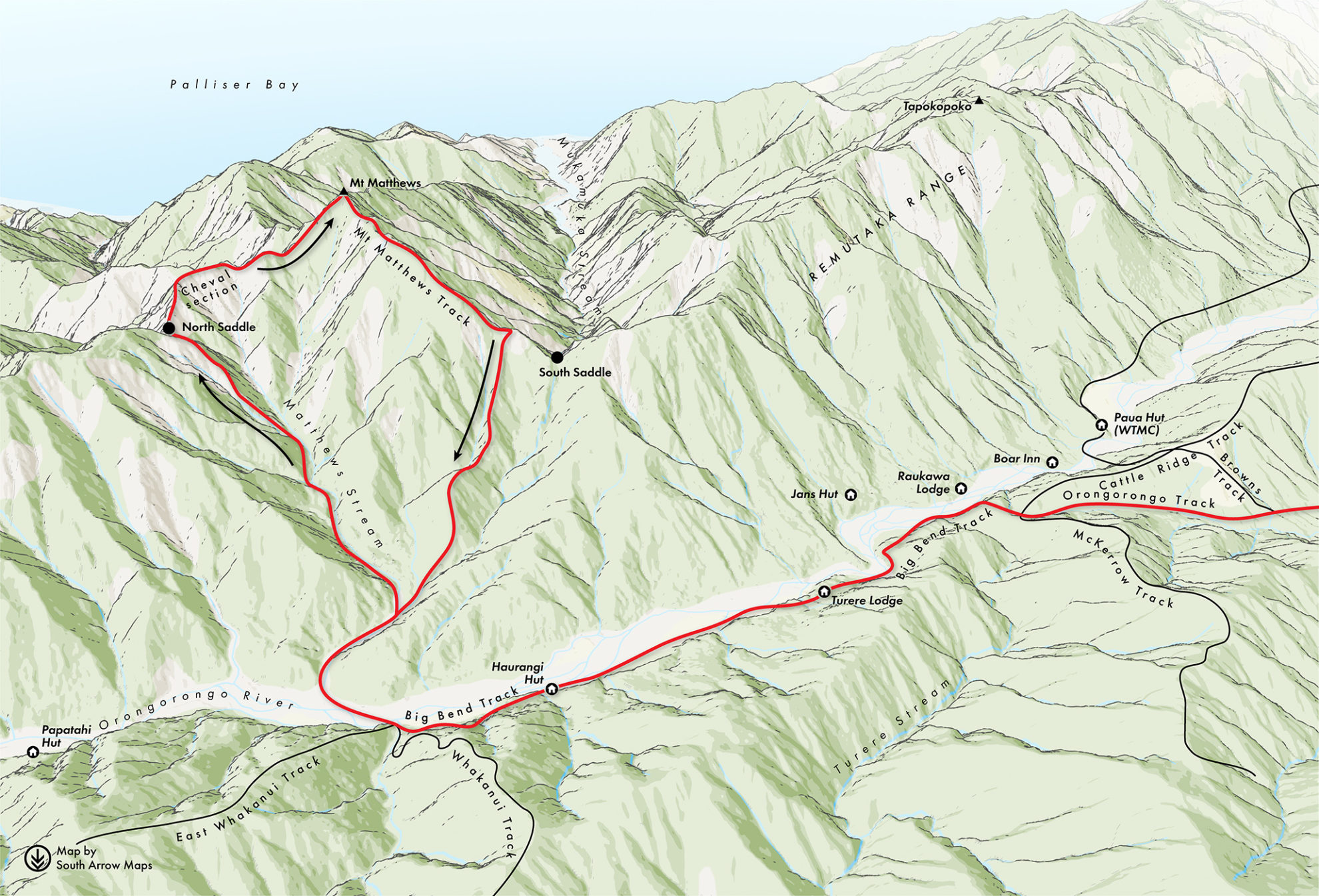
The weather was calm and clear. My companions Simon, Caron and Sefton were travelling light – day packs and trail shoes. The plan was to access the North Saddle, to the northeast of Mt Matthews, via Matthews Stream. Then we’d head up the craggy ridge, via the cheval (sorry Paul – I’m a New Zealand Alpine Club member), over Mt Matthews and down the well-trodden Mt Matthews Track, a trip expected to be about eight hours return.

We set off at dawn, leaving plenty of time to get back before the Catchpool Campground gate was locked at 6pm.

We made good progress up the Orongo- rongo River, then up Matthews Stream. I enjoyed the climb up the streambed, finding it easier than expected. Being an off-track route, I checked off each tributary stream on my topo map and Garmin altimeter, confirming we were where we thought we were. Eventually, we reached 460m, the point where we understood the route to head steeply up through bush to North Saddle. A tributary stream appeared that was not marked on the map, but pink triangles just visible in the narrow gloomy gut indicated this was our route.

February 2023

Read more from

February 2023

Ascending the side stream leading east towards the ridge and North Saddle. Photo: Peter Laurenson

I was leading, working hard to keep tabs on the sometimes difficult-to-spot triangles and weather-beaten pink tape, and excitement was building to get up onto the ridge top. At a steep waterfall, there was no evidence of triangles or tape. The others were taking quite a while to join me so I carried on up what appeared to be the smear of a trail. It also remained in clear terrain, avoiding dense undergrowth to the right.

As I cleared the waterfall Simon emerged from the gut below, shouting for confirmation as to whether or not my route was best. I was starting to question this, so gestured that either to his right (which proved to be the correct route) or following me were options. Going right into dense undergrowth wasn’t appealing, and I wasn’t keen to downclimb, but in such perfect conditions I figured I’d keep climbing until I reached the ridge, then follow it to the right until it led me back along to the saddle, where I’d rejoin the others.

As I climbed towards the ridge, the vegetation became very dense. I picked up pig trails on my knees then stomach, grovelling through gaps in the stout trunks and rotting branches only just wide enough to let me through. Then the bush lawyer made its appearance. The park was feeling less and less like a nice soft pre-amble to the Tararua Ranges.

Reaching the ridge, I was relieved to see the pink triangles reappear. I concluded that if I stuck to them like glue I’d soon be at the saddle. The triangles led off down the ridge, which  was exactly what I expected to see.

After about 20 minute’s I sensed I should’ve reached the saddle by now. My altimeter revealed that I’d dropped 250m, placing me below the 620m saddle. Then a clearing in the trees revealed a lovely view of the North Saddle and the entire ridge leading up to Mt Matthews, now above me and stretching off to the distant south. So, back up the bogus spur I went. It was a well-marked pest control line heading 90-degrees off from where I should have gone. Back at 800m and now aware that my instincts had been wrong, I carefully searched and found another pink triangle-marked trail. This time, it led to the saddle. The tiny distant figures of the others were waiting for me at the cheval.
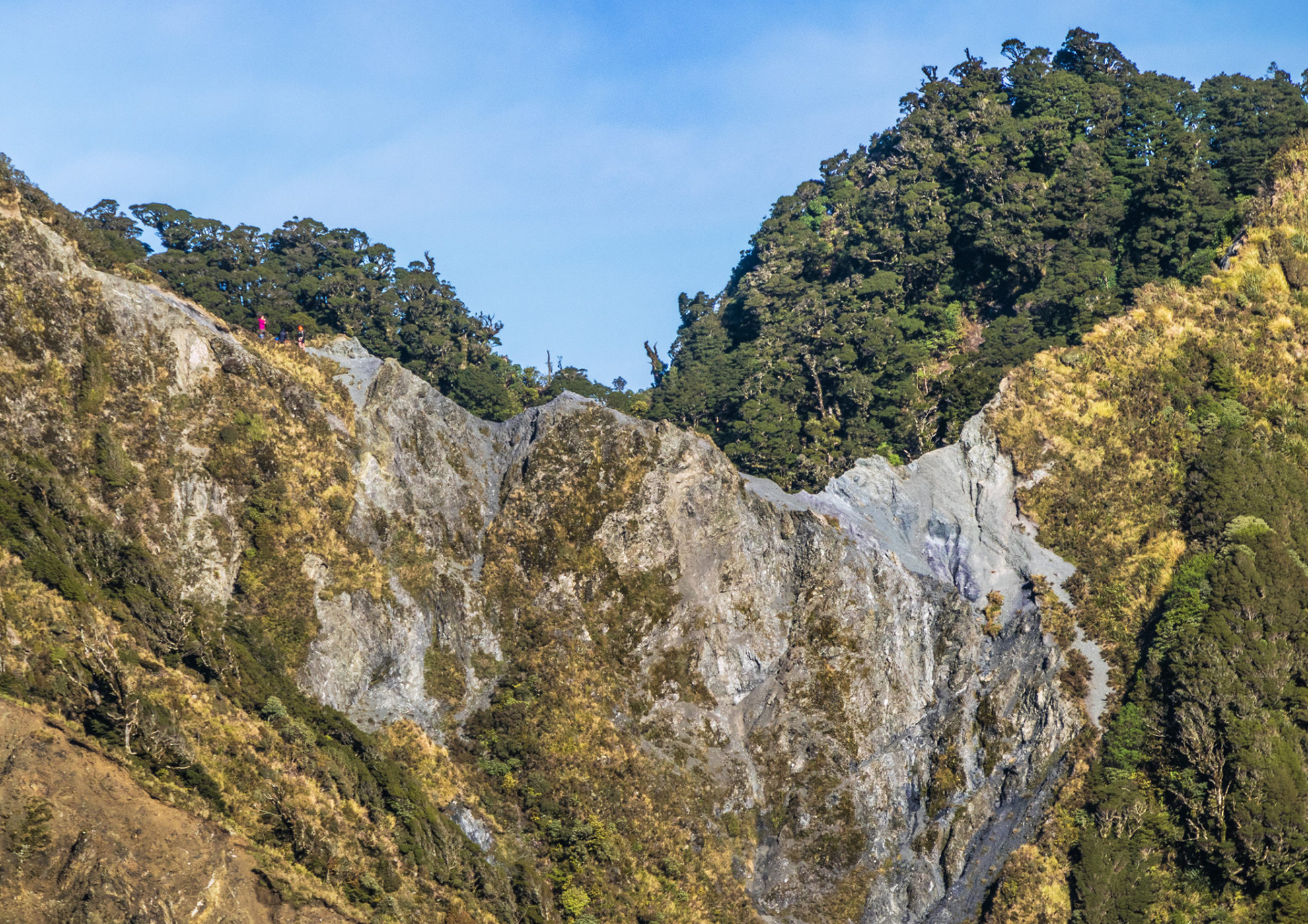
The knife-edge, or cheval, viewed from about 700m, above North Saddle. Photo: Peter Laurenson

A few more ups and downs and I was with the others. I took a breather while Sefton worked his way across to the mid-point of the exposed section of the cheval. Simon, who had gone across first, was already eyeing up the main challenge beyond the mid-point; it was knife-edged. Stretching perhaps 20m was a steep section of exposed silty rock. It was firm but brittle and, in places, unreliable. On either side of the knife-edge were drops, but the southern side was the biggest menace – certainly a no-fall zone.

Fortunately, it’s possible to drop below the knife-edge on the north side to avoid having to cross it, which is what Caro and Sefton did. Being nimble, Simon made it look quite reasonable, until the final few metres where he resorted to straddling the knife-edge like a horse – just like many climbers do on the Malte Brun cheval. Getting off the knife-edge onto more stable grass-covered ground proved to be the crux.

I followed, testing each hand and foothold before weighting it to make sure it wouldn’t crumble. After some grunting and sweating I also found myself ‘straddling the horse’ just below the grass. I stood up carefully and positioned myself to lunge upward as Simon had done, but I couldn’t quite get into a failsafe position. The cliff on the south side seemed to suck at my back and my tired left leg didn’t feel up to the challenge. I decided this was no place to take a leap of faith so sat back down and bum-slid my way down the north side to join the low trail.

Above the cheval we climbed steeply for about 230m up scrubby, bushy terrain to Mt Matthews. That familiar spot was reassuring and the clear afternoon light allowed us to view the Inland and Seaward Kaikōura ranges to the south.

The Mt Matthews Track is rugged to begin with, but soon becomes a well-trodden trail. We had a problem though: it was now past 3pm and we still had a good 1300m of descent and 11.7km to cover in three hours. A forced march at the end of a hard day wasn’t ideal, but we did manage to hobble into the car park just minutes before the gates were locked.

My Garmin watch told me I’d walked 42,000 steps that day – and so did my thighs. I was barely capable of stairs for several days afterwards. Several toenails also died a miserable death.

We’d learned that the cheval and the route leading to it deserved respect. Even the relatively low-lying Remutaka Range can offer worthy challenges if you choose to take them on.
Distance
24km
Total Ascent
1807m
Grade
Moderate / Difficult
Time
8-10hrs
Accom.
o get aAn early start or to avoid concerns about becoming locked in, camp at Catchpool Valley Campsite. If you want to stay nearer the base of Matthews Stream, Haurangi Hut and Turere Lodge are options.
Access
From Wainuiomata, follow Coast Road to the Kotara Downs turnoff to Catchpool car park
Map
BQ32
Peter Laurenson

About the author

Peter Laurenson

Peter is a tramper, occasional climber, photographer, editor and writer. His adventures, spanning 30+ years, come together on his website ‘OccasionalClimber’. Richmond-based, Peter is editor of FMC’s Backcountry and has published three books: Occasional Climber (2013) and Khumbu (2021) and Aotearoa Light (2025).

More From February 2023

More From February 2023

Related Topics

Similar Articles

The Tararua’s forgotten traverse

The past beneath our boots

High country gold

Join Wilderness. You'll see more, do more and live more.

Already a subscriber?  to keep reading. Or…

34 years of inspiring New Zealanders to explore the outdoors. Don’t miss out — subscribe today.

Your subscriber-only benefits:

All this for as little as $6.75/month.

1

free articles left this month.

Already a subscriber? Login Now
