

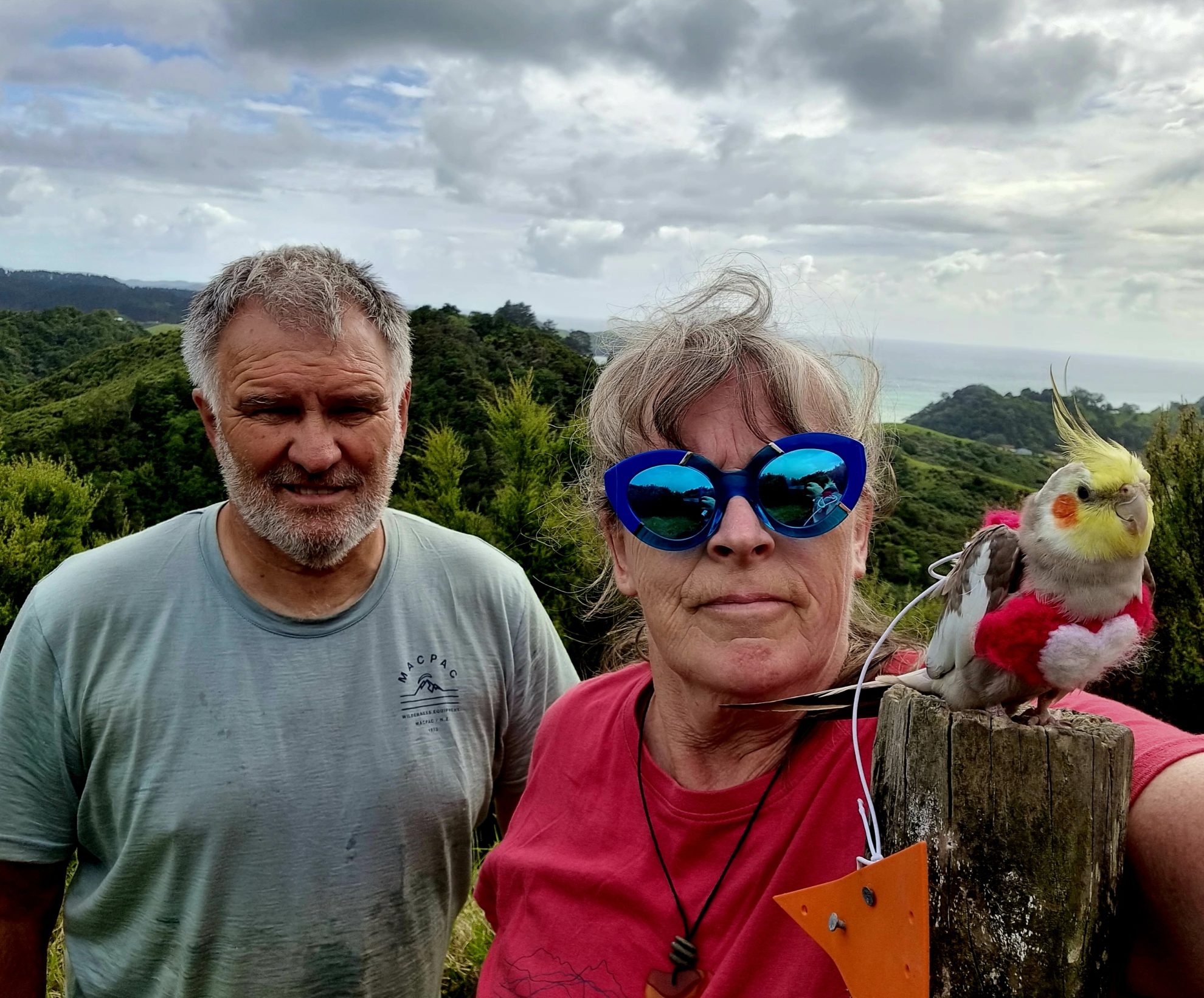
At 13cm tall and covered in feathers, Ollie isn’t your average Te Araroa walker.
With one crippled leg and sporting a snazzy hand-crocheted harness and leash, you’d be hard-pressed to find another on Te Araroa quite like him. You could argue he’s more of a passenger on this journey as he is usually found perched on the shoulders of his adoptive parents, Robyn Chappell and Andy Williams. The trio, who are section-walking Te Araroa, are raising funds for Te Araroa Trust. When I caught up with Robyn she was busy planning their next section, keen to pick up where they left off in Kerikeri but aware of the trail conditions due to recent flooding and wild weather.
But what makes two self-described ‘ageing Teletubbies’ head out on a 3000km walk with their beloved pet cockatiel?
“I really needed to get off the couch,” says Robyn. “I wasn’t fitting my clothes and I needed to get fit and I thought, how can I do this in a dramatic way?”
Not one for the gym, Robyn pondered the idea of walking Te Araroa, and once that seed was sown she was bound to the trail. But it was a shaky start. Lockdowns and regional border closures around Hamilton and Auckland in spring 2021 prevented them from starting at Cape Reinga.
“It just didn’t feel right. It was a bit of a shambles to be honest,” Robyn says.
After some arduous tramping and plenty of road walking around Whanganui, they returned home. But once regional borders were removed, Robyn, Ollie and Andy returned to the trail – this time to where they had dreamed of starting, Te Rerenga Wairua.
They had just enough summer left to finish the Cape Reinga to Kerikeri section and were ecstatic with the result. Ollie seemed quite at home on the trail, with new views and plenty of dried kiwifruit snacks.
“You can’t keep a bird in a cage. He’s got to be the most-travelled cockatiel that exists,” says Robyn.
But the typical notion of smashing out Te Araroa in one season is a foreign concept to these three.
“It’s not really just about the trail for us. It’s a goal, but it’s about getting out there and doing something different while encouraging others to get out there too,” says Robyn. “It’s a way of connecting people.”
And while the trail has had its highs and lows, Robyn found that what made it really special was that there are no rules.
“Andy and I have to remind ourselves it’s not a race. There is no right or wrong way to do Te Araroa. If a crippled cockatiel can do it, we can get off the couch and do it too. I know we don’t fit the typical image of Te Araroa walkers, but nature isn’t just for the elite, it’s for everybody – even ageing Teletubbies like us.”
Ollie and his parents aren’t alone in challenging the stereotype of a Te Araroa walker. Smash, who started walking Te Araroa northbound in January, has been challenged by health conditions, including bipolar, fibromyalgia, ADHD and endometriosis. At the height of the Covid pandemic she moved home to New Zealand after a stint in Australia, but her poor health meant she wasn’t able to do many of the things she usually enjoyed.
“I was too scared to go out with mates, I was too scared to go out into the bush on my own because I was unsure if I could look after myself,” she says.
But instead of becoming a recluse, Smash used fear as a motivator for starting Te Araroa.
“Anytime I realise I’m scared of something, I push against it. I try at the very least to give it a go. I knew that if I walked the length of the country I wouldn’t be scared anymore.”
Another motivation for walking Te Araroa is raising funds for the Adventure Specialties Trust so others with health conditions, including mental illness and chronic pain, can experience adventure therapy through the trust’s Inspire programme.
“My dream is to raise enough money so that 10 adults can feel the healing benefits of nature and find their own confidence and inspiration,” says Smash.
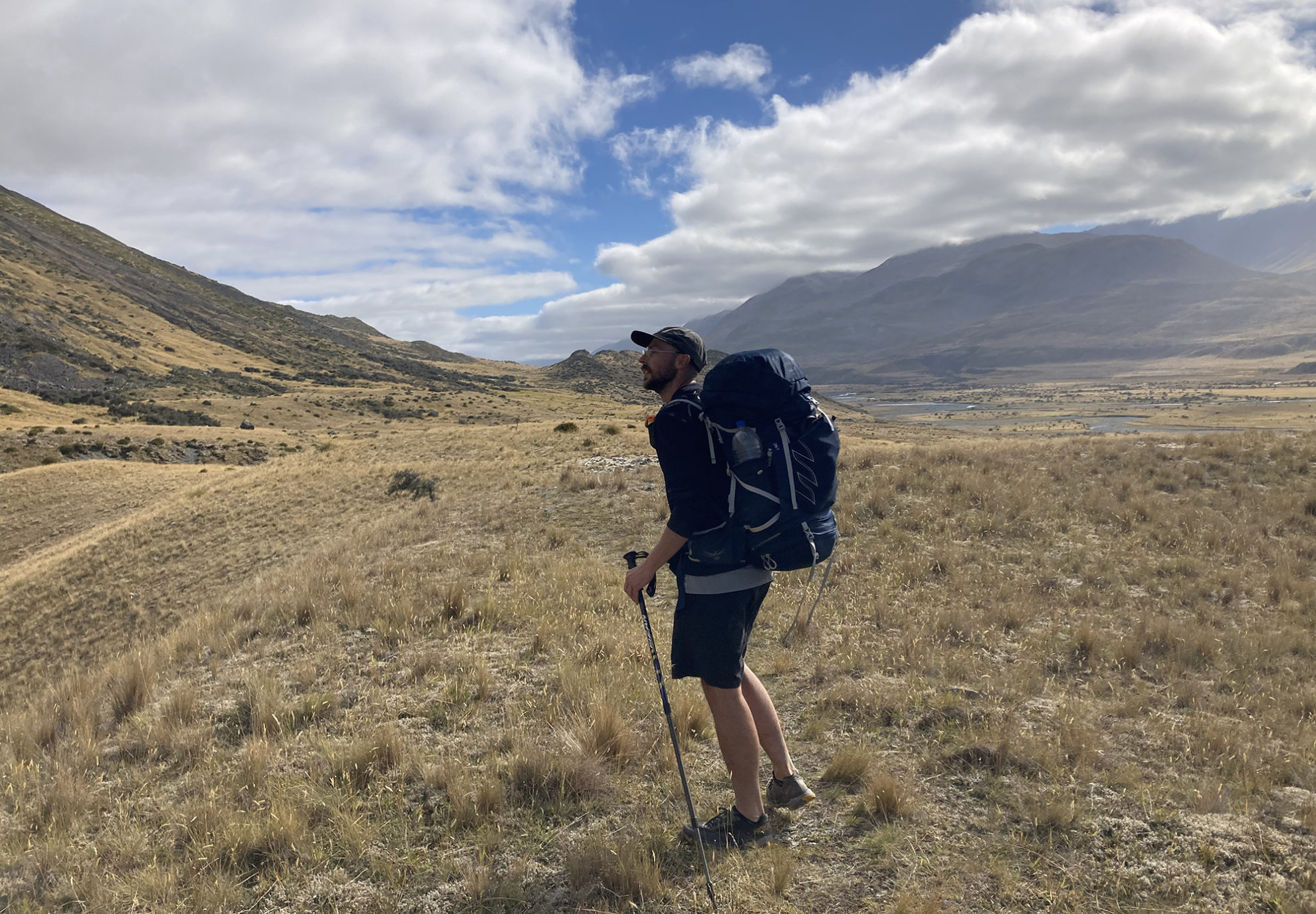
She set off from Bluff with a huge backpack of supplies and everything in order to keep her wellness in check, but on the Greenstone Track she met her biggest challenge. After a stressful week she arrived at Greenstone Hut knowing things weren’t quite right.
“I didn’t realise that I was going manic [into a manic episode]. I ended up there for three days just trying to sleep.”
Smash spoke openly with other trampers at the hut and left a note for the hut warden detailing what was happening. “There wasn’t much they could have done but it was nice to know they were there.” She decided that the best thing was to head to Queenstown.
“On my last night at Greenstone Hut a group of hunters shared venison with the rest of us and we spent the evening chatting. It made me really happy. It’s still one of my favourite nights on the trail, even though I hadn’t slept for a week at that point.”
Smash had a painful walk out but had good company in new friends: the hunting party had waited and gave her a ride to Queenstown.
“I expected to camp there for another night,” she recalls. “It was really nice to be around so many people who care but who also just leave me to it. I can do stuff – it just takes me longer and it might hurt a bit – but it was awesome to have that level of support.”
So when the going gets tough, what keeps a Te Araroa walker going? No stranger to the unexpected, Blake Acklin, who was diagnosed with multiple sclerosis in 2017, completed the South Island section of Te Araroa in May this year. He walked to raise awareness of what life with MS is really like, as well as raising funds for the Otago Multiple Sclerosis Society and the Multiple Sclerosis Society of New Zealand.
Blake started off southbound on the Queen Charlotte Track but struggled with his knee, doing damage to his patella. He took time off after completing the Pelorus River Track, and after some quick R&R was back on the trail, this time northbound from Bluff.
He walked through much of Southland before being struck down with food poisoning after some dodgy lamb’s fry at Aparima Hut. Blake took three weeks to recover before once again resuming the trail. Third time lucky. His knee was improving and Te Araroa was etched in his mind.
“On the Motatapu Track I did three big climbs in one long day, and on the third-highest point I was dancing and just so fizzed,” he says. “It was the moment when I realised my knee is not in pain, I feel great, I can do this.”
These are the moments that Blake wants people to know about. There are lots of different realities to MS but, as Blake says, “most aren’t very positive or informative. The stories of good health, which is really important, aren’t talked about very much especially for those who are newly diagnosed.”
Trail logistics for Blake include six-weekly infusions of Tysabri, a drug that helps control some of the symptoms of MS. “I definitely winged it,” he says. “It was a bit of a rollercoaster but everyone has been so supportive – the DHBs, the nurses, they’ve all been so invested in my tramp, it’s been awesome.”
Blake has created many friends and allies through sharing his story: “You create these bonds with people. You might only be sharing one night in a hut but there’s something about the shared struggle, the shared vulnerability. I’ve taken away a lot from that.”
And, while he never set out with the intention of Te Araroa being a profound experience, he finished the trail in deep contemplation of how he wanted to live life. “I was learning so much on Te Araroa. I knew it would help me when I got home. There was much more meaning to the walk than I expected.”
And, while you are more likely to see solo 20-something-year-olds on Te Araroa, you aren’t so likely to see a newborn, unless you met Aaron, who at two-and-a-half months may have been the youngest person on the trail. The Meththas were one of the few families to walk Te Araroa last summer. Asanka, Mariya and their three children, Alexander (10), Victoria (8) and their now 11-month-old baby Aaron, completed the South Island but started first in Northland.
“When we started in Cape Reinga we were terrified,” says Asanka.
He and Mariya quickly learned to trust in their parenting skills. “The more we walked, the more confidence we had. We obviously had to be careful, but we also realised we didn’t have to be overly cautious. Everything was by trial and experience.”
34 years of inspiring New Zealanders to explore the outdoors. Don’t miss out — subscribe today.

Questions? Contact us



