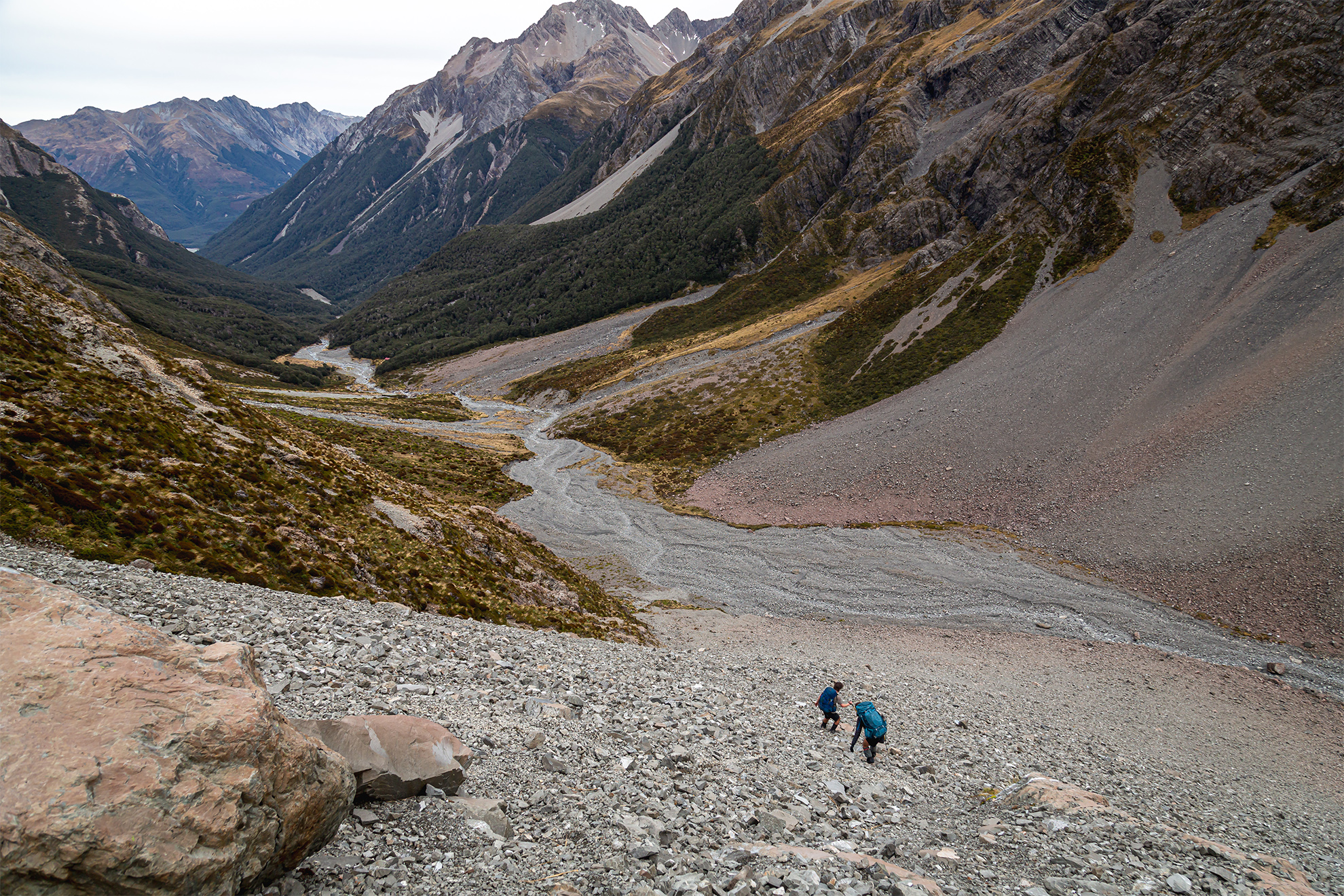
Running and leaping down a scree slope is an exhilarating way to descend a mountain. Photo: Sam Harrison

Moving with the mountain

December 2024

Read more from

December 2024

Climbing scree is laborious, but running down it is a stirring, rapid-fire way to cover ground – once you get used to the sensation.

Canterbury has some of the best scree slopes in the country, and the descent from Avalanche Peak to the Crow Valley in Arthur’s Pass National Park is among the most memorable. 

On a free weekend I managed to convince three friends to come with me to see it for ourselves.

Avalanche Peak is the most frequented peak of the pass, despite its 1000m grunt. The climb was sweat-inducing, even in the cool autumn weather. Eventually the bush gave way to an alpine environment dominated by golden tussock and rocky slides. 

We reached the peak late in the morning and shivered and snacked there for 15 minutes before leaving the crowds behind for the scree. 

After an initially steep drop off the peak, we travelled northwest, capitalising on the scree cover to traverse the slope quickly, descending as we went. The route was unmarked, requiring careful attention to detail to ensure we stayed on track. It was definitely not a place to be in poor visibility. The ridge ahead was impressive, if not a tad intimidating. Mt Rolleston loomed in the background, its flank covered by the Crow Glacier. 

I have a special reverence for that landscape. In June 1966 my great-uncle John Harrison, an accomplished mountaineer, was killed by an avalanche while camping on the infamous scree slope known as the Otira Slide. He was just 33. The tragedy was compounded by the fact that he was with a search party for four young climbers who had not returned from attempting the Otira Face of Mt Rolleston. 

We continued along the ridgeline as it undulated, alternating between barren rock and tussock. To our left a number of gullies cascaded towards Crow Valley, and although it was tempting to go down one, our route notes warned against it. Instead we followed occasional rock cairns to Pt1658 where we had our first view of the route down: 500 vertical metres of scree. Crow River looked impossibly small beneath us, dwarfed by the rocky bluffs under Mt Lancelot. 

To enter the scree field we continued 100m along the ridge to a lonely warratah that signalled it was finally time for the descent to begin. 

December 2024

Read more from

December 2024

Near the valley floor scree gives way to larger rocks and boulders which require more care to navigate. Photo: Sam Harrison

What is scree?

Scree. A steep, often unstable slope on a mountainside formed by a mass of stone fragments and other debris (Oxford English Dictionary).

Scree slopes in New Zealand are commonly formed either by the accumulation of scoria from volcanic eruptions, or by the shattering effect of the freeze–thaw cycle (where water filters into cracks in a rock face then expands as it freezes, chipping off pieces of rock). Scree can be found all over the country and provides a unique habitat for   a range of flora and fauna, including pīwauwau rock wren and tutāhuna vegetable sheep.

Climbing a scree slope is often one step up and two steps down, a harsh reality experienced by anyone who has climbed Taranaki Maunga. But scree running offers a rapid descent where an ascent might have taken hours. It takes advantage of the slope’s mobility and is a thrilling way to lose altitude.
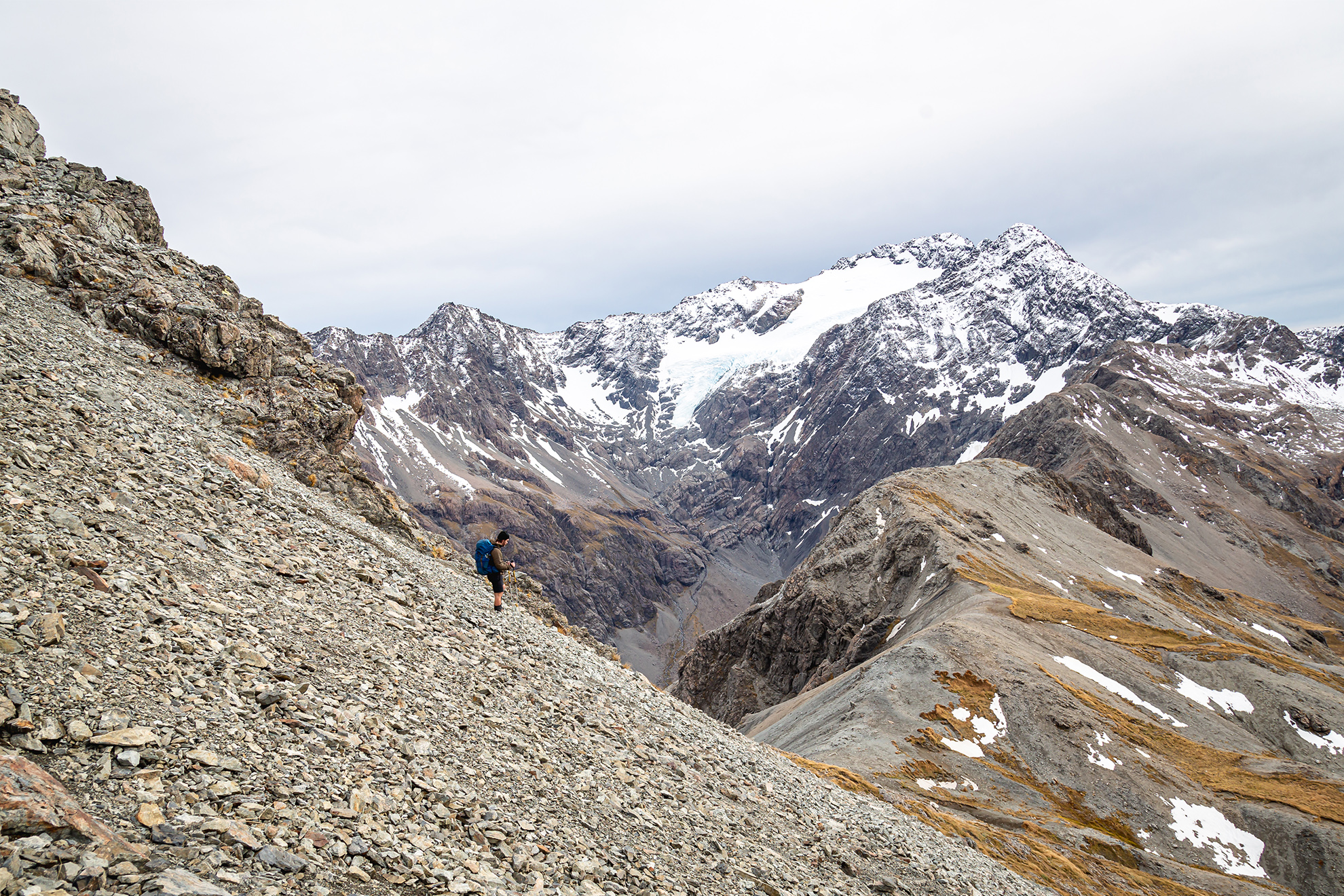
Scree is much easier to descend than to ascend. Photo: Sam Harrison

As I fiddled with my camera the others set off, quickly becoming ants in the landscape. My pulse quickened as I looked down: there would be no going back.

I launched over the edge, my heels digging into the loose rock as I picked up speed. Dust kicked up behind as my legs flailed and the scree moved down the mountainside with me. It was hard not to grin; I felt alive.

I caught up with the others quickly and we made our way down together. There were a few tumbles but the scree was forgiving, often softening our falls. The hardest sections were the sudden transitions between soft scree and immobile rubble, and at these our feet sometimes remained planted while the rest of the body kept moving. On the lower sections larger boulders had to be negotiated carefully.

The terrain flattened as we approached Crow River. Those without gaiters emptied their boots of rogue stones. I wiped the sweat from my brow. What a descent that had been! As my heart rate returned to normal, I looked back at the slope and felt grateful that I didn’t have to go up it – climbing scree can be a matter of one step up and two down. A painful business.

We set off along the rocky banks of the river. About 300m before Crow Hut we climbed to the right away from the river to traverse some open scree, then passed through a short section of forest to reach the hut.

The following day we walked out down the Crow Valley Track, which spat us out on the expansive flats of the Waimakariri River. We made good progress along the river’s many braids to Klondyke Corner, where I had stashed a bike. Cycling back to the car with legs that still felt like jelly from the day before, I reflected that I wouldn’t be forgetting my descent down the Crow Valley scree anytime soon.

Tips for tackling scree

Scree travel can take longer than expected, even downhill. It can also take a while to adjust to the way scree moves beneath you. 

Here are a few tips:

1. Be aware of your surroundings – if possible, avoid walking directly above others to mitigate the risk of rockfall.

2. Know your route – make sure you know where you are before going down scree to avoid ending up in a dangerous situation.

3. Understand the conditions – in cold weather scree can freeze into a solid mass. Avoid if possible.

4. Dig your heels in – this will help stabilise you with each step and help you retain control of your descent.

5. Wear gaiters – otherwise the scree will fill your boots.

Sam Harrison

About the author

Sam Harrison

Sam Harrison is a chocolate addict who tramps on the side. When he’s not in the bush he can be found pushing paper for a government department in Te Whanganui-a-Tara. Sam graduated from the University of Otago in 2021 with a Bachelor of Law, a Bachelor of Arts, a large student loan and a love of all things tramping. He is easily identified in the hills by his oversized camera and his distinctive knack for finding type II fun.

More From December 2024

More From December 2024

Related Topics

Similar Articles

Lessons learned the hard way

How to clean your sleeping bag

How to treat a wasp sting

Join Wilderness. You'll see more, do more and live more.

Already a subscriber?  to keep reading. Or…

34 years of inspiring New Zealanders to explore the outdoors. Don’t miss out — subscribe today.

Your subscriber-only benefits:

All this for as little as $6.75/month.

1

free articles left this month.

Already a subscriber? Login Now