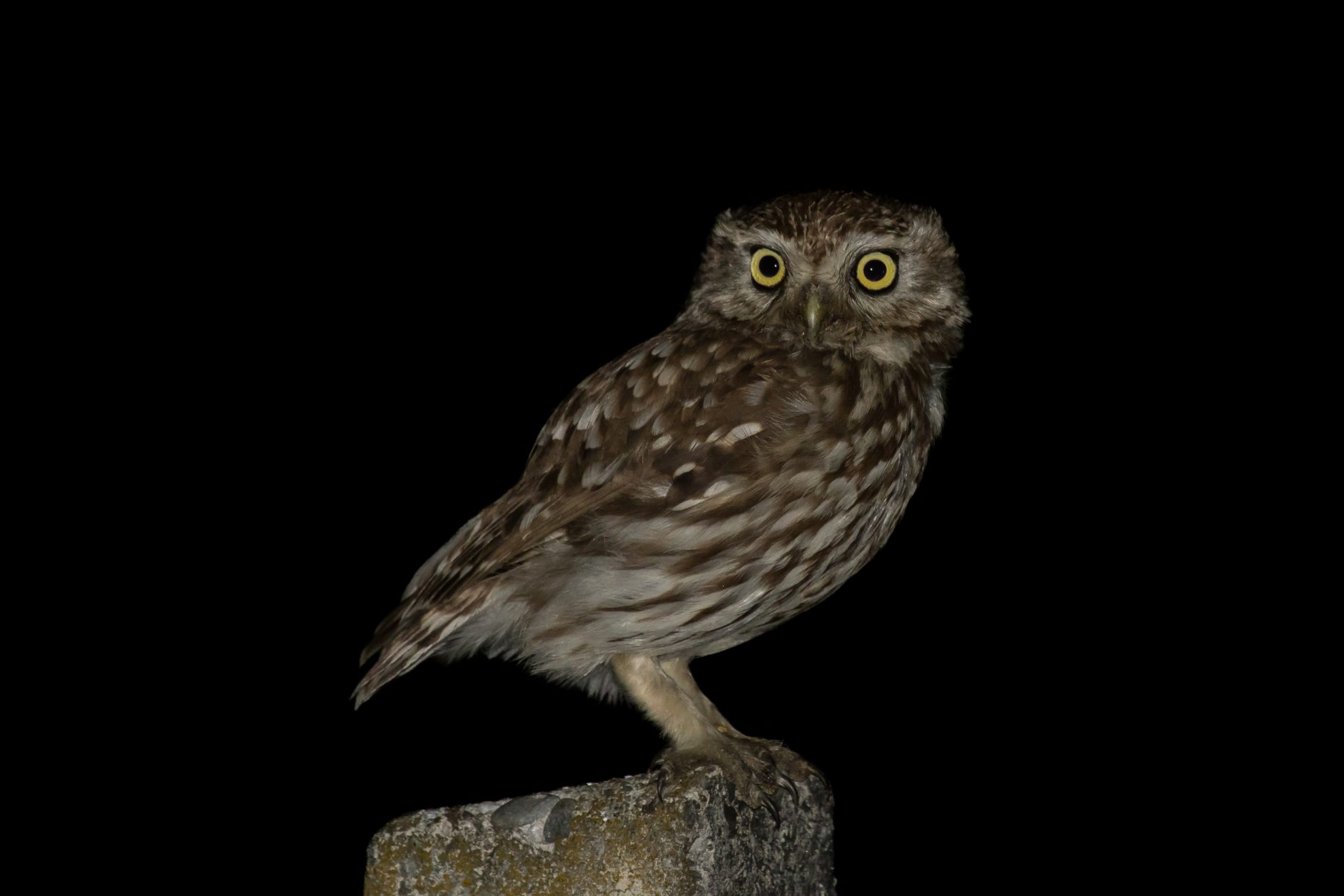
A bird introduced to control other introduced birds – sounds familiar, doesn’t it? But this owl is no pest.
The little owl was introduced from Germany between 1906 and 1910 in the hope it would control the increasing number of introduced small bird populations, which were becoming a pest for food and grain crops. Several releases were made in the South Island and only one pair in the North Island. Today, they only exist in the south.
Conservation status: Introduced and naturalised
Features: Little owls are smaller and paler than the morepork, weigh 170g and are around 23cm long. They are a grey-brown colour with white mottles, streaks and spots. Their legs have thick white feathering all the way down to the toes which are pale yellow-grey. Compared to a morepork, their head is wider in relation to their body but they do have the same bright yellow eyes.
Call: The most likely call that you will hear is a distinctive ‘kiew’ sound, most often made in the evening.
Nesting: Little owls are cavity nesters, favouring spaces such as trees, stacked hay bales, old buildings, banks or rocky crevices. They breed from October to January and lay anywhere from two to five eggs, which are incubated over 28 days. The chicks fledge at 33 days old.
Diet: Insects such as beetles, caterpillars, earwigs and moths make up the majority of their diet. Most of these are caught on the ground either catching them directly or running after them. They occassionally eat small mammals, birds, lizards and frogs.
Bird spotting tip: They are common throughout the eastern South Island, particularly in drier areas and closer to the coast, but are rare on the West Coast. They inhabit farmland and urban areas, often around farm buildings, small stands of open trees and hedgerows. They are most often seen perched in the open in the late afternoon and mainly hunt at dawn and dusk, feeding on the ground where they walk and run.
Feathery fact: New Zealand has three species of owl – everyone’s favourite, the morepork, as well as the barn owl (self-introduced) and the little owl.