In the outdoors, good judgement is gained through experience, but sometimes that experience is the result of bad judgement.
The time you spend in the backcountry builds experience. Every trip you make contributes in some way to your bank of knowledge, skill and thought processes. But unless some of those trips involve challenges – planned or unforeseen – or critical decision-making, your depth of experience might be shallower than you think.
The following stories are some of the mistakes and mishaps that have taught me invaluable lessons.
At 20 years of age I’d been tramping regularly for a few years and should have known better than to let my judgement be swayed by a person I did not know. But it was too late to change that now and I was powerless to make a difference as my partner Hana let go of foliage and committed to crossing a narrow, surging brown stream.
I stood, sodden, on the other side of the four-metre-wide channel. A hunter that we’d met held out a tree branch, the other end of which Hana held with both hands to retain her balance in the swift current. The previous day this drainage would have been dry, but after hours of rain it now brimmed with fast-moving water. Just metres away it flowed into the turgid, debris-filled Tauwharenīkau River – floodwaters in which you would have little chance of survival.
One moment Hana was on her feet, focused on the opposite bank, the next her footing was gone. It happened so fast that her reactions became pure subconscious survival as she clutched the branch, water pouring into her sleeves, her pack pushing her under as the hunter swung her towards the bank. The difference between life and probable death relied on her grip on the branch and the kick in her legs to close the gap.
It was enough – just. As she swung close to the bank I grabbed her pack strap, acknowledging the panic in her eyes and the mutual awareness of our stupidity in attempting to cross a stream that instinct had told us was too risky.
The hunter was older, heavier and more gung-ho than us, and more determined to push the limits to get out of the hills that Sunday afternoon, and this influenced our usually conservative approach to river crossings. It’s better to be late to work than not make it at all.
Rockfall dislodged by other party members
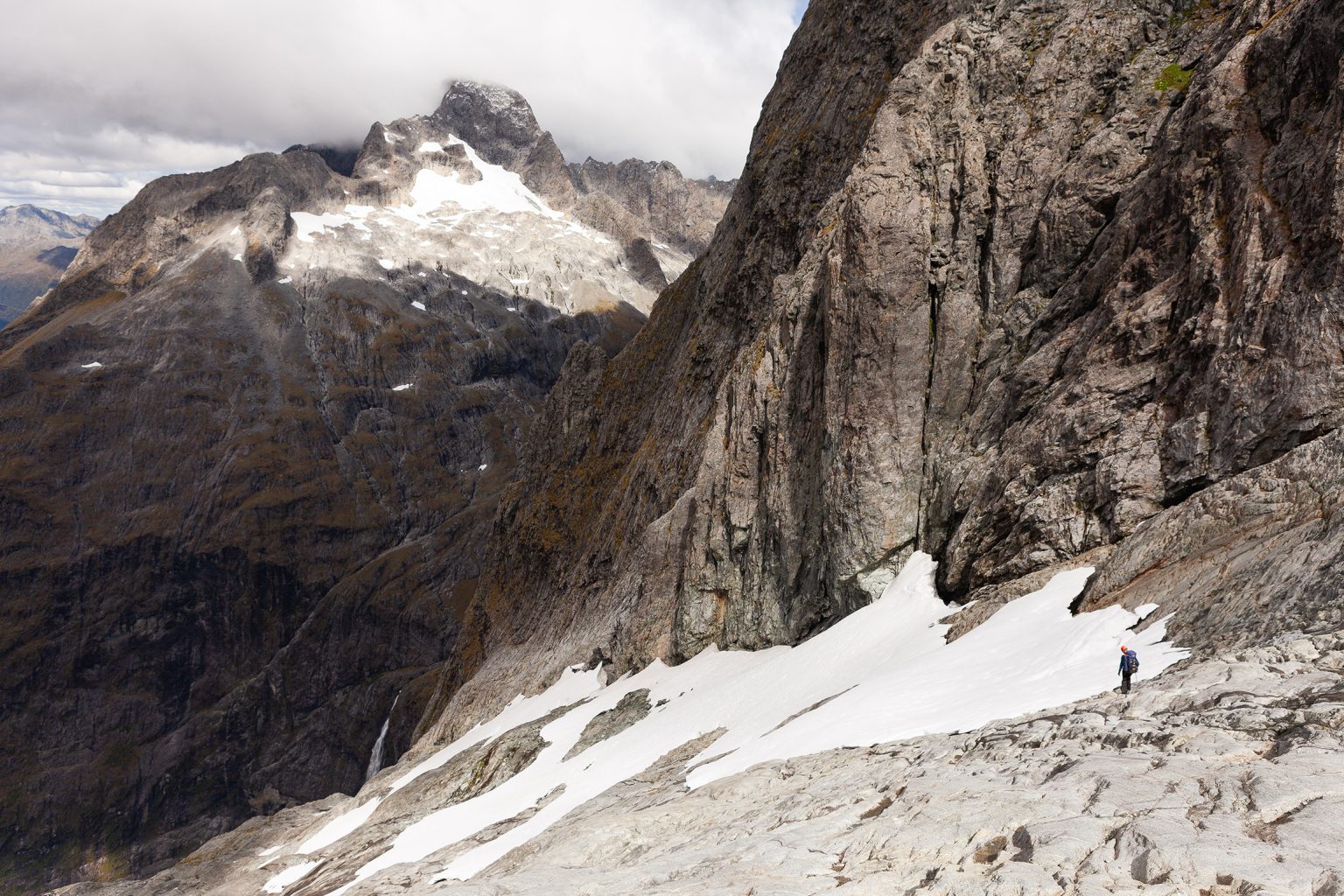
From the saddle, the rock slabs descended steeply in a series of large steps before easing into the cirque below. Large patches of névé, vestiges of a once-wide snowfield, covered the slabs in places. Four of us picked our way down on the rock, zig-zagging back and forth, downclimbing short walls and traversing rock ledges as we searched for the most secure route under the weight of heavy packs.
Perhaps feeling more confident, Alan and I moved faster than the other two. They were soon out of sight as we scrambled down the glacier-polished diorite. We stopped on a ledge at the base of a big step. Beside us, an overlying island of hard old snow had melted out to make a partial cave. We stood at the margin of its cooling shade, taking the opportunity to shelter from the sun and from rock fall, should anything release above, while we waited for the others.
We relaxed and chatted, and after a minute or two we decided to continue. I was mid-sentence as Alan turned to step over a steep channel in the rock, but my words caught his attention and he stopped and looked back at me. A second later a volley of rocks, dislodged by the others above, cascaded down the channel, leaving the air sharp with the tang of shattered rock.
Although this travel zone had a lower risk of rockfall than some we had crossed, the risk was present enough that we should have made a collective decision to travel close together to avoid the chance of knocking rock off onto one another. As party size increases, so does the risk of an incident.
Failed climbing knot
“There’s a couple of prusik loops in my pack!” Adrian yelled down from the belay.
I rummaged in the tangle of loose climbing gear until I located two loops of static cord and pulled them out. I’d hurt my ankle and didn’t want to climb that day, but I offered to ascend the rope to my partner’s belay, cleaning the gear out of the crack on the way, so that he could lead the next pitch.
Adrian was a keen climber on a working holiday from the UK and he was older and had more experience than me – an 18-year-old who’d been fitting trips into school holidays and the odd weekend. We hadn’t climbed together, however, and I wasn’t familiar with his gear.
I scrambled up a pocketed slab and into the fork of a tree that grew from the crack, several metres off the ground. Once I’d twisted the prusicks onto the rope, close together, I clipped one to my harness. The other was for my foot. I stood up in the loop and slid the waist prusik as high as I could, letting it take my weight. I repeated the cycle again until I was clear of the tree, my security committed to the rope. Continuing, I sat back to let the waist prusik take my weight a third time … and regained consciousness to the sound of my own desperate, strained wheezing as my lungs tried to recover from my sideways impact on the ground. Blood ran from a cut on my head.
It was soon assessed that no immediate life-threatening injury had occurred and no bones were broken, but I’d hit my head quite hard, been momentarily knocked out, and my whole body hurt. Other climbers escorted me to a car and then to a medical centre. I had landed in sloping dirt between rocks after a fall of six or seven metres, and was lucky to be alive.
One of the loops I’d carelessly used to ascend with, without bothering to back up, was only half tied, leaving my life hanging – not by a thread but by the knob of melted nylon on the cord’s end, caught in the knot’s delicate grip.
Avoid the hard lessons
Lessons learned the hard way are lessons you tend not to forget. Rather than suffering your own close calls, however, learn as much as you can from others’ mistakes, maintain an inquiring and open mind, and always consider the ‘what ifs’.