The first pākehā to settle was Scotsman Donald Sutherland, who arrived in 1877 and built thatched huts he dubbed ‘City of Milford’. He became known as the Milford Sound Hermit, and remained until his death in 1919.
His biggest claim to fame was his discovery of Sutherland Falls, thought at the time to be the world’s highest.
Although long dethroned of this title, the impressive feature added further wonder to the region, and it remains a must visit side trip on the Milford Track.
As the story tells it, Sutherland and John Mackay were surveying the Milford valley in 1880 when they stumbled upon a beautiful – but much less impressive – cascading falls, and decided to toss a coin for naming rights. They made a gentleman’s agreement that whoever lost the toss could name the next waterfall.
The winner – although, perhaps not in hindsight – was Mackay, after whom the attractive, yet comparatively small, Mackay Falls is now named.
“Then, of course, they found Sutherland Falls, and Mackay must have been quite miffed about that,” Bradley says.
At 580m, Sutherland Falls became an iconic feature of the Milford Track, but “they could just as easily have been named the Mackay Falls,” Bradley says.
The first woman made the overland journey to the falls a decade later. She was quoted but unnamed in an Otago Witness article saying: ‘Its magnificence is too great for me, and requires to be seen.
‘I intend to return the same way if not prevented, and be a living witness of what may be accomplished even by a woman.’
According to the report, the trip nearly cost her life when she tripped and landed on a sharp sapling which pierced her skin behind her left ear and tore a large scalp wound.
‘I shall carry the marks of it to my grave,’ she said.
The same year also saw the first successful climb of the falls, by young surveyor William Quill – who gave his name to the source lake.
Using simple equipment, he ascended the 580m falls in three and a half hours, reporting to his chief surveyor that ‘the least slip would send me down the perpendicular rock to be dashed to pieces hundreds of feet below’.
Quill returned ‘without a scratch or bruise’, but died less than a year later after falling off a 600m cliff near Homer Saddle. Eerily reminiscent of his earlier report, his brothers found jaw, skull and scalp fragments at the bottom after a 42-day search, and he was identified by the hair still clinging to his scalp.
The Milford Track route over McKinnon Pass – although likely already known to Māori – was discovered by Scotsman Quintin McKinnon in 1888, who was employed by the Otago Survey Department to find an overland route to the sound – now a popular tourist destination.
He gave his name to the pass and became the first Milford Track guide. The route soon became well worn by the feet of visitors, who, prior to the route’s discovery, could access the ‘eighth wonder of the world’ only by ship.
McKinnon died four years later – he was last seen sailing on Lake Te Anau in November, 1892. A search party recovered his wrecked ship and belongings, but his body was never found and a memorial now stands at the pass.
By 1901, control of the track had been taken over by the government’s Department of Tourist and Health Resorts, and walking the track soon became limited to guided walks.
With the male-dominated explorer era of the 19th century now over, the 20th century gave way to a feminine majority.
Ray Willett – a Milford Track legend whose involvement stretches back to the late 50s – says it wasn’t uncommon to have 30 women, and just two or three men on guided expeditions.
“No red-blooded Kiwi male was going to go on a guided walk – it just wasn’t their thing,” he said.
Willett started guiding on the track in 1958, and fondly recalls the time as the most memorable working days of his life.
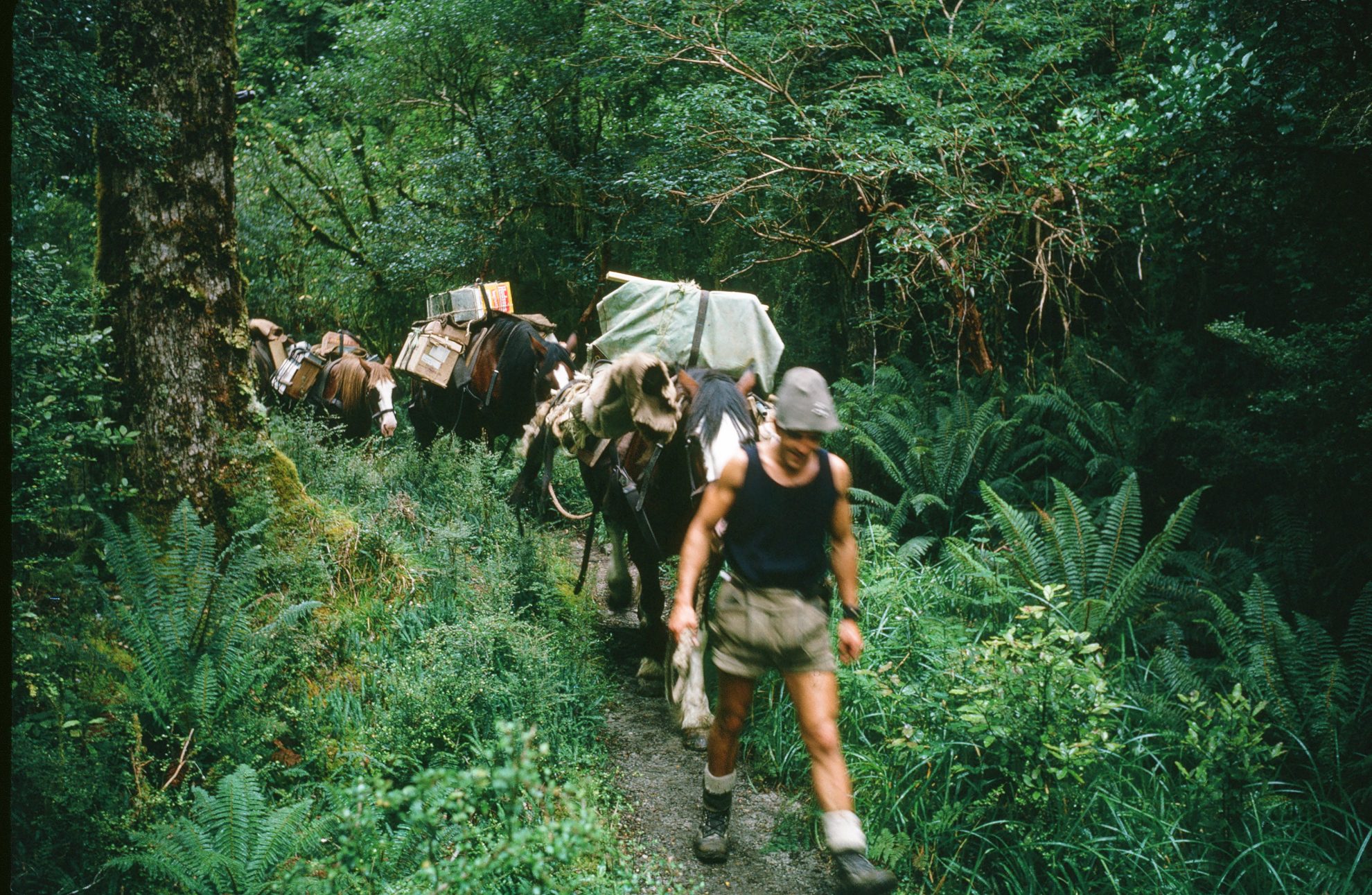
“We cut down trees to cook food and we had four pack horses to carry gear, and they never broke an egg,” he says.
Guided visitors came from all walks of life, Willett says, but the track itself was a great leveller of people.
“There was never any discrimination of the groups. Whether they were truck drivers, lords or ladies, they all had to queue up just the same for their dinner.
“There was no alcohol, either. If we could carry a dozen beers on a pack horse, then we could have carried more diesel, kerosene or food.”
The middle of the century saw the track open only to commercial guided tours, which few could afford, and by the early 60s, disgruntled Kiwis were beginning to take exception to the elitism happening in their own national park, and decided to take action.
In a bold move now known as the freedom walk of 1965, members of Otago Tramping Club walked the track in protest, without the permission of the Tourist Hotel Corporation which then managed the track.
The publicity generated by the walk put pressure on the government to open the track to the public, and in 1966, the dual system was established, allowing independent and guided walkers to coexist on the track and stay in separate facilities.
Today, it’s a smoothly run operation, but Willett says it was not always so.
“It was originally set up with no booking system, and it was a bloody disaster. You would have a 40 bunk hut, with 80 people in it,” he says.
“We had to make it run similarly to a guided walk, only independent walkers paid less and didn’t get showers.”
From the days of settlers’ shacks and exploration, to pack horses and privatisation, the Milford Track has changed dramatically over its 130-year history, but for Willett, there is comfort in the timeless spectacle of the route.
“What hasn’t changed is Mother Nature. You still have those glacial carved valleys, the crystal clear Clinton River… it just hasn’t changed,” he says. And long may it continue.