

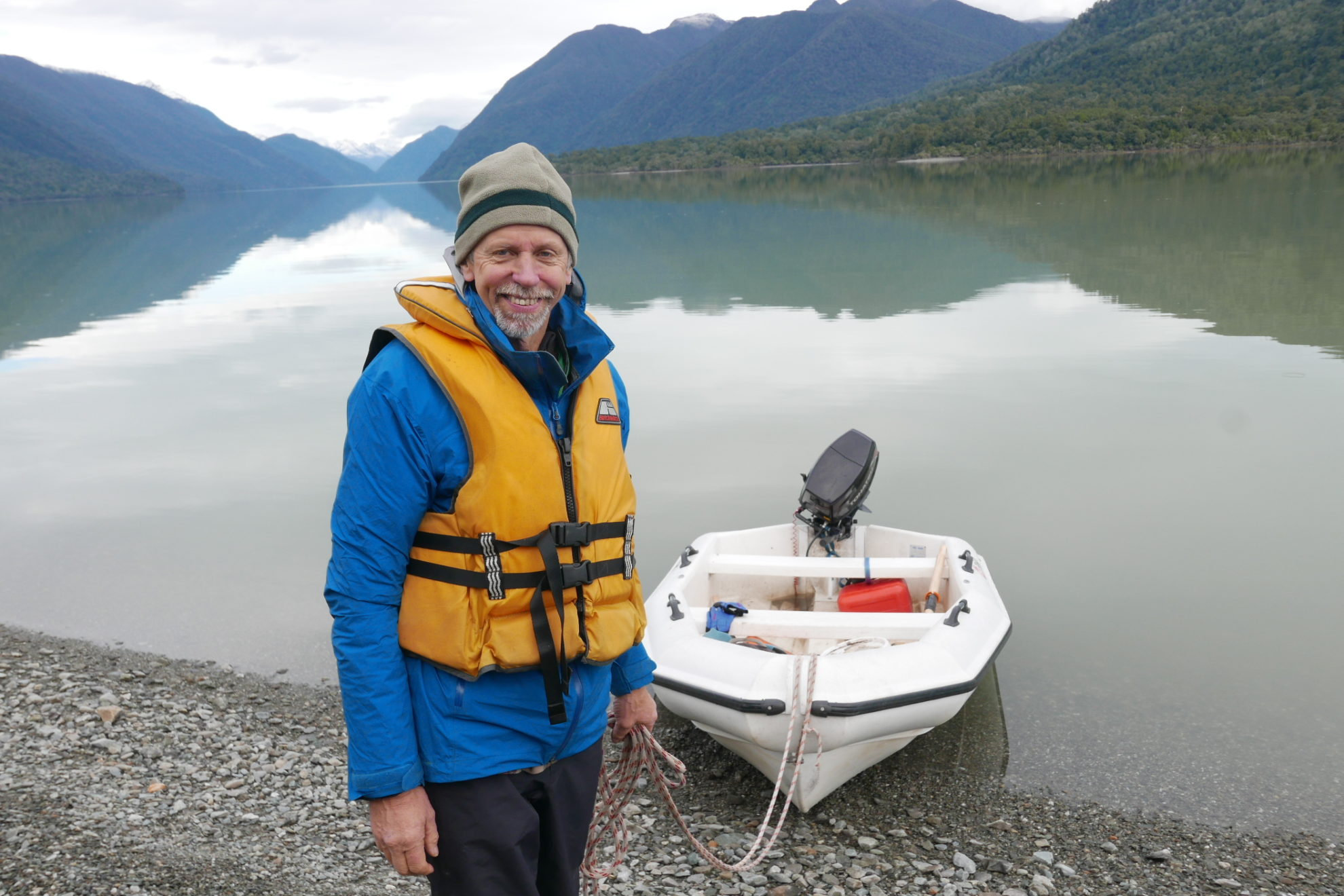
Webb and his daughter Erika have been here for several days when I arrive. They’re from Wellington, where they also volunteer with the Mainland Island Restoration Operation (MIRO) in East Harbour Regional Park. Webb says much of what he learns from Wilson is used to help at MIRO.
For Wilson there are huge logistics involved in running this winter programme: so many lines and traps to check, volunteers with varying experience to organise, supplies to order – bait (meat and eggs for the traps, peanut butter for the tunnels and Pindone for the bait stations), fuel for the dinghy, fuel for the volunteers – and always the need to factor in extreme weather and remoteness.
Whakatipu Waitai (Martins Bay) is the ancestral home of chief Tūtoko and Te Rūnunga o Makaawhio. British settlers tried to live here. They thought they’d be supplied by ships direct from Australia, but the bar had other ideas. Ships couldn’t get near, many settlers starved and there’s little now to show they were ever here. Except the cemetery.
Martins Bay is also a biodiversity hotspot. Prim-eval. Grand beech and podocarp forests give way to fragile dune systems and internationally recognised lagoons and wetlands that support hosts of nesting seabirds, tawaki and forest birds, including rare species. Bottle-nosed dolphins sometimes swim three kilometres up-valley to Lake McKerrow, the only known place where dolphins enter a freshwater lake.
The weather is dynamic. Landslides scar the hillsides. In early 2020 the river, swollen from a storm that devastated northern Fiordland, blasted directly through the bar. Wilson says that dozens of traps and bait stations were lost, but he’s not fazed: he’s well used to living on nature’s terms.
From deer culler to DOC biodiversity ranger, Wilson brings huge experience to this role. He’s worked on the Northern Te Urewera Mainland Island project, Campbell Island rat eradication, and in Fiordland National Park managing major restoration programmes including island pest eradications. He has also helped with Pacific Island conservation projects and managed Cape Sanctuary in Hawke’s Bay. Now he’s back in his Fiordland mountains doing the work he loves.
“It’s a dream job,” he says. “When I was with DOC I was involved in helping to establish the trust. I just feel so passionate about restoring this amazing place.”
He’s waiting to meet me off my helicopter flight from Milford Sound / Piopiotahi. I’d hitched a ride with a Jobs for Nature team heading further north to Big Bay to establish tracks and lines for a whole new 2000ha restoration project contiguous to the Hollyford.
As Wilson steers our little dinghy up Lake McKerrow to the team base, a basic but cosy, well-equipped hut provided by trustee and local landowner Simon Hall, he is bursting with good news about progress made by the trust.
“The fuchsia and the rātā are coming back,” he shouts over the motor. “We got here just before the possum numbers peaked. DOC hit them with three aerial 1080 drops and now our bait stations are knocking the remainder. Last year was a beech mast and we knocked back a lot of stoats.”
All this knocking is good for the birds.
“We introduced 180 robins in 2019 and they have really established,” Wilson says.
“Bellbird numbers have increased from one per hectare when we started to eight per hectare, tomtits from one to six per hectare. Fernbirds have increased dramatically.”
But is this massive remote project even sustainable? Wilson says yes.
“Our trustees are incredibly supportive. They contribute their expertise, generate funding from partners and grants, and they personally invest a huge amount to help with our logistical needs.”
The trustees are not only a list of who’s who in national restoration projects. Most are also private landowners at Martins Bay and have a strong personal interest in the wellbeing of the land. Representing the mana whenua is trustee Kara Edwards (Kāti Māhaki), a descendent of Chief Tūtoko of Whakatipu Waitai.
Trust chair Ron Anderson has had a hut at Martins Bay for 50 years. “I was ashamed of where it was all going, those beautiful rātā were dying. Now we’ve turned the tide. We’ve got rid of thousands of possums and rats and hundreds of stoats. I leave my hut door open at night and the birds wake me up. It’s a dawn chorus I never knew existed.”
Anderson believes the trust model is an example for the rest of the country.
“Right now in New Zealand we see millions of dollars going into organisations that don’t get invested on the ground,” he says. “It’s up to private organisations like ours to pick up the cudgels of conservation restoration. Many people are out there looking for a way to give something back to society, and there are all sorts of opportunities for projects such as this.
“As trustees, our rewards are so much more than the financial investments we make.”
Anderson is a great facilitator for the trust, says Wilson. “The Martins Bay community is diverse. The mana whenua is Makaawhio and there are seven rūnunga involved, plus there are 21 blocks of private land and a strong tradition of hunters and whitebaiters. Ron has pulled everyone together in support of our work.”
Ngāi Tahu Tourism and Hollyford Guided Walks, who operate a lodge at Martins Bay, has become a major partner, he adds.
“Support from Ngāi Tahu is huge. For example, helicopter access is expensive so they’ll often backload for us, fly our volunteers out when they bring supplies into the lodge, or they’ll fly traps and gear in when they are taking their clients out. That’s a massive saving.
“Mainly, the trust uses fixed-wing planes when it can, while supportive locals with fishing boats help with the heavy lifting, keeping both costs and carbon emissions down.”
Next morning the wind has come up, spoiling Wilson’s plans to check traps across the lake. Surf crashes on the beach and the lake is more like an ocean. “We won’t be taking the little boat out in those big waves,” he says.
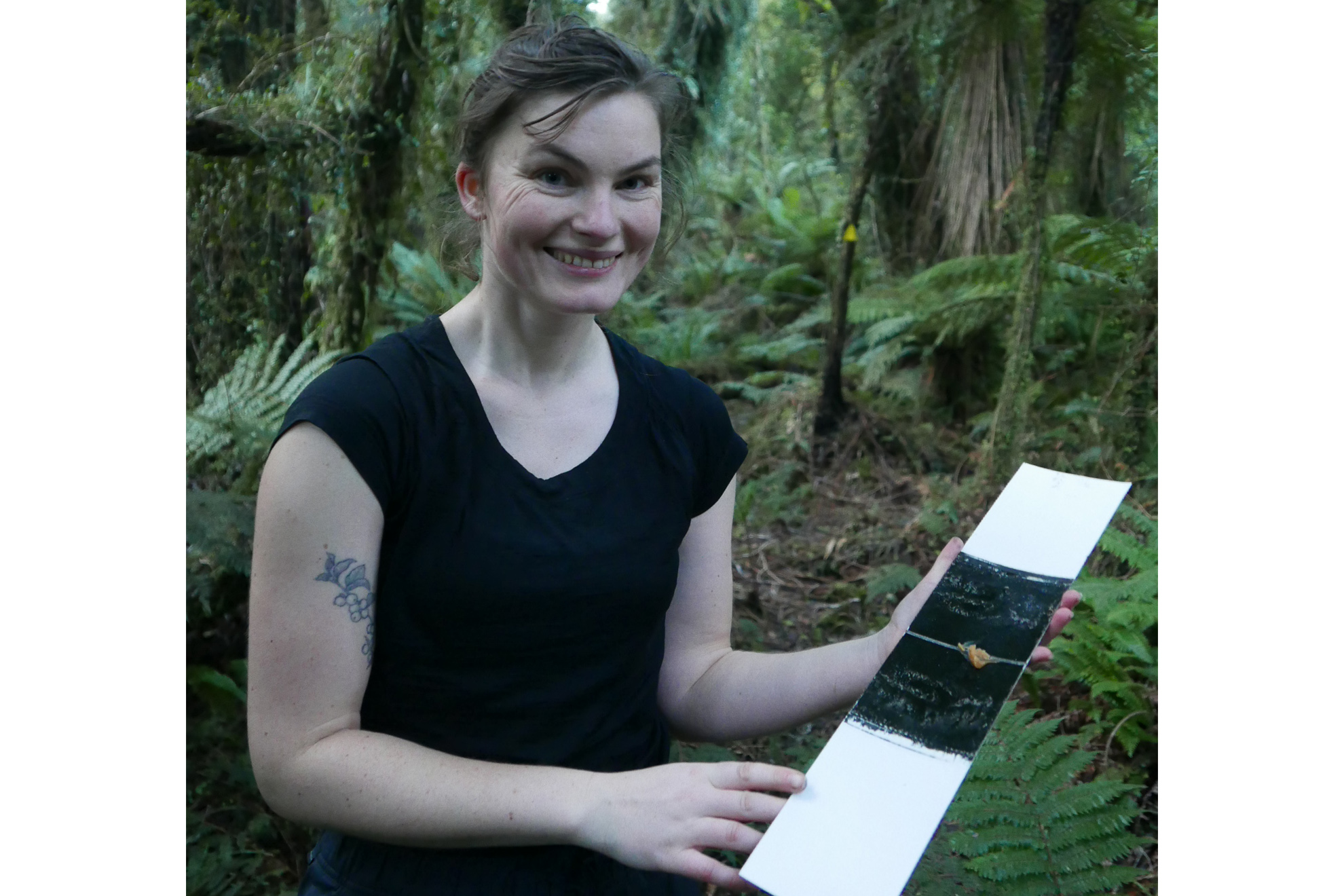
Instead, I go with Erika to collect the cards she’d put out overnight in what Wilson calls the ‘podocarp block’. It’s drier than yesterday’s swamp and the trees are giants. At their feet we gather the cards and find a mix of little prints (mice or perhaps kiore), big prints (rats) and, best of all, no prints.
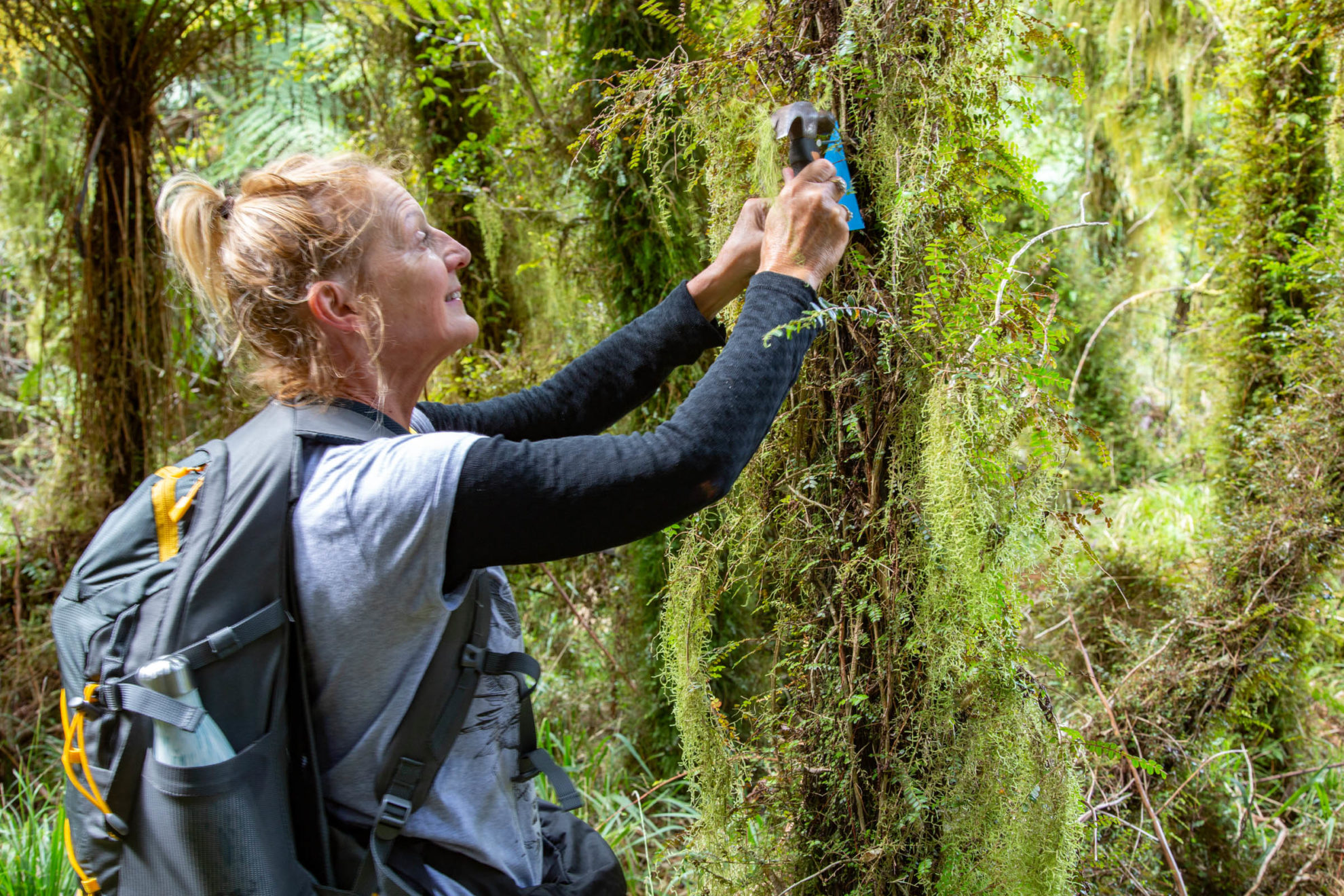
We call at Martins Bay Lodge. It’s closed for winter, though builders are at work and the manager says hello. He lets the trust teams keep meat in the lodge freezer, recharge batteries, use the wifi, and store the dinghy safely at the lodge when they go out.
This is Erika’s first time in the Hollyford and she’s happy. “Lindsay and the trust have such a vision, you feel you’re part of something that will really make a difference,” she says. “The project is so intensive: if you’re a rat in here, you’ve got no chance.”
About 50 volunteers, including 20 regulars, come from around the country to help the trust, says Wilson. “It’s a specialised job, in a special environment, but I haven’t had anyone yet who hasn’t been useful. Most are recruited by word of mouth.”
Back at the hut the fire is cosy but the wind still screams. Wilson takes me through the astonishing details of all those grids. “We have 383 trap boxes, each with two DOC200 traps, checked eight to 10 times a year, and 496 GoodNature A24 traps. Plus we have 2117 bait stations. Our network has a 100m grid set for shippies (his name for ship rats) because they have a one-hectare range. Kiore have a smaller range so we might have to increase our traps to target them. That said, their impact on birds and seeds is far less than tree-climbing shippies.”
Sid and Jack call in. They’re the bait contractors and are staying in a private hut nearby. They tell Wilson that the rat bait they put out 14 days ago has largely been taken so they are topping up most stations. Good news for the birds.
Finally, Wilson tots up the latest numbers. “Three weeks ago we got 159 rats in the DOC200s; this time we got 50 and the tracking tunnels show fewer rats. That’s with the bait only recently gone out. Next time we should see a big difference. We also got 10 stoats this time. Our stoat numbers now are the lowest recorded for the last two years.”
Friday morning and it’s time to leave but the helicopter doesn’t show. Is it the wind? Are we stuck in paradise? Lindsay checks his Garmin inReach. Smiles. “They’ll be here a bit later. They’re flying in some stuff for the lodge so will backload us out. Fantastic, you can buy a lot of traps for the cost of a helicopter flight.”
We’re happy to wait because new traps are indeed on the trust’s shopping list. Thanks to Jobs for Nature funding, the trust’s restoration area is about to expand exponentially from 2600ha to 12,000ha. Wilson is beyond excited.
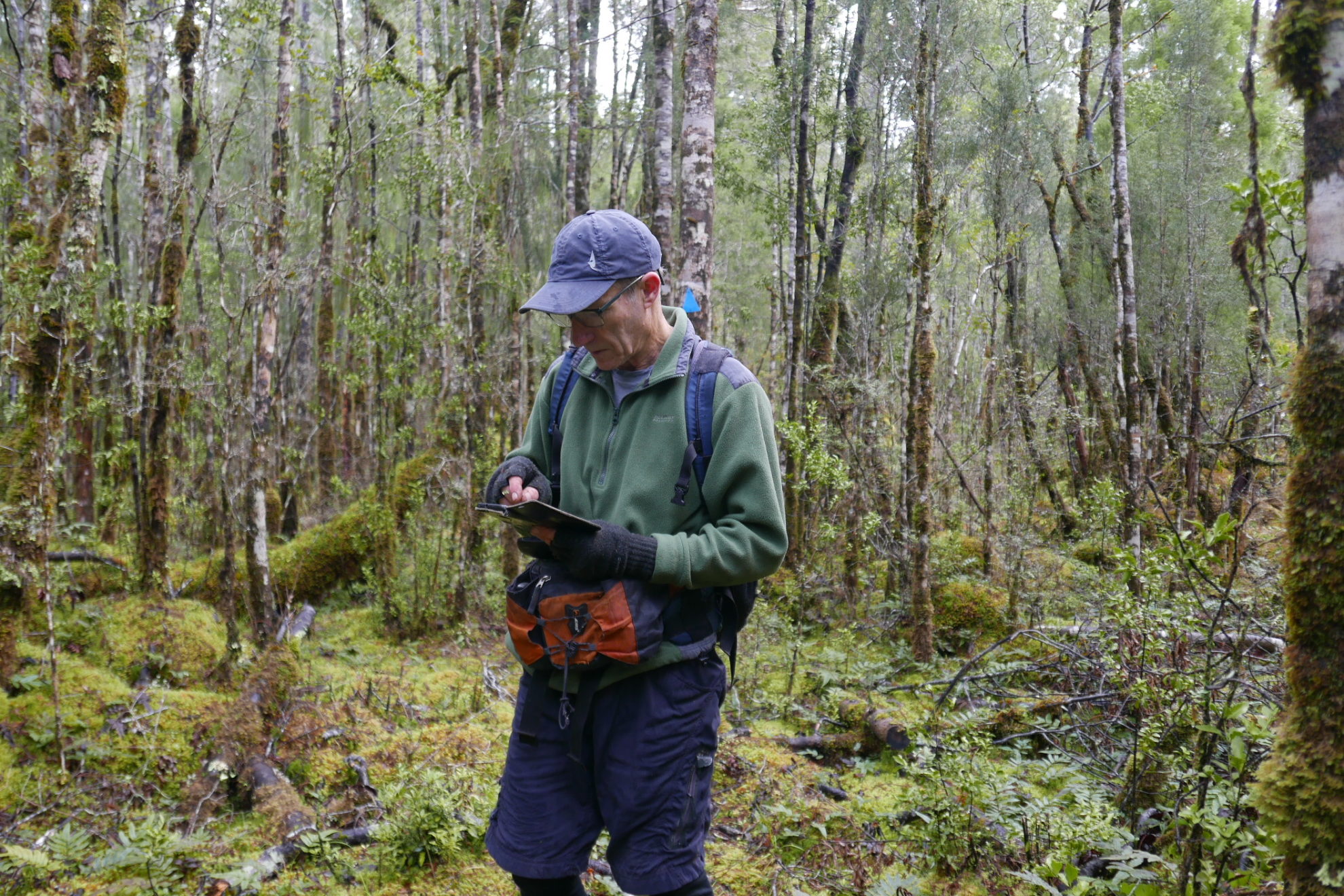
“With our expansion, plus the Big Bay Awarua Conservation Trust that’s getting established to the north, we’ll be targeting stoats, possums and rats across a 14,000ha contiguous area. That’s a huge chunk of northern Fiordland.”
What if Jobs for Nature funding comes to an end, I ask; the resident wet blanket. Wilson remains upbeat. “The big cost is setting up the tracks and traps. Last year we put 60km of tracks in the Kaipo; another 60km will go in this year. Putting in the traps will be helicopter intensive and costly. Once all that’s done, we’ll just need lots of fit keen volunteers and contractors.”
Tracks for predator control, it should be said, are not major highways, and are only cut for trap lines, bait stations and tracking tunnels. You have to break some eggs to make an omelette, says Ron Anderson.
“When we started we had the knockers, saying that we’d get reinvaded from over the ridges,” he says. “Well, the pest numbers keep going down, the bird numbers are growing, and now we’re expanding our predator control over those ridges. This project is already rewarding, we’re heading into the unknown and our motivation is huge.”



