

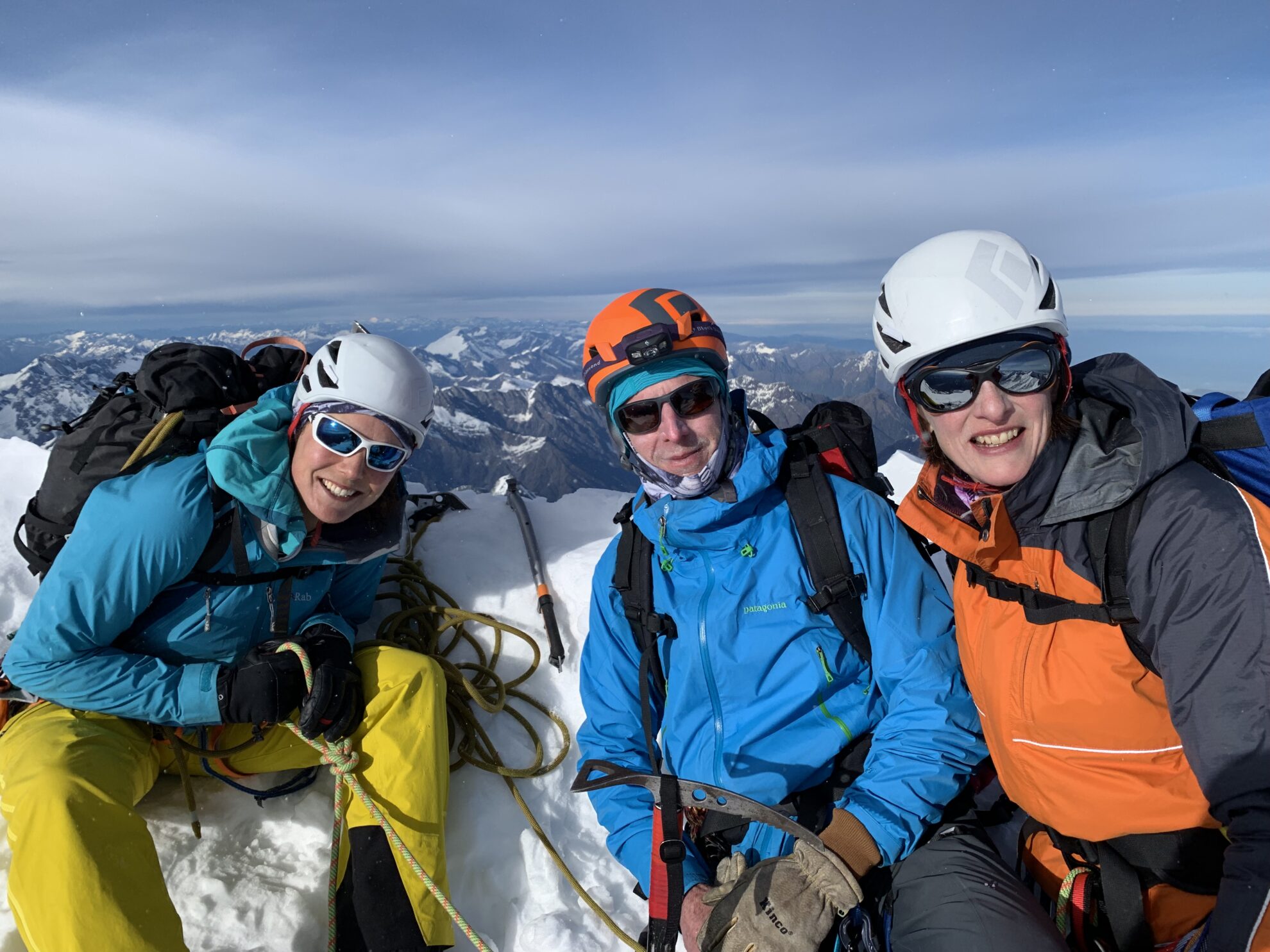
It was her father who introduced Braun-Elwert to the mountains. German-born, Gottlieb was a renowned climber and professional mountain guide. He moved to New Zealand in 1978, met and married Anne and the couple established Alpine Recreation.
In 1998, Gottlieb guided his daughter, then 14, to the summit of Aoraki/Mt Cook, setting the record for the youngest person to climb the mountain (a record she lost a year later to her younger sister, Carla).
That was when she knew she’d like to be a mountain guide, with her Dad’s big guiding footsteps to follow.
But Gottlieb was also a nuclear physicist so it’s perhaps not surprising that Braun-Elwert headed first to university to study science. She completed a Masters in Computational Biomechanics (you might need to look it up). The dynamics of skiing was her thesis topic and the degree set her up for a wide choice of specialist jobs, from sports coaching to prosthesis development. But she was torn.
“There were not many opportunities in computational biomechanics outside of Auckland or overseas,” she says. “I didn’t want to live in those places and I’d always said that I wanted to be a mountain guide.”
Fate intervened when Gottlieb died suddenly of a ruptured aorta, aged 59. He was in the Two Thumb Range guiding a ski touring party that included long-time client and family friend, then Prime Minister Helen Clark. Braun-Elwert’s decision was made.
Today, Alpine Recreation retains a strong family ethos. Braun-Elwert works alongside Anne, now company director, and long-time family friend, general manager and ski guide Axel Reiser. When not guiding, she’s involved in everything else needed to run the business, from web design and IT support to marketing, logistics, hut restocking and staff training.
Covid aside, there are more challenges in running the company these days, she says. “Adventure safety audits are one example. Then there’s climate change, with glacial recession and peak weather events affecting access to huts and climbing routes.”
Caroline Hut, in Aoraki/Mt Cook National Park, is another potential issue. Built in 1990 by Alpine Recreation, it is used by the company for mountaineering courses and guided Ball Pass trips. The hut includes an emergency shelter for all-comers but its use is essentially private, and its 30-year lease expired in 2020.
An application to renew the lease is currently pending, along with a review of the Aoraki/Mt Cook National Park Management Plan. The Conservation Act calls for private huts on conservation land to be phased out and submissions for and against a lease renewal have been received by DOC.
“We have no control over this, it’s a matter of ‘keep calm and carry on’,” says Braun-Elwert.
Further north, in the Two Thumb Range, the company’s Rex Simpson Hut has been busy with winter ski touring and snowshoeing groups. Set on conservation land beside the boundary with Mt Gerald Station, it is available to the public via a booking system but essentially is used by Alpine Recreation groups.
Braun-Elwert believes privately-owned, bookable huts, on private high country land are the way of the future. “New Zealand is really struggling for alpine huts,” she says. “Many in our parks are in need of repair or replacement. The demand now is huge. Rex Simpson and those on Glenmore Station were heavily booked last winter.
“These huts have fully equipped kitchens, gas for cooking, log burners for heating and they are so much more comfortable than our current alpine huts. When you’ve been out skiing in sub-zero temperatures, you can light the fire, warm up and dry your gear. Some have walking access, others are reached by 4WD or helicopter.
“DOC’s alpine huts can often be overfull and I think people like the security of being able to book. And many of the private huts are small, catering for up to eight people so you can be in your own group.
“I see a lot of potential for high country landowners to pursue this direction of tourism, for both winter ski touring and summer hiking and mountain biking.”
And with Covid decimating the guiding industry of international climbing clientele, Braun-Elwert wishes more ‘typically DIY’ New Zealanders would consider going guided in the summer.
She speaks not only to help the family business but also New Zealand’s guiding industry as a whole.
“Guiding companies are really struggling with Covid. It takes a long time for guides to build the experience they need and to get the necessary qualifications, so with fewer clients at the moment we are running the risk of losing current guides at a time when there are not many new ones coming on because of the lack of opportunities.
“Basically, instead of running a profitable business, we are just trying to keep our guides employed.”
Braun-Elwert is working with colleagues to build awareness of what a qualified guide can do. “Anyone guiding in New Zealand has to be not only highly qualified but self-sufficient, there are no gondolas here, you can often be the only people on the mountain,” she adds.
Braun-Elwert also does her part as an NZMGA ski guide assessor, which involves technical, multiday assessment trips on glaciers and snow-covered high country.
She is proud of how she has helped Alpine Recreation evolve and grow over the years. “We offer a lot more trips now, with more variety and we cater for all levels, from beginners right through to experts.”
Perhaps not surprisingly, she spends her downtime out in the mountains. Ski mountaineering is her top holiday choice. “I’m not a beach person,” she says. “We did try one holiday in Fiji; we spent our time snorkelling and windsurfing, it was too hot to do anything else.”



