Want to complete a trip like the Wangapeka Track? You’ll need a pair of sturdy, comfortable trekking boots.
Trekking boots, also known as transalpine boots, are designed for all-day walking that might include rough off-track travel, heavy loads or alpine conditions. They have warmer, sturdier, more supportive uppers and a stiffer sole than a hiking boot, making them suitable to wear with crampons. The ideal boot strikes a balance between being durable, lightweight and suitable for a wide range of terrain.
Rand
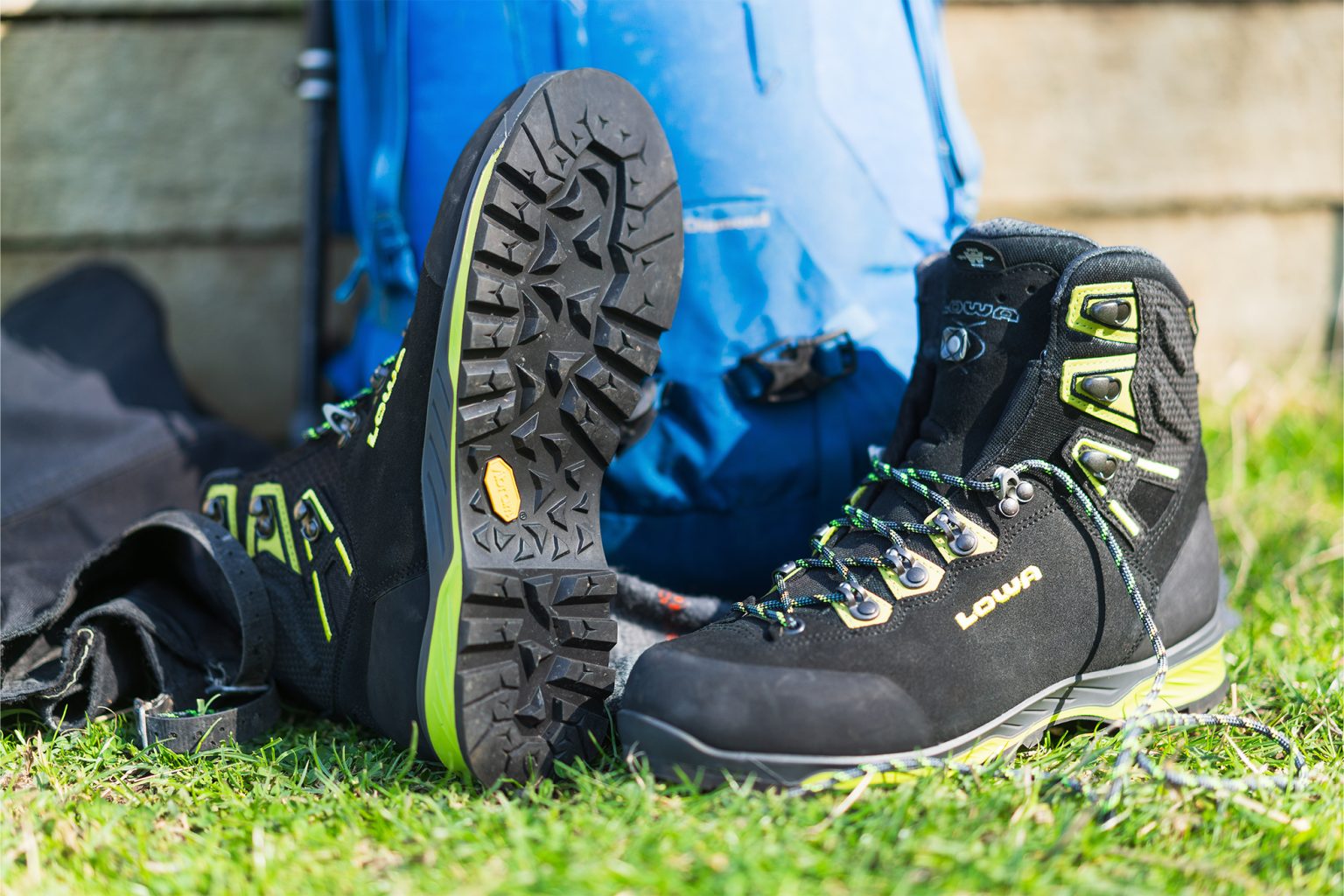
The lower part of the boot’s upper should be protected with a partial or full rand. This thin strip of rubber protects the boot material and feet from rock strikes. It also provides more grip when boulder hopping or rock scrambling.
Reinforced midsole
A full or three-quarter-length shank inserted into the midsole (often made of carbon fibre or Kevlar) makes the boot rigid enough for crampons and edging on steep slopes and in snow. It also helps to protect the foot and reduce foot fatigue. It flexes slightly to ensure all-day walking comfort. The rest of the midsole is composed of dense shock-absorbent materials such as polyurethane and EVA.
Crampon compatibility
For boots to be safe and reliable with crampons they need a stiff sole, supportive uppers and to be torsionally rigid so they don’t twist from side to side. Boots will be classified B1 or B2 (stiffer). Strap-on crampons (C1 class), which sometimes have plastic toe and heel cradles, can be used with either type of boot. C2 class crampons, which have a locking heel bail, can only be used with B2 boots, which have a special notch below the heel to hold the bail.
Toe box
The part of the boot forward of the lowest lacing eyelet is stiffened to protect the toes. Although it’s important to have some wiggle room, too much can mean an imprecise, clumsy fit. Toe boxes vary in shape, width and height, so if you’re buying boots for the first time, ask an expert to determine your foot width and the brand or model of boot that will best suit you.
Outsole
While tread designs vary, all will have a hard-wearing rubber compound that still performs well in cold conditions. Firm rubber that doesn’t deform under pressure is important for tackling rough ground, walking on hard snow and when crampons are worn. A prominent instep will give the boot’s heel section plenty of bite when descending on snow and loose ground. Some soles have a section of closely spaced or joined blocks (sometimes called a ‘climbing zone’), providing additional friction for rock scrambling.
Lace hooks and eyelets
Lace eyelets usually extend to near the toe to provide precise adjustment and a firm fit. At the ankle there is usually a pair of locking eyelets that allow the lace tension to vary between the foot and the boot collar.
Gusseted tongue
A tongue that attaches to the upper almost to the top of the collar will keep debris out of the boot. Some have a hook or lace loop to keep them positioned correctly.
Collar
This part of the upper encloses the ankle. A trekking boot collar is typically taller than that of a hiking boot: it provides greater ankle support, protection and warmth and should be flexible enough for comfortable cramponing.
Heel cup
The inside of a boot is shaped to cup your heel in order to prevent it from lifting when walking – particularly uphill. It also contributes to ankle stability. Some cups are more prominent than others. It’s important that the cup suits your heel shape and width.
Uppers
Most boot uppers are full-grain leather or a combination of nubuck (roughout leather) or suede (split leather) with synthetic materials. Those made from a combination of materials tend to be lighter and faster drying than full leather boots. The most durable designs minimise stitching in the upper’s lower part, which avoids weak points. A waterproof and breathable lining, such as Gore-Tex, sandwiched between the outer and the inner of the boot, is a standard feature.