Anyone who’s slept in a sleeping bag will be familiar with that cosy cocooned feel of their favourite bag. Sometimes referred to as ‘the pit’, the sleeping bag, combined with some sort of mat, is our portable bed away from home. It’s the refuge you slither into to warm up, to sleep, or to relax after a long day.
Here we explain the typical features of a sleeping bag suitable for 3–4-season use, and the features to expect in other bags.
Temperature ratings
A scale indicating ‘comfort’, ‘limit’ and ‘extreme’ is used for sleeping bag temperature ratings. Comfort is the rating that an average female should expect to be comfortable in the bag (women are typically colder sleepers); limit is the rating for a male to be comfortable; and extreme is the temperature a male should expect to be able to survive in the bag without hypothermia or frostbite.
Consider the coldest conditions you expect to use the bag in and choose a comfort rating that’s for a slightly lower temperature. Your ground insulation, a liner and additional clothing can have a considerable impact on improving the bag’s comfort rating.
Foot box
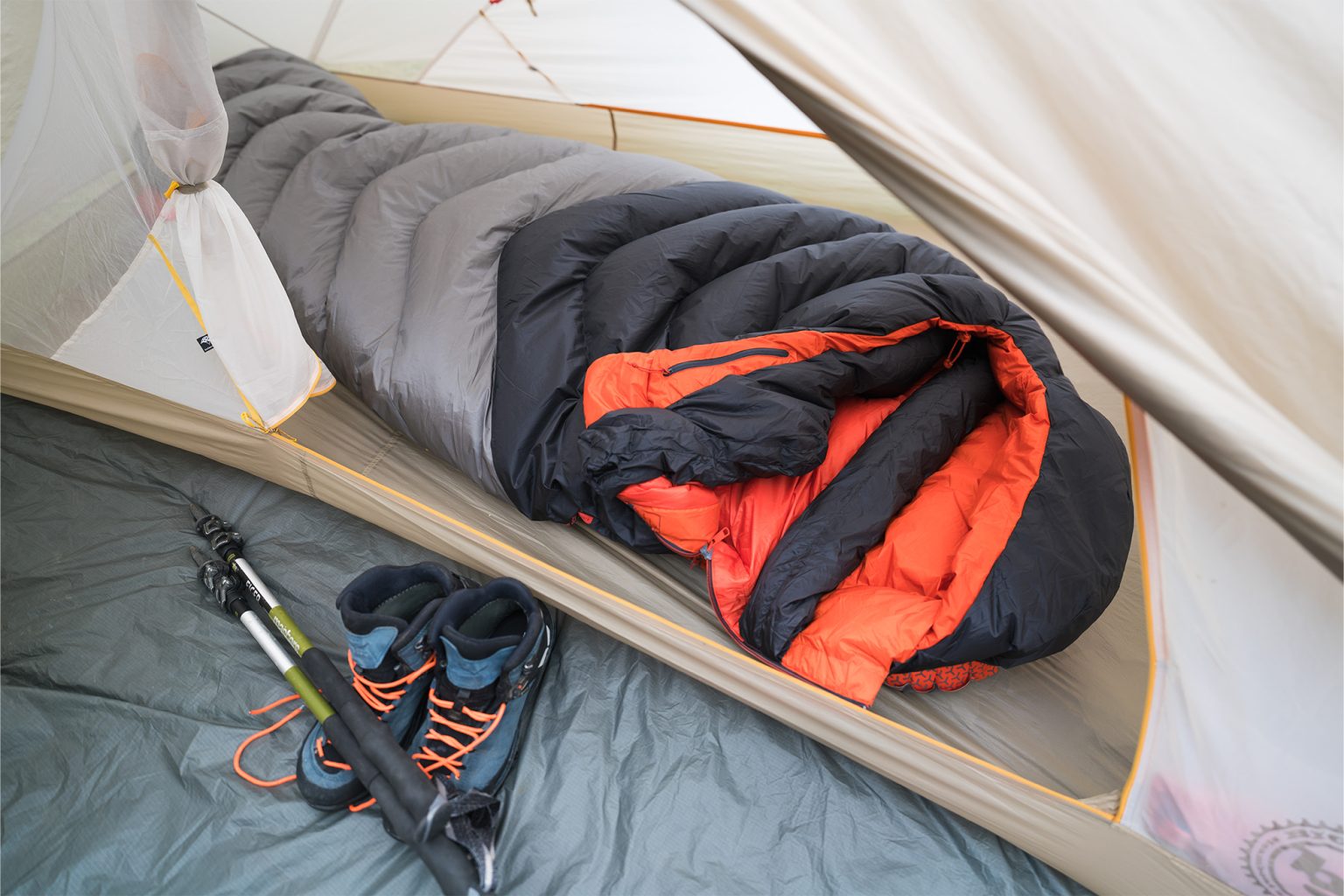
Mummy bags usually have a 3D foot box to accommodate the feet without causing cold spots.
Shell fabric
Nylon and polyester fabrics are used. If you plan to camp or bivouac often, a DWR-coated or water-resistant shell fabric is desirable.
Zips
Mummy bags like this example typically have a two-way zip that ends at the calf. The two-way zip allows better temperature regulation. Semi-rectangular bags sometimes open right up so they can be used like a duvet. Ultralight bags often have a shorter zip.
A strip of webbing along the length of the zip prevents the slider from catching on the fabric. Some bags have a special non-snag slider, too. To prevent heat from being lost through the zip, an insulation-filled baffle runs the length of the zip.
Storage tabs
Two webbing tabs at the foot-end of the sleeping bag are for hanging it to dry or for storage.
Insulation
Goose or duck down is the warmest and most compressible insulation. Down quality is rated by fill-power, which is how much space the down occupies for its weight. A higher number is better for warmth, weight and compactness; good-quality bags are commonly rated between 500 and 900. Down that has been hydrophobic-treated for waterproofing will insulate better in damp environments, dry faster and last longer than non-treated down.
Synthetic insulation is bulkier and heavier, but it absorbs very little water and performs better than down in persistent damp conditions or if your sleeping bag gets soaked. It’s cheaper and easier to look after.
Hood
An insulated hood is crucial for preventing heat loss. It should have a drawcord adjustment for reducing the size of the opening.
Baffles
Internal mesh baffles divide the down into sections so it doesn’t move around between the outer and inner fabrics. The baffles in a good-quality bag are body-mapped so that the down is concentrated in places where the body requires it most. The chevron shape of the baffles on this bag helps prevent the down from moving to the sides. Synthetic-fill bags don’t have baffles, but the insulation is body-mapped and secured.
Shape
The most common sleeping bag shapes are semi-rectangular and mummy. This Rab bag is a mummy shape: its body-hugging design makes it the most thermally efficient because there is less ‘dead air’. Semi-rectangular bags are roomier for all-round comfort.
Draught collar
A draught collar (aka neck muff) adds a considerable amount of warmth by insulating your neck and trapping warm air inside the sleeping bag. The warmest ones are adjustable with an elasticated cord.
Inner pocket
Some bags have a small internal pocket for ear plugs, lip balm or valuables.