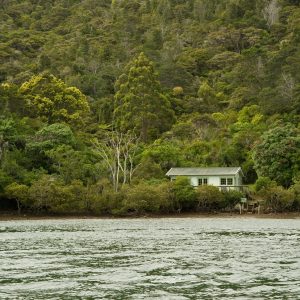
FMC ‘Love Our Huts’ is a summer-long activity where you choose a hut, head in for a trip, give it a spring clean, check how it’s holding up, and report back. It’s a fun way to give back to the backcountry while enjoying the places we love most with people we love most.
Last year, hundreds of people participated in the program. This year, FMC is going bigger — with more time, more huts, and more ways to help.
By giving huts some care and recording how they’re used, FMC is hoping to free up time for conservation work — while also keeping the hut network in public hands.
Read more about the program and register at FMC’s website.
Four hikers on magic mushrooms rescued in New York
Four hikers who had consumed psychedelic mushrooms – including one experiencing a “debilitating high” – had to be rescued from New York’s Catskill Mountains after they got lost there, according to state authorities.
In a news release, forest rangers from the the New York state department of environmental conservation (DEC) said that they were alerted to the situation at about 5pm on 29 August after the receipt of a satellite text.
“The original caller admitted the group had consumed mushrooms and one of them was experiencing a debilitating high,” the DEC said.
Three forest rangers responded and located the group at approximately 6.45pm. They helped the group to the trailhead, where the hikers were evaluated by a Shandaken ambulance crew.
Complicating matters for the group of hikers was the fact that they had also lost their car keys, the news release said.
Ranger Russell Martin, who participated in the rescue, told the New York Times: “I’m not an expert in mushrooms, but these gentlemen definitely rode highs and lows.” Read the story from the Guardian.
Drones take on Everest’s garbage issues
A team of drone operators joined climbers and guides at Everest Base Camp this climbing season, armed with heavy-duty drones to help clear rubbish from the world’s highest peak.
Two DJI FC 30 heavy-lifter drones were flown to Camp 1 at 6065m, where they airlifted 300kg of rubbish down during the spring climbing season, which usually lasts from April to early June.
After a successful pilot on Everest last year, the company tested the system on nearby Mt Ama Dablam, where it removed 641kg of waste.
“This is a revolutionary drive in the mountains to make it cleaner and safer,” said Tashi Lhamu Sherpa, vice-chairman of the Khumbu Pasang Lhamu rural municipality, which oversees the Everest area.
The drones are proving to be far more efficient, cost-effective and safer than earlier methods, said Tshering Sherpa, chief of the Sagarmatha Pollution Control Committee. “In just 10 minutes, a drone can carry as much garbage as 10 people would take six hours to carry,” Sherpa told AFP.
Beyond waste removal, the drones have also been deployed to deliver essential climbing gear such as oxygen cylinders, ladders, and ropes – reducing the number of dangerous trips across the Khumbu Icefall, one of Everest’s deadliest sections. Read the full story from the Guardian.
TA Trust increases fees for international walkers
It is hoped that a price increase for overseas walkers on Te Araroa this season will inject more funds into the trail’s development and repairs.
“We’re thinking about the future of the trail, and the trail’s needs,” Te Araroa Trust executive director Matt Claridge said. “We’ve got a huge difference between what’s needed to service and develop the trail and what our reality has been.”
For those international hikers doing the full journey or just the South Island leg, the cost of the TA Pass is now $1350; for North Island or section walks it is $605.
The international Te Araroa Pass includes registration and membership of the TA Trust, the Trail Pass (which provides access to accommodation on public conservation land) and a contribution towards the ongoing development of the trail.
“We’ve got a responsibility to develop the trail, repair the trail, and this comes as a lot of climate events impact us now,” Claridge said.
Claridge said about 70–75 per cent of those who register to walk Te Araoa are internationals. “We want New Zealanders to see that internationals are paying their way.” Read the full story from Wilderness.
Watch: Ice fall triggers avalanche in Aoraki/Mount Cook National Park
An ice fall triggered an avalanche in Aoraki/Mount Cook National Park last week. Video footage of the incident was shared on the NZ Avalanche Advisory social channels. The avalanche occurred on the eastern side of Mt Haidinger on Wednesday and was filmed by glacier guide Kerry Bellringer.
NZ Mountain Safety Council chief executive Mike Daisley said it was triggered naturally by a serac collapse or ice fall. “This type of avalanche is common in Aoraki/Mt Cook National Park during winter and spring, and the video is a timely reminder that avalanche safety in the backcountry remains critical at this time of year,” he said. Daisley said no one was caught in the avalanche.
The NZ Avalanche Advisory shows avalanche danger is “considerable” or “high” in many parts of the country at the moment. “We remind anyone heading into the alpine backcountry, such as skiers, snowboarders and mountaineers, to wait 24-48 hours after a storm to allow the snowpack time to settle,” Daisley said. Read the full story and watch the video at Stuff.
New DOC apps let Kiwis aid marine conservation
New Zealanders are being urged to turn everyday moments into marine conservation wins, as the Department of Conservation launches two new citizen science tools aimed at protecting some of the country’s rarest ocean species.
The SeaSpotter and Spyfish Aotearoa apps make it easy for anyone to contribute to marine research and protection, simply by snapping photos or identifying fish on screen.
Marine technical adviser Hannah Hendriks said everyone can contribute. “From identifying fish at your desk, to snapping photos of seals on the beach or spotting Māui dolphins while you surf, you can be taking action for nature.”
Sightings contribute to an open-source platform directly supporting research and conservation efforts for marine mammals. The application was developed by conservation technology not-for-profit MAUI63, with DoC, WWF-New Zealand, the Ministry for Primary Industries (MPI), and others. Read the full story from Sun Live.