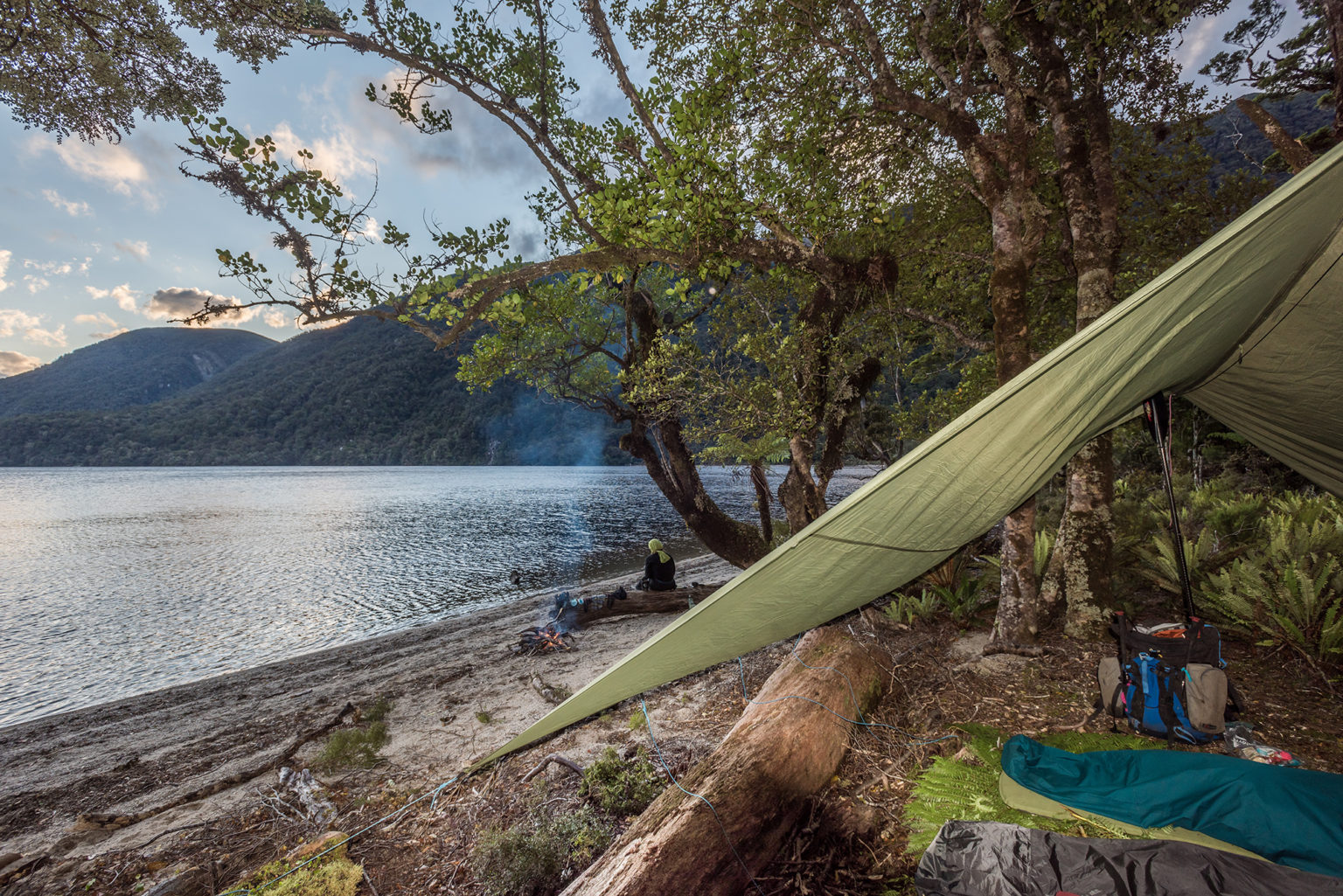
A tarp is light, packs down small and provides a closer-to-nature experience.
It’s no secret that I dislike huts. Crowded, damp, loud, smelly, they offer shelter from the elements but rarely, for me, an enjoyable experience or a good night’s sleep. I think of huts as turning the ‘great outdoors’ into the ‘great indoors’, artificial barriers keeping the tramper from experiencing the natural environment.
Every time I venture into the wilderness the question comes up: what type of shelter shall I pack? Nowadays there are multiple options, each with advantages and disadvantages, depending on the type of trip. On trips below the bushline, camping under a tarp (a rectangular fly stretched between trees or rocks, open at the sides and without a floor) is one of my favourite choices.
My early tarp camping was in my Otago University Tramping Club days. Almost every weekend a van-load of us would head into the hills carrying one or two tent flies for shelter and a couple of cooking stoves. Wet nights turned into learning experiences and the good memories left an indelible mark on my soul. One day when we were ordering some new tent flies for the club I seized the opportunity to order one.
Almost 20 years have gone by. I still love tramping. I’ve had to replace my tent fly once, and yes, I still love camping under a tarp.
Two years ago I embarked on a three-week overland journey to Puysegur Point and Preservation Inlet. I was right in the middle of it when a storm doused the region with 600mm of rain in 24 hours. The Milford Road, Hollyford Track and Routeburn Track were washed out in places. Trampers were rescued off the roofs of partially submerged huts. Oblivious to it all, I stayed put under my tent fly. Most importantly, I stayed dry. After a couple of days’ rest, I resumed my journey as if nothing had happened.
1. Connecting with friends. You can easily sleep six to eight people under one tarp. Close to one another, it’s a great opportunity to share stories or play games.
2. Connecting with nature. With a door that’s always open and a floor made of moss or ferns, you are always in close contact with nature. Having a little blue penguin waddle under your tarp in the middle of the night and try to push its way into your sleeping bag, a giant wētā stride over your tired body, a tomtit or dragonfly perch on your pack or boots and share your shelter from the rain, all make for unforgettable experiences That’s what we are out there for.
3. Staying dry. It may seem counter-intuitive, but with its large footprint a tarp offers superior shelter in heavy rain. The slightest leak will turn a tent’s bathtub floor into a bathtub, keeping the water in rather than out. A drip under a tarp will soak into the ground and can be easily diverted outwards if required.
4. A lightweight yet roomy abode. A tarp will shelter multiple people plus packs while weighing less than 1kg. You can easily cook underneath it, a no-no in any tent. And yes, you can toilet under your tarp, too!
5. Water supply. Nobody enjoys donning boots and raincoat to fetch water when it’s raining. The heavier the rain, the higher the resistance to leaving one’s shelter. Under a tarp, you can collect water by placing a billy under the tarp’s edge and the heavier the rain, the more efficient the water supply. My record is a full two-litre billy in 10 seconds flat during a storm in Starvation Creek. And, I didn’t have to leave my sleeping bag.
A few caveats
With its large surface area, a tarp turns into a sail in high winds, lifts off and is easily reduced to shreds. Tarp camping is best avoided in exposed locations above the bushline. With its open sides, a tarp will also let in sandflies and mosquitoes. Some additional protection from insects in the form of a bivvy bag with a built-in insect net is required.

Rab Siltarp 2 $299.95
Shelters 2-3 people and is made from waterproof Sil-Coat Cordura fabric. 16 attachment points for multiple set up options, 1 central lifter point for support with a ridge line. Stuff sack included. 2.4m x 3m. 433g. www.outfitters.net.nz

DD Hammocks Superlight Tarp $219.95 19
attachment points for multiple set up options, waterproof with taped central seam, ripstop nylon fabric with 3000mm PU coating. Stuff sack included. 3m x 2.9m. 460g. www.gearshop.co.nz

DD Hammocks 3×3 Tarp $139.95
16 reinforced side attachment points, 3 centre attachment points for multiple set up options, waterproof 190T polyester fabric with 3000mm PU coating, seam taped, four pegs, stuff sack. 3m x 3m. 790g. www.gearshop.co.nz

DD Hammocks 3×3 PRO Tarp $169.95
21 reinforced attachment points for multiple set up options, 16 eyelets for use with poles or pegs, guy line stowage loops, press studs to attach multiple tarps together. Waterproof 190T polyester fabric with 3000mm PU coating. Stuff sack, 8 pegs, four guy lines included. 3m x 3m. 875g. www.gearshop.co.nz

Alton Ultralight Tarp $219.99 23
reinforced attachment points, ripstop nylon fabric with waterproof coating, Dyneema Hardcord guylines, paracord ridgeline, fully seam sealed, 9 pegs and 4 guylines included. 782g. www.gearshop.co.nz
34 years of inspiring New Zealanders to explore the outdoors. Don’t miss out — subscribe today.

Questions? Contact us