The fantail is one of our best-known birds and often accompanies trampers on their bush walks.
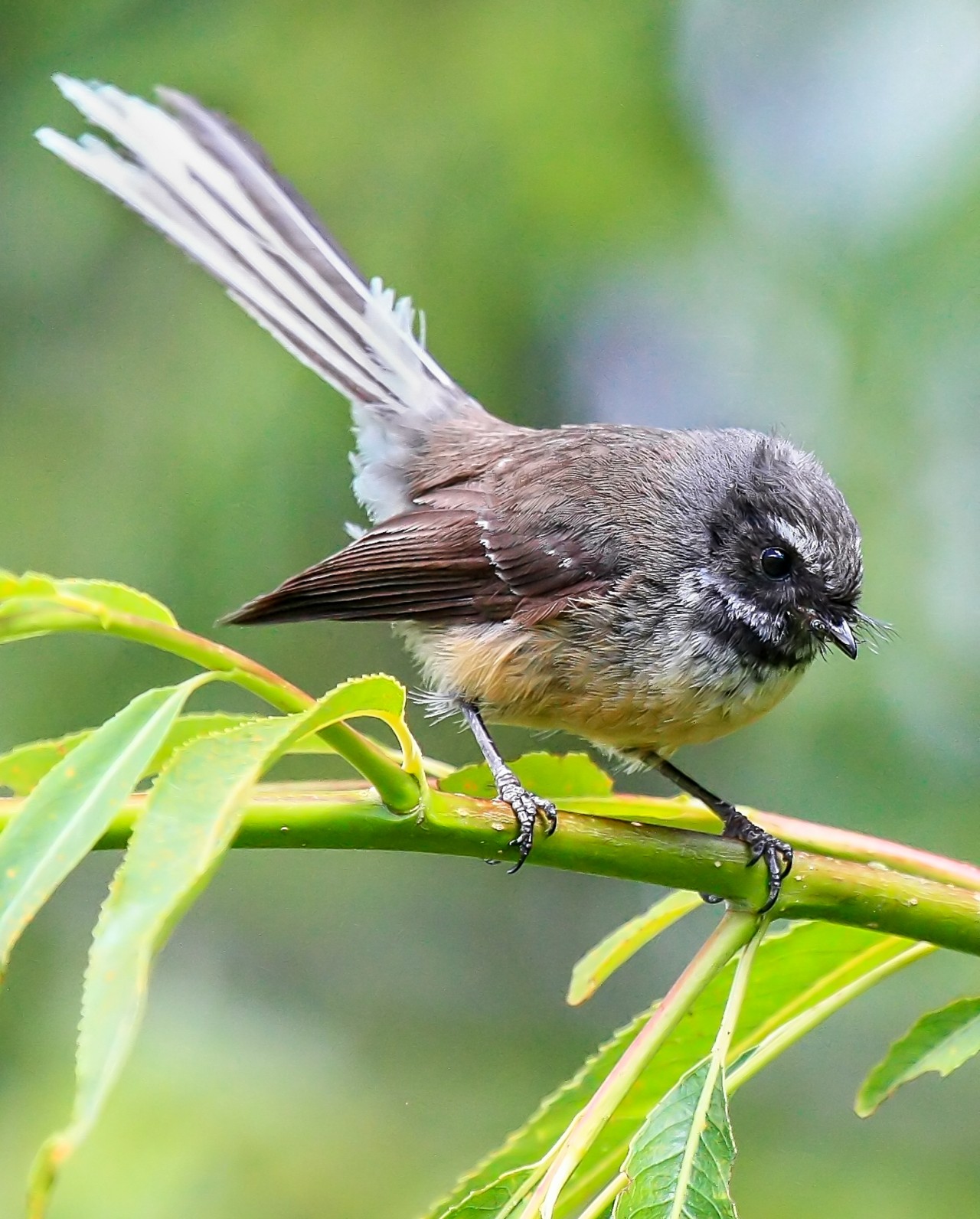
The fantail or piwakawaka would have to be one of New Zealand’s best known birds due to its confiding nature, often approaching within a metre or two of people.
They are widely distributed throughout the country and live in a variety of habitats – including native and plantation forest, scrubland, farm shelterbelts, orchards and well-treed suburban parks and gardens. Their altitudinal range extends from sea level up to the snow line.
There are two colour phases or ‘morphs’ with the more common pied morph occurring throughout its range and the black morph comprising up to five per cent of the South Island population. The black morph occurs only occasionally in the North Island.
The pied variety has a greyish head, very obvious white eyebrows with a brown back and rump. White and black bands are present across the upper breast, which is a cinnamon colour and continues down to the belly. The fan-shaped tail is black and white. The black variety is mostly black with a black-brown tinge over the rump, belly and flight feathers.
Timing of fantail breeding varies with location and weather conditions, and will fall somewhere between August and February.
Nests, constructed of fine materials tightly woven with cobwebs, will be sheltered from above by hanging foliage and often include a tapered ‘tail’ of material below the base. Between two and five eggs are laid with both adults taking turns on the nest through the 14-day incubation period. Fantails also have the ability to rear more than one brood each year. One pair was recorded as raising five, totalling 15 fledglings.
Fantails mainly eat small invertebrates, such as moths, flies, beetles and spiders which are caught using three distinct methods – ‘hawking’, catching prey in mid air, ‘flushing’, scaring insects from foliage using their broad fan tail and flicking movements, and ‘association’, following other animals (and people) nabbing disturbed insects as they travel along.
An ethical guide to visiting the Muriwai gannet colony
Trending Now
Green Point Hut, Gamack Conservation Area
The possibilities of packrafting
Every Tararua hut reviewed and ranked
The Tararua’s forgotten traverse
Leaning Lodge, Rock and Pillar Conservation Area
Subscribe!
Each issue of Wilderness celebrates Aotearoa’s great outdoors — written and photographed with care, not algorithms.Subscribe and help keep our wild stories alive.