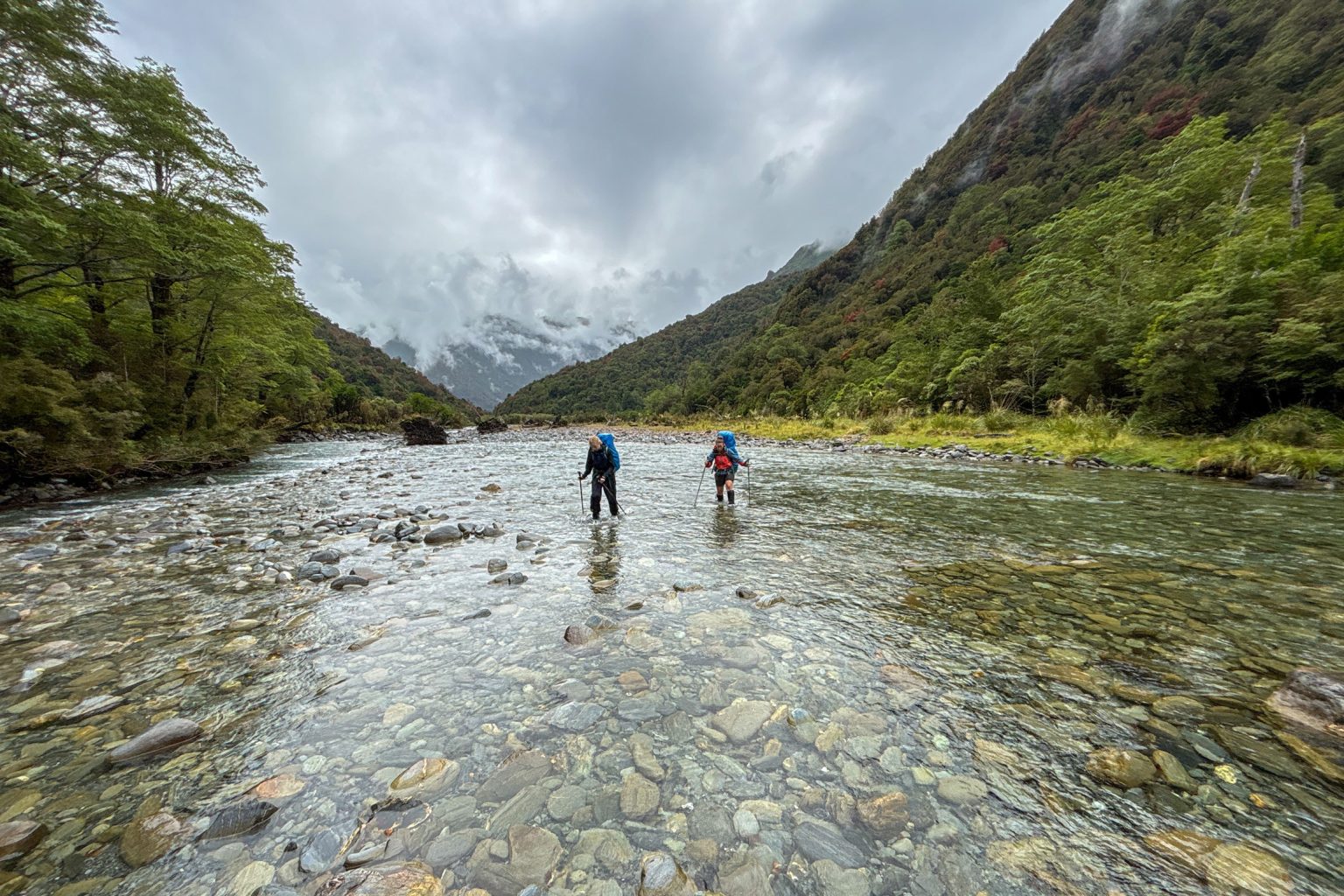
You come to an unbridged river, consider it carefully and decide it is safe to cross. What should you consider?
Marked crossings
If signs or markers indicate the crossing point, check the far bank for the exit marker – often an extra big orange triangle. This might not be straight across the river. Evaluate the crossing before setting out, as riverbeds and banks can change during floods.
Exit points
Make sure you will be able to exit the riverbed at the end of your crossing. Avoid a steep climb onto a bank, especially if it is undercut or crumbly. Remember the force of the water will take you downstream as you cross. Consider where you would exit if you decide to back out; this exit will be further downstream on your entry side.
Water behaviour
Here are things to consider when choosing the best crossing point:
→ Avoid rapids with turbulent water. Holes and troughs commonly form near boulders or obstacles; feet can get trapped here. Obstacles may also create recirculating waves, where the water continually folds back over itself with a breaking crest. This water will be full of air bubbles that reduce its buoyancy. It won’t support a person as well as clear-flowing water does.
→ Waterfalls and weirs often have a strong recirculating wave and a deep hole at their base.
→ Standing waves may form downstream of a sudden narrowing of the river or a submerged rock or obstacle. These waves stay in the same place and may be breaking or smooth. There may be several standing waves that reduce in size downstream. If a wave breaks over you, you could be pushed under.
→ Where the current passes over a boulder or around a corner it can cause a calm spot – known as an eddy – where the water moves in the opposite direction to the main flow. The line between the eddy and the main flow will be turbulent and require effort to cross.
→ The inside of river bends often look shallow, but there may be a deep channel near the outside.
→ In a narrow stretch the river will be deeper and swifter. Shallow, rapid water tends to create an uneven riverbed with obstacles. Outside of the main current, deeper water is often slower, with less force. It’s best to cross between bends, where the river is wider, in an area with slower water.
Riverbed
It is easier to cross where the river bottom is even. Avoid rocks that may shift as you stand on them, could trap your foot or that you need to edge around.
It is generally safer not to try jumping between rocks to keep your feet dry. Rocks may be slippery or can move, and a slip can result in injury and a soaking. With a pack on, you may struggle to get up if you land face down.
Hazards downstream
Consider what will happen if you lose your footing. Do not cross where you could be swept over a waterfall, through rapids, a gorge, into strong currents, a bigger river or the sea. Avoid downstream trees that overhang the bank, bridge piles, abutments and other structures in the river. Look for strainers – things that let the water through but create a barrier. These include fences, rocks close together and submerged trees. A single stick seen above the water may signal an entire submerged tree.
What next
When crossing a river, decide first whether it is safe, then choose where to cross. Your final decision is how to navigate safely to the other side. For more on how to cross safely, head to wildernessstg.mystagingwebsite.com and search ‘river safety’.
– Heather Grady is an instructor with Outdoor Training New Zealand