

An insulating layer is key to staying warm, and many camping-style hammocks have a sleeve for this purpose, as a sleeping bag alone is often not enough for the New Zealand climate.
Hammock underquilts are a popular solution, but sleeping pads will also suffice – even if a little difficult to wrangle into a hammock.
“Most sleeping pads are designed for the flat – in a hammock it’s like putting a Therm-a-Rest in a bathtub. It’s not gonna work unless it’s deflated to around 50 per cent,” says Bennetts.
While comfortable and convenient, hamping is not without its drawbacks.
Roll over in the night, and you’ll pay for it for the next five minutes, swaying back and forth until gravity secures you.
Relaxing for some, I’m sure, but I found the gentle pendulum movement to be verging on unpleasant.
As a side sleeper, I expected to encounter difficulty, but to the contrary, I found it to be more comfortable than sleeping on my back. With knees tucked towards my chest, the curve of the hammock was less noticeable, and I found the support to be comfortably even, with no reverse-pressure on my joints.
Like a baby in a swaddle, the hammock supported my entire body, but the enveloping sensation of the fabric felt restrictive at times.
Lying diagonally seems counterintuitive, but it allows your body to rest flatter, and opens up the enveloping fabric, diminishing feelings of restrictiveness.
Journalist Amanda Saxton was enlightened to the benefits of hamping by a friend, and has never looked back.
“I loved the idea of the flexibility it would give me to camp in beautiful, tricky places such as abandoned buildings, forests, or inner city parks,” she says.
“Hammocks are also great for a daytime break with a book or for a snooze, so I take mine almost everywhere.”
Describing herself as a frugal ultra-light traveller, Saxon says her hammock – which weighs 450g and is slightly bigger than a rolled up pair of jeans – is the perfect size for hand luggage, and proved to be an ideal camping option on a recent trip to Japan.
“My first night sleeping in a hammock was on Okunoshima, a bizarre island inhabited by thousands of friendly rabbits and the site of an abandoned Second World War poison factory,” Saxon says. “I tied my hammock between two trees on a steep hillside with a perfect view of the sea down below, and it was glorious. No one could see me and there’s no way you’d have pitched a tent on that terrain.”
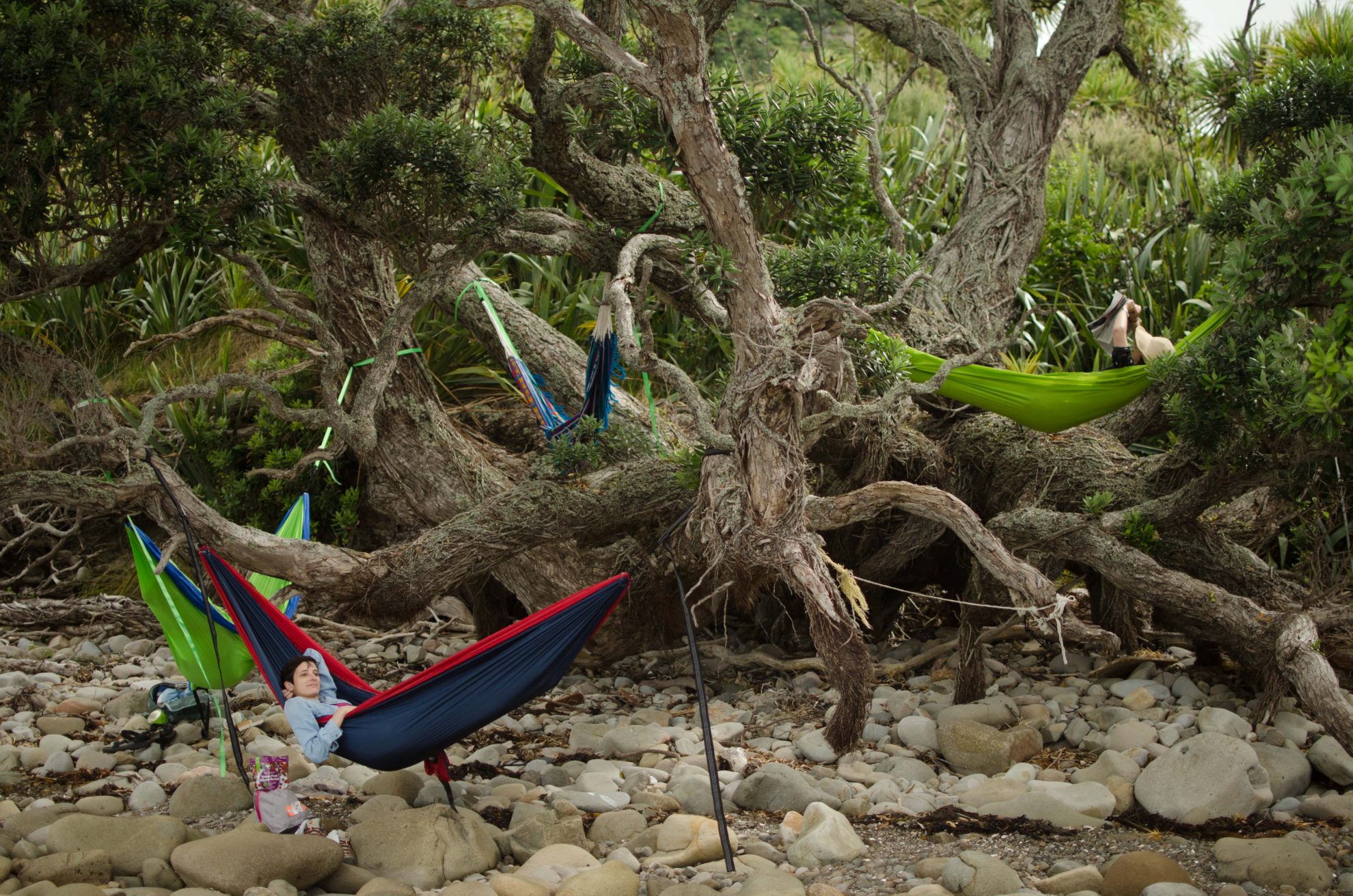
Saxon has also hammock camped in Kyrgyzstan, Vietnam, and on the beaches of New Zealand amongst pohutukawa – “the most hammock-friendly trees ever”.
Know before you go
Lightweight as they may be, there’s no point carrying a hammock if it can’t be slung at your destination. Some campsites won’t allow it, and others don’t have appropriate hanging points, so save yourself trouble and check ahead of time.
Watch and learn
Pitching a hammock correctly takes practise and patience. Too loose, and you’ll endure a painful sleep with a bent banana back, but too tight and the hammock will feel restrictive and taut. With many video tutorials available online, there is no excuse for turning up to a campsite clueless – learn from the pros and practise before you set off.
Leave no trace
Hammock camping is arguably a greener alternative to traditional tenting, as sensitive ground isn’t damaged. Take care with trees though and opt for tree-friendly pitching straps rather than thin rope, which may cut into the bark. DOC currently has no national policy on hammock use at campsites or conservation land.
Take a tarp
If you’re planning an overnight expedition, bring a tarp or rain fly and a mosquito net – nothing will ruin a trip faster than a horde of mozzies and a rainstorm if you’re unprepared.
She finds it more comfortable than sleeping on the ground, but says a night out can be “damn freezing”.
“If I’m going somewhere colder, I take some cut-out bits of a foam sleeping pad to put against my shoulders and rump. I also line the hammock with a silver foil survival blanket,” she says.
It’s perhaps no surprise that her biggest tip for a good night’s sleep is “know what the weather is up to”.



