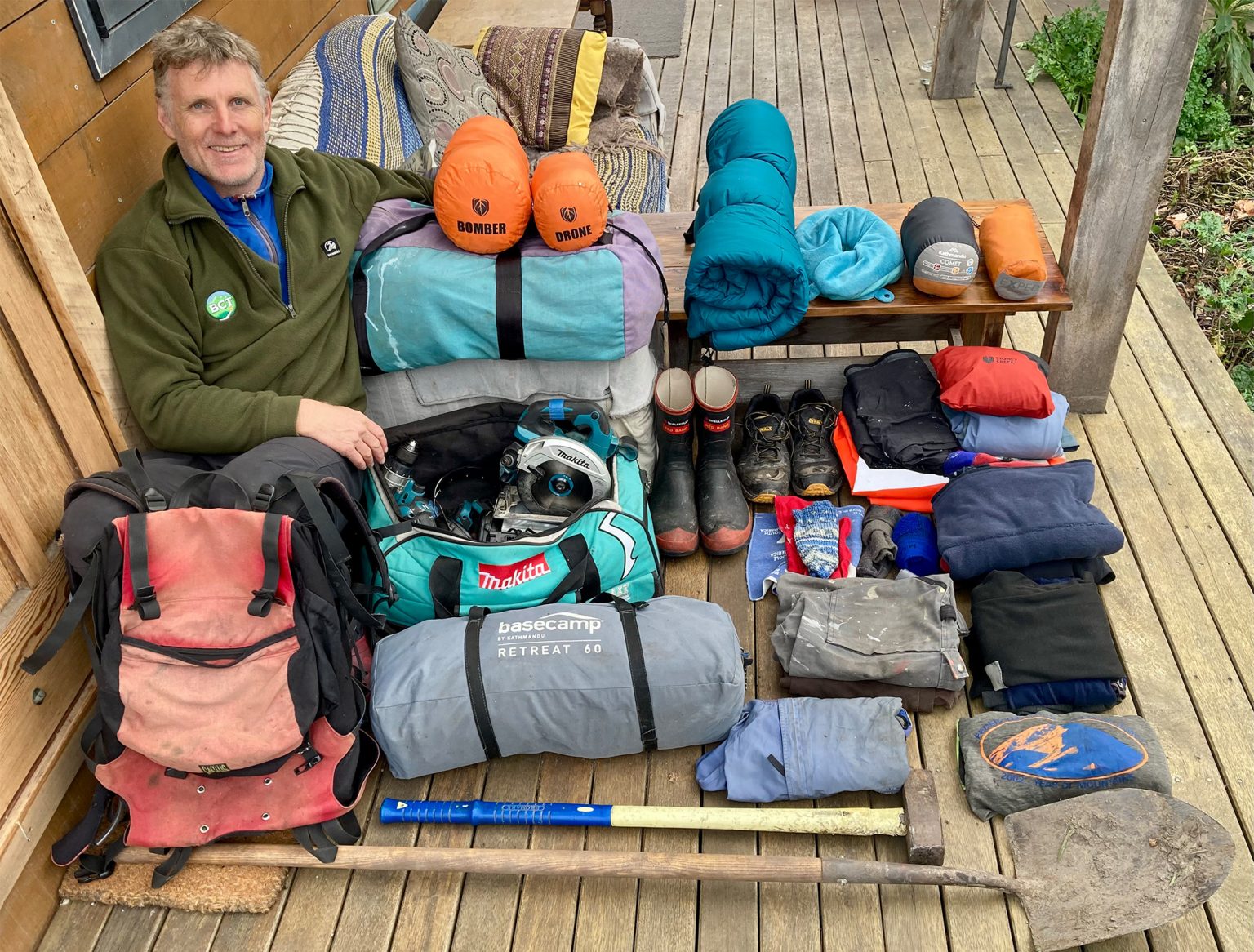
Ollie Clifton likes to buy good-quality, New Zealand-made gear that lasts. “Most of my gear is 10 to 20 years old and going well – and that’s the way it should be. Hence, I have quite a personal connection with my gear.”
This is his set-up when coordinating Backcountry Trust (BCT) trips. “Helicopter transport makes a big impact on my gear choices. There is no way I could carry all this kit on my own.”
Building and camping gear
I take my own Makita tool bag with the basics, and these items tend to get shared around the group. I also have a couple of Stoney Creek camping flys that are really handy and light – they readily create a dry outdoor work space or cover gear and materials when needed.
Footwear
Skellerup Red Band gumboots for wet ground, DeWalt sneakers (with steel caps) for dry plus Crocs for the end of the day is my winning combo. The DeWalt sneakers are okay for a couple of hours’ tramping if need be.
Sleep system
I usually take two sleeping bags with me. My Kathmandu Comet is great for warm nights, and for colder temps I jump into an old Fairydown synthetic bag as well. I also use a cotton sleeping bag liner, which is over 20 years old now. My Exped Ultra sleeping mat is plenty warm enough for me, and the pumpbag is handy for storing gear when it’s damp. I picked up a small ‘bean bag’-style pillow a couple of years ago, which is so comfortable.
Pack
My trusty Cactus Deepwinter paired with an old canvas duffel bag (from a mid-90s Youth to Everest trip) soaks up all my personal gear, with the exception of my tent.
Shelter
I started off using my Macpac Minaret for BCT work four years ago but soon found it was (a) a bit small, and (b) not an especially good use of a very expensive tent. I’ve switched to a bigger, lower-spec tent – a Kathmandu Retreat 60. A bigger tent has been awesome as it’s not only where I sleep but also for gear storage and a mobile office as well.
Clothing
I generally take two or three of everything – socks, thermals, fleece, etc. One set for working in, the other for the end of the day, and sometimes extras if I know it’s going to be wet. Working in the backcountry is quite different to my other outdoor adventures – you need to be warm and comfortable in conditions where you’re not actually doing much physical movement. Cactus work shorts and trousers are my fav, and I find Icebreaker socks and thermals tend to last the longest. I have an old Earth Sea Sky anorak that I absolutely love – the front pockets are awesome for odds and sods.