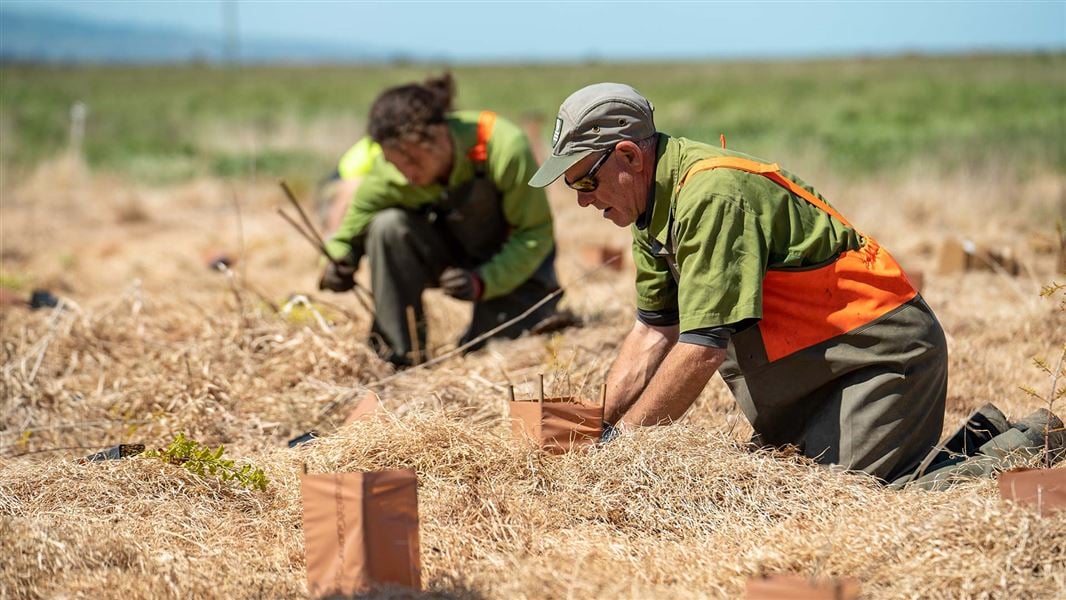
DOC is launching a new cadet programme for rangers to get on the job experience. The first 10 cadets will be situated at DOC’s Renwick base in Marlborough for the 30-month programme, which starts in January.
DOC said it wanted to invest in its future workforce and protect New Zealand’s unique ecosystem at the same time. DOC monitoring and insights director Karl Beckert told Checkpoint the need for a cadet programme was largely down to the ageing workforce within DOC.
There were a few key criteria that DOC was searching for in cadet candidates. “We’re really looking for people who are fit, flexible, resilient and ready to work in remote and really challenging environments and who are especially really passionate about conservation.
The starting salary for the programme is $60,000, and slowly trickles up as more experience is gained. Applications open 20 October. Read the full story from RNZ.
Was Shackleton’s Endurance doomed before it set sail?
On Oct. 27, 1915, after being caught and crushed by packed ice for nine months in the Weddell Sea off Antarctica, Ernest Shackleton and his crew abandoned the Endurance. For over a century, experts have blamed the ship’s demise on an ice floe overwhelming the rudder and creating a large gash in the vessel.
But a study released earlier this month contends that the ship, not the ice, was to blame. Jukka Tuhkuri, an ice researcher and naval architect at Aalto University in Finland and author of the new study, was aboard Endurance22 with the team that discovered the wreck in 2022. He began analysing diaries, personal correspondences and the ship’s wreckage to find out why the Endurance sank.
A hypothesis came to him. He noticed that the hull of the Endurance lacked the beams that would have given it enough brawn to endure an onslaught of crushing ice. As a result, the rudder, stern post and part of the keel were torn apart, causing the ship to fill rapidly with water. Read the full story from the New York Times.
School offers hikes instead of detention, teachers see results
High school students who break rules normally get detention, but Leslie Trundy, a high school counsellor and avid hiker in the United States, was excited to offer students an option to hike instead.
Some students were less enthusiastic. “I kind of thought it would be boring,” senior student Alexander Soto said. “Why would I even want to hike?” junior Elsie Nelson-Walling recalled thinking. “I could just sit here at school and just wait it out.”
But after their first hikes – smelling pine trees, listening to birds chirping and discussing their lives – they realised hiking wasn’t so bad. In fact, they found it actually improved their moods.
“People seem really different in a good way at the end,” Trundy told the Washington Post. “Kids have even expressed it to me. They’ve said, like, ‘That was really awesome, thank you.’ … Even if they’re not as vocal about it, I can tell that they’re in a better place.”
Science supports Trundy’s observations. Amy McDonnell, a postdoctoral research fellow in cognitive neuroscience at the University of Utah, said spending time outdoors improves mental and physical health, decreases stress and enhances focus.
A few students who hiked for detention last year decided that even if they were no longer getting into trouble, they wanted to hike. Read the full story from The NZ Herald.
Microplastics being brought into wilderness on hiking shoes and gear
Hiking shoes and outdoor gear are probably a significant source of microplastic pollution in the wilderness, new research suggests.
Researchers measured microplastic levels in two lakes – one that sees heavy foot traffic from hikers, and another lake that is far away from a path and rarely touched by human activity. The samples from the lake that sees heavier foot traffic showed levels that were about 23 times higher.
Soft-soled trail shoes and synthetic clothing “appear to be significant contributors to microplastics finding their way into these remote, otherwise pristine waters”, said Tim Keyes, a Sacred Heart University data scientist, who independently worked on the project with his company, Evergreen Business Analytics, and the Adirondack Hamlet to Huts non-profit.
Microplastics are tiny bits of plastic either intentionally added to consumer goods, or which are products of larger plastics breaking down. The particles may contain any number of 16,000 plastic chemicals, of which many, such as BPA, phthalates and Pfas, present serious health risks.
The substance has been found throughout the human body, and can cross the placental and brain barriers. Among other issues, microplastics are linked to chronic pulmonary inflammation, which can lead to lung cancer. Read the full story from The Guardian.
New North Face gear collection built with steel-strong yarns and space-age insulation
The North Face has unveiled the next generation of its Summit Series Advanced Mountain Kit, and while it’s designed with elite alpinists in mind, the technology behind the new collection shows where outdoor gear could be heading.
The updates showcase three big advances: a women-specific kit designed through gender-based thermal testing, a modular layering system for changing conditions, and some groundbreaking material innovations. Spectra yarns claim to be stronger than steel yet ultra-light as well as boosting durability.
Meanwhile, new Cloud Down technology eliminates cold spots and introduces a versatile mid-loft option, while FUTURELIGHT electrospun membranes provide waterproof breathability without PFAS. Read the full story from T3.