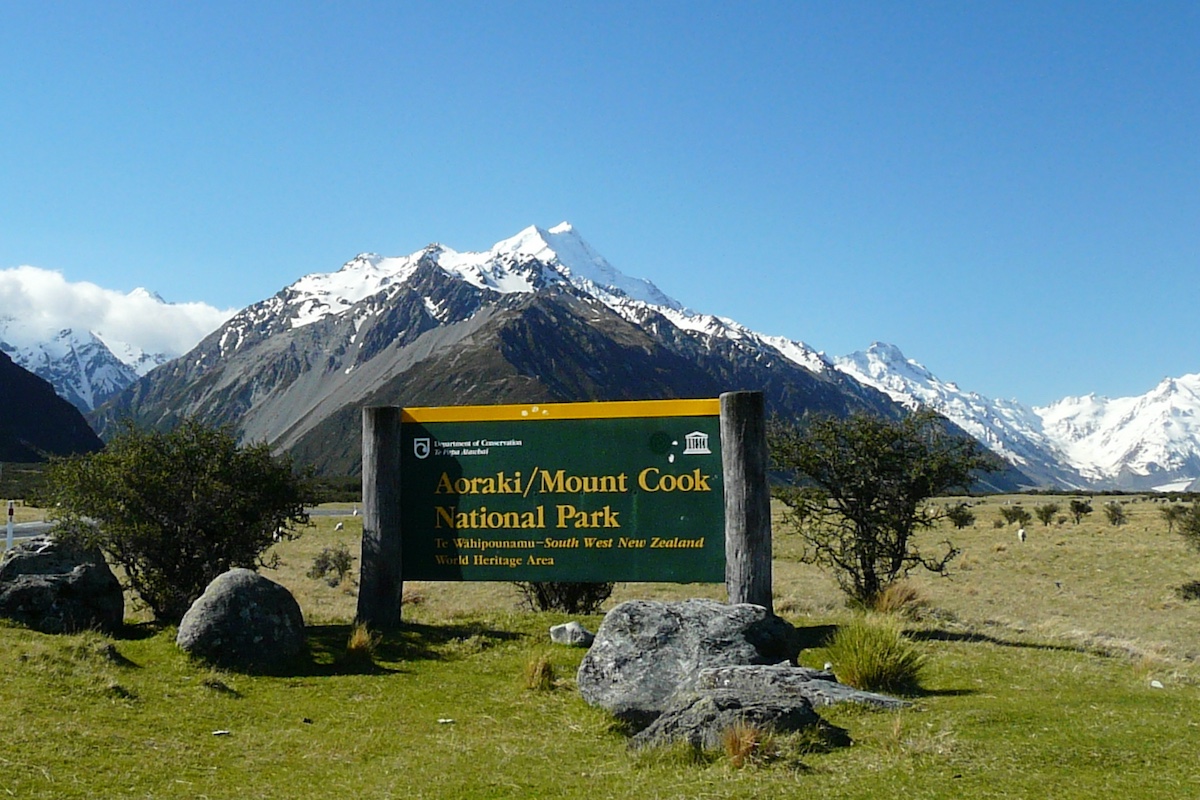
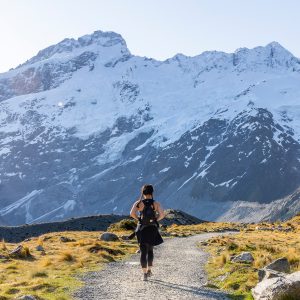
Visitors will have to pay $5 an hour to park at Aoraki/Mt Cook under a parking trial being carried out this summer.
Fees will include a day rate of $25 and $60 for an annual pass for regular users, including trampers and hunters, and will apply to anyone living outside the Mackenzie District. The first 20 minutes of parking will be free. Mackenzie residents only have to pay $10 a year.
DOC has conceded the programme may cause more congestion nearby, and is proposing to counter this with temporary traffic management on Hooker Valley Rd, including reduced speed limits and messaging boards with information on parking availability and traffic issues.
Catherine Wilson, DOC’s director of heritage and visitors, said, “We will be looking at how we can manage travel demand and really thinking about the possible future locations for a park-and-ride so we can reduce the number of people who are having to park up on the top of the Hooker Valley Road,” Wilson said. “We absolutely recognise that car parking charges isn’t going to solve that in year one.”
The paid parking pilot will start in December and run until the end of June. Read more from The Press.
Kārearea crowned 2025 Bird of the Year
The kārearea New Zealand falcon has taken out the top spot in the 20th anniversary Bird of the Year competition. “It’s been a privilege to champion such a remarkable manu, and we’ve loved seeing the public get behind it,” said Caitlin Pieta from Auto Mossa, who managed the kārearea’s campaign.
Forest & Bird said after an early lead, the falcon kept its talons firmly on the top spot. “They are fierce, they are the spitfire of the bird world… One of our handful of avian predators,” Forest & Bird chief executive Nicola Toki said. While they are fierce, they are also vulnerable with only 5000 to 8000 of them left.
The 2025 win puts the kārearea among a group of winners that have secured multiple titles over the past two decades. Hoiho won in 2019 and 2024, and kākāpō took home the crown in 2008 and 2020. The falcon previously won in 2012.
Forest & Bird said this year had seen record engagement, with more than 75,000 voters flocking online to back their favourite native manu. Read more from RNZ.
First-ever goat granted DOC pack animal permit
Gavin the goat has been training since he was a kid to join the hunt. His owner Alesha Tomasi said the two-year-old loved to swap his paddock for adventures in the hills.
“The full two years we’ve been training him, just taking him on little wee walks with us when we’re hunting and the walks have gotten bigger and bigger,” Tomasi said.
Eventually, she said Gavin would be able to carry between 20 to 30 kilograms of gear. “We’re hoping to do multi-day trips with him into tops or up river beds, hunting,” Tomasi said. “With him, being able to carry weight in for us, it’s really game changing, so we can take more food and more supplies or more meat out.”
But it was not just his ability to carry that was handy on the hunt. “He’s actually really good bait. The deer get really confused. They just stand there and look at him and they’re like ‘what is this?’ and we seem to get quite a few extra seconds away.”
Gavin’s also the first-ever goat to have a DOC pack animal permit, meaning he can now join hunts on stewardship land. Read the full story from RNZ.
Scale of invasive wasp problem in New Zealand revealed
Results from a nationwide survey conducted by the Moths and Butterflies of New Zealand Trust (MBNZT) found Northland, Waikato, Bay of Plenty, Tasman and Marlborough were the regions worst affected by pest wasp problems, with many respondents saying their presence made outdoor life unpleasant or unsafe, while others reported wasps preying on birds, invertebrates and reptiles, leading to ecological imbalances.
MBNZT trustee Connal McLean said there were more than 2000 species of native wasps that “pose zero threat to humans or ecosystems”, but the introduced predatory social wasp species did. Invasive species include the Asian and Australian paper wasps, and German and common wasps.
McLean said, “The survey confirms what many New Zealanders already suspected – these wasps aren’t just a nuisance,” he said. “They’re a serious threat to native wildlife, conservation efforts, and even the wellbeing of people.”
Wasps were also being recognised as a serious health and safety risk with numerous accounts describing stings, allergic reactions and disrupted recreation and volunteer programmes. Read the full story from The Press.
Cape Palliser paper road: Vehicle ban gets the nod
Vehicles will soon be banned from accessing a scenic stretch of South Wairarapa coastline for at least two years, but pedestrians and cyclists will still be allowed.
At a bylaw deliberations meeting on Wednesday, South Wairarapa District councillors agreed to scrap their initial proposal, which aimed to ban all access to an unformed legal road in the Cape Palliser area for three years.
Council chief executive Janice Smith said the initial proposal would not have been enforceable and “could have led to legal challenge”. The paper road, which gives public access to a stretch of South Wairarapa coastline, traverses both privately-owned Māori land and Crown land managed by DOC.
It had historically been used by the public for access to remote coastal areas, including surf breaks and parts of Aorangi Forest Park, but the area had suffered extensive environmental damage due to the misuse of the road to access private land by four-wheel drives, quad bikes, and illegal campers. Read more from One News.