

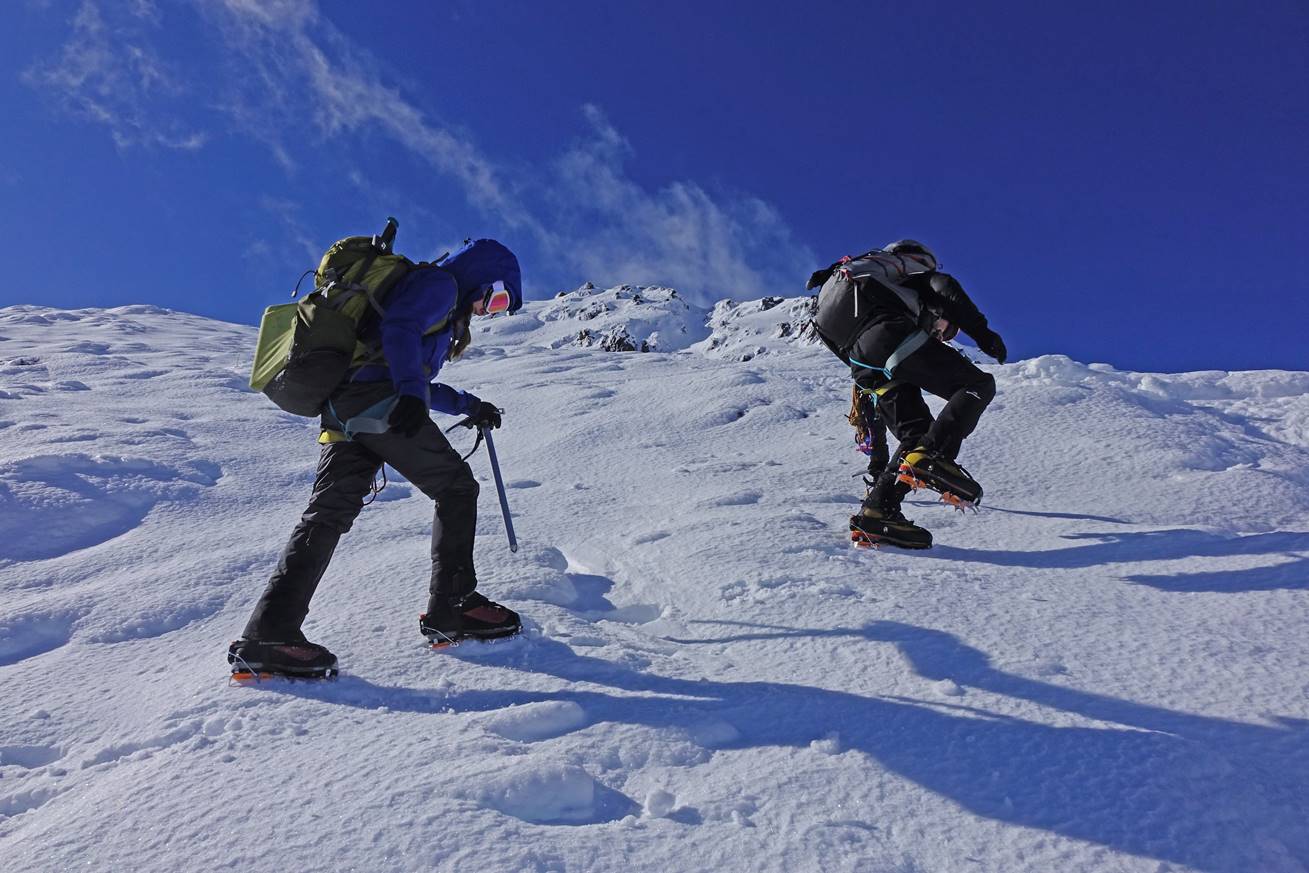
Crossing slippery terrain
If you find yourself having to attempt a self-arrest, it means all other efforts to stay on your feet or to prevent sliding have failed.
The best thing you can do to prevent a slide is to concentrate on maintaining good footwork on the mountainside. On snow, set yourself up for success by wearing mountaineering boots with well-fitted crampons and carry the ice axe in the uphill hand with the pick facing backwards. The best way to carry a helmet is on your head.
Don’t stand or travel with both feet on the same contour as this is a poor balance stance, and use your ice axe as a point of balance.
At all times be aware of the nature of the surface and check your footing and balance. If your boots are not making a good impression in the snow or only crampon points are penetrating, this is a ‘no fall’ situation.
The easiest and worst thing you can do when wearing crampons is to trip yourself up – good focus on footwork is required to avoid this.
If you want to look at the scenery, stop and then look. Don’t let your focus drift from terrain and footwork while you are moving.
Preventing a slide with a slip-arrest
A simple stumble that is not corrected can result in a slide down a mountainside.
As you travel across the snow, note its consistency as this will dictate your response should you slip or stumble.
With a trip or slip in medium or soft snow, the ice axe can usually be used to arrest the slip by vigorously plunging the shaft/spike directly into the snow and gripping it firmly until your feet have regained purchase.
On very hard or icy snow, this technique will be ineffective. Instead, direct the pick at the snow and drive it hard into the surface of the snow using arms and upper body.
In some situations, a rapid swing of the pick into the snow with a hand down the shaft may be the only way to prevent a slide.
Stronger and more confident people may assume the ‘frog jump’ by doing a quick spring, lifting both feet and resetting them parallel to the slope facing downhill. It’s important to use your axe for balance and compress your knees over your feet when doing this manoeuvre, and it can be repeated a number of times until security is regained.
The ‘frog jump’ can be used on virtually any snow to regain purchase and balance.
Environment
Any mountainside where a melt and freeze of the snow has occurred will always have frozen slippery surfaces first thing in the morning and in shaded gullies and slopes. Your judgement should always be on how the surface presents and it does not have to be high altitude; it could even be your first steps outside a hut in the tussock.
North Island mountains get extraordinary frozen surfaces, direct from the maritime climate blowing moisture-laden air onto the lofty volcanoes. This incoming moisture is extremely threatening and can form rime ice over all surfaces, even in subalpine zones where scree and plant-covered slopes can become frozen.
Be wary of a thin snow cover over icy surfaces; while the appearance is of a soft surface, the sliding layer is just underneath and can be very hard.
– Chris Prudden is NZOIA Alpine guide/instructor



