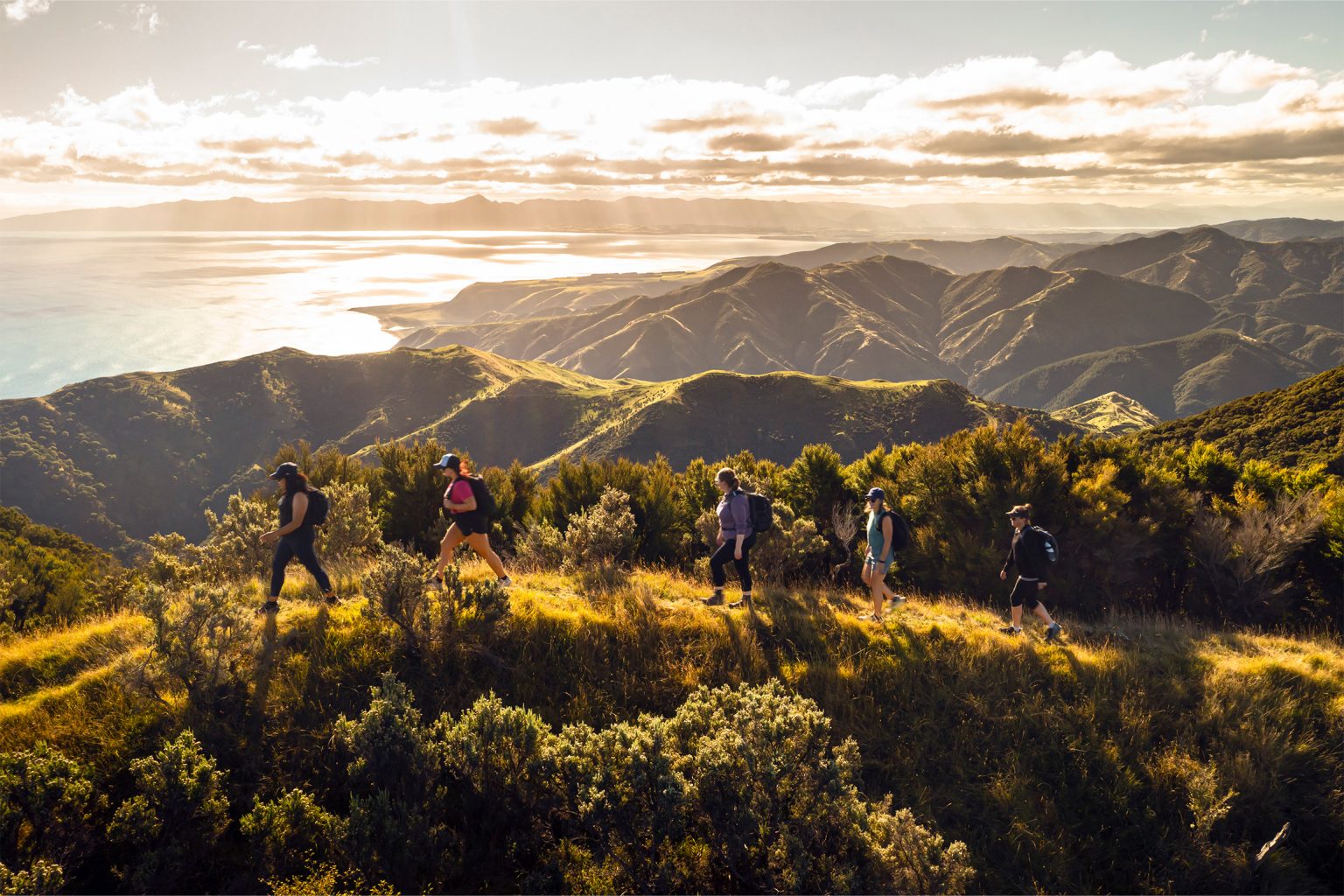
Following a post-pandemic surge in popularity, a number of private walks are becoming available on farms around the country. For walkers, they open up forests, beaches and mountains that few have experienced; for farmers, the benefits are more than just economic.
For most trampers, the North Island’s King Country coastline is a blackspot on the map. Few roads and even fewer tracks penetrate the rugged landscape to the black-sand coastline.
But that’s where you’ll find Nukuhakari Station, a 14,045ha coastal farm that includes a number of wild west coast beaches that few have experienced.
Two decades ago, Bridget St George and Hamish Nelson took over the station from St George’s parents, who’d run it for 10 years.
St George says they have had plans to develop a private walk on the property since they first moved there; now, with their youngest child at boarding school, the couple has finally had time to prepare for trampers.
“We knew it was going to take a lot of work,” St George says. “But it’s worth sharing. The natural bush deserves to be visited.”

After a year of developing accommodation for the three-night walk, and hacking a 30km track through farm and bush, they are at last embarking on their first season of hosting Nuku Walk.
And they are not the only ones. In Canterbury, two farming families are also prepping for their first season as private walk hosts.
Three years ago, as a fundraiser for their local school, Harry and Megan McElrea from Washpen Falls farm combined with neighbours Dan and Georgie Harper, from Quartz Hill Station, to offer a 4WD experience through their land.
“We were blown away with the feedback,” Megan says. Visitors were “wowed by the scenic value of the land”.
The experience led to the three-year journey of developing RockRidge, a 31km two-day, two-night hike that traverses both farms through the Rockwood Range, overlooking the Canterbury Plains.
The trail includes an impressive 1750m of elevation through the range, near Rakaia River, and ends with a descent through beech forest and an impressive waterfall.
These are just two of a growing number of private walks around the motu that offer multi-day hiking experiences through farmland with added luxuries you won’t find in a backcountry hut.
Most ventures will transport your pack and offer a refined dining experience, and many include private rooms with ensuites rather than bunk beds.
Those who have established a private walk have found that it’s much more than just a side-hustle for the farm.
Catherine Ward is about to embark on her third sold-out season operating Pahi Coastal Walk, which traverses a 2023ha farm on the northern tip of Coromandel Peninsula at Port Jackson.
Her husband, Zander, is a fifth-generation Coromandel farmer and the couple have run the sheep and beef farm, Pahi Station, for almost 25 years.

Ward says she’d long harboured plans of developing a tourism business on the property and took the leap in 2021. Over 18 months they upgraded two farm houses and developed a three-day, 34km loop walk that takes in the hills and coastline.
“People seem to love it,” Ward says. “It’s a good wholesome few days away.” She says it has created an opportunity for city folk to learn about farming.
“Pretty much everyone in New Zealand used to have an uncle who lived on a farm – or lived on a farm themselves – so they had an affinity with and a knowledge of farming,” she says.
“These days that’s not the case; people tend to believe every farmer is like the ones they read about in the media, so they don’t have a great impression.
“But our farm is well run. We’ve got nothing to hide and we’re able to showcase farming in a really good light.” The income from the walk has helped to fast-track some conservation projects on the land.
Rebecca and Iain Durry have been running Kawakawa Station Walk for six years and also find it offers a much-needed opportunity for dialogue between town and country.
“It’s been a great way to discuss rural issues with people,” Rebecca says. “They see the farm close up for what it really is, not the misinformation they may have learned about farmers.”
Clinging to the wind-swept hills of Cape Palliser, the 1619ha station overlooks Cook Strait and across to the South Island’s Kaikōura ranges.

When the couple bought the station in 2019, it came with the established but little-known private walk that helped make the farm financially viable.
They started their first season that year, but in March 2020 the arrival of Covid brought business to a halt.
Although it was “a pretty scary time”, the lockdown actually boosted the track’s popularity as Kiwis began to seek local experiences.
“People were searching for something to do and they found us,” Rebecca says.
She notes that the venture helps the farm both financially and environmentally. “That stream of income helps us farm more sustainably – we don’t have to push stock numbers to make it work,” she says.
As well as offering people the opportunity to see seldom-visited locations, Rebecca says private walks are a way to make the outdoors more accessible. People can “walk some of it, or none of it – it’s up to them … if necessary we can transport them so they get all the experience plus a chat with a farmer in the ATV [all-terrain vehicle].”
Rachael Sullivan has done several private walks in the South Island and is drawn by the quieter experience, as many tracks are limited to 10 people or fewer.
“The people who run them are always knowledgeable about the area,” Sullivan says, “and it’s nice that someone will carry your pack and you can have a shower and use flush toilets.”
She says the added facilities have also helped encourage her friends who are less enamoured with the stripped-back experience of a night in a DOC hut.
Although some may be put off by the cost, Sullivan says some walks are cheaper if you carry your own food, and she finds the glamping-style facilities on the more expensive walks to be good value for money.
“Even a DOC hut on a Great Walk is over $85 a night, and there are no showers or hot water.”